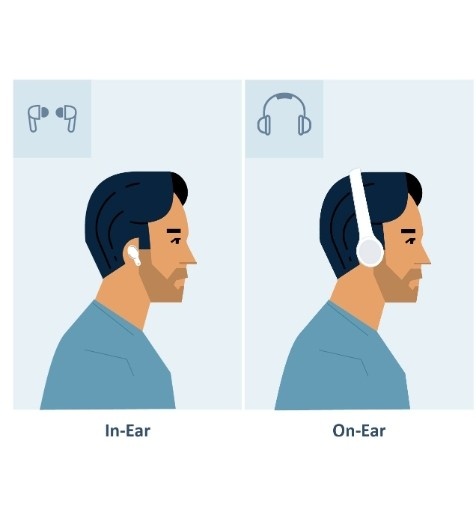
If you want a fast decision: in-ear usually wins for noise blocking and commuting; on-ear can feel quicker and more breathable but often isolates less. For hearing safety, WHO highlights measurable dose targets like 80 dB ≈ 40 hours/week and 90 dB ≈ 4 hours/week. See WHO safe listening guidance.
In-ear is usually better for commuting and noise blocking because a good seal reduces outside sound, helping you keep volume lower. On-ear is better for quick, breathable comfort—but it typically isolates less and can press on ears. RTINGS comparison.
Table of Contents
Context tabs (tap your scenario)
Frequently Asked Questions
Often, yes. In-ear headphones can block more outside noise because a well-fitted tip creates a seal in the ear canal. On-ear models sit on the ear and can leak when the fit shifts. If you commute, better isolation can help you listen at lower volumes. Read the type comparison at RTINGS, then see TechOzea’s best headphones guide for practical picks.
Neither is automatically safer. Risk depends on volume and time (sound dose). WHO recommends keeping volume down (often around 60% of max) and using well-fitted, noise-cancelling headphones to reduce the need to raise volume in noisy environments. Better isolation (often in-ear) can help indirectly by lowering required volume. See WHO safe listening and TechOzea’s best for your ears guide.
Use a measurable weekly “sound budget.” WHO estimates you can safely listen around 80 dB for ~40 hours/week, but 90 dB drops to ~4 hours/week. If you’re in noisy places, use better isolation/ANC so you don’t raise volume. For the table and tips, see WHO. For how noise dose is framed at 85 dBA exposure, see CDC/NIOSH.
They can be, if fit is comfortable. In-ear comfort depends heavily on tip size and insertion depth. If you feel irritation, switch tip material (silicone vs foam), use a shallower fit, reduce volume, and take breaks. WHO recommends limiting time spent in loud listening and resting your ears frequently. For general buying guidance across types, see SoundGuys, and for practical recommendations see TechOzea’s best headphones.
They can, especially if clamp force is high. On-ear headphones sit on the ear cartilage, so pressure hotspots can appear after 30–60 minutes depending on your ear shape and pad softness. If soreness is common, try softer pads, a looser headband, or a different style for long sessions. For how on-ears trade isolation for portability, see SoundGuys, and explore alternatives on TechOzea.
Yes, especially in noisy environments. WHO recommends well-fitted, noise-cancelling headphones because reducing environmental noise lowers the temptation to raise volume. ANC is strongest for steady low-frequency sounds, while the physical fit still matters for other noise. If ANC helps you keep volume down, it supports safer habits. See WHO and TechOzea’s best ANC earbuds guide.
In-ear is usually better for commuting. It packs smaller and can isolate more noise when the seal is good. More isolation can mean you don’t need to raise volume to overcome traffic or train noise. WHO also recommends noise-cancelling headphones in noisy settings to reduce volume increases. Compare type trade-offs at RTINGS and see TechOzea’s travel picks: best earbuds for airplane.
In-ear is usually better for workouts. It’s more stable during movement and easier to carry, while on-ear models can shift with sweat and may create clamp-pressure discomfort under exertion. Keep volume down and take breaks—WHO emphasizes reducing time spent in loud listening and monitoring exposure. For product roundups, see best earbuds for working out and WHO’s guidance at WHO safe listening.