




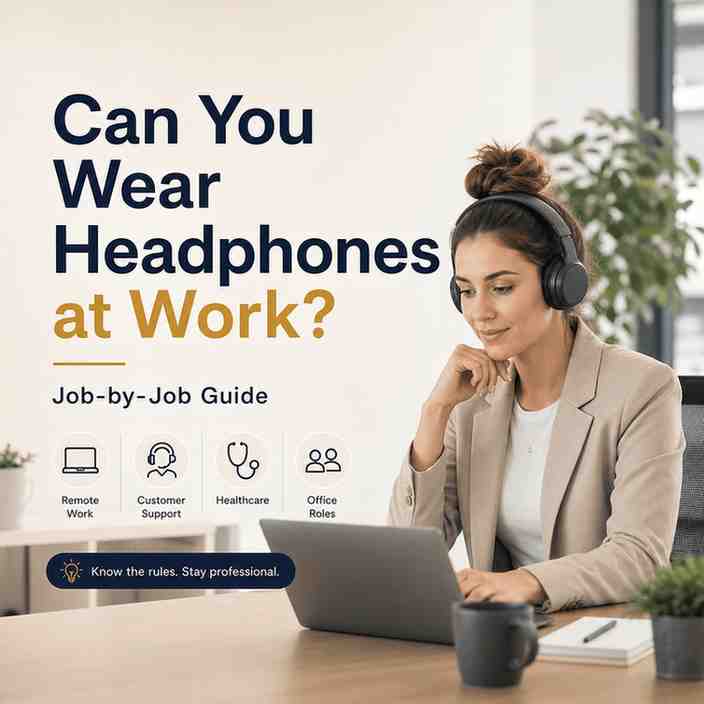
Wearing headphones at work sounds like a small thing, but it can turn into a real issue fast. In some jobs it is totally normal, helps you focus, and nobody cares. In other jobs, headphones are a safety hazard, a customer service problem, or a policy violation that can get you written up.
So, can you wear headphones at work? Yes, often you can. But the real answer depends on your role, your workplace rules, and whether headphones interfere with safety, communication, or customer experience.
Quick baseline: if you work a desk job, headphones are usually acceptable. If you work around customers, vehicles, patients, machinery, or hazards, they are often restricted or banned.

Is it illegal to wear headphones while working?
Usually, no, it is not “illegal” in a broad sense. Most headphone restrictions are company policy, not criminal law.
That said, headphones can become a legal problem in a few situations:
- Regulated safety environments: If your job is governed by OSHA-style safety rules or industry-specific regulations, headphones may be treated as a safety violation.
- Driving as part of work: Many places restrict or prohibit headphones while driving (especially covering both ears). If driving is part of your job, that matters.
- Negligence and liability: If you ignore a safety rule, wear headphones anyway, and an accident happens, your employer may argue you contributed to the incident.
Best practice: Treat it as a workplace safety and policy question first. Then ask HR or your supervisor what is allowed.
Whether you can—or should—wear headphones generally depends on a few practical and safety rules
Here’s the framework most workplaces follow, even if it is not written down perfectly:
Office & Desk Roles
Wearing headphones (especially over-ear or closed-back models to prevent sound leakage) is widely permitted. However, some workplace cultures view constant use as anti-social or a barrier to impromptu collaboration.
Customer-Facing & Safety-Sensitive Roles
In retail, construction, manufacturing, or healthcare settings, headphones are almost universally prohibited. Situational awareness is critical to avoid accidents, and listening to audio reduces your ability to hear warnings or converse with customers.
Accommodations
If you deal with sensory overload, conditions like tinnitus, ADHD, autism, migraines, or anxiety may qualify you for reasonable accommodations depending on your location and employer.
Job-by-job: can you wear headphones at work?
Below is a practical guide. Consider it a starting point. Your employer can still set stricter rules.

Corporate office jobs (accounting, admin, finance)
Usually allowed: Yes.
Why it works: These are low-hazard environments where focus matters and interruptions are frequent.
Common rules you will run into:
- Keep volume low enough to hear fire alarms and urgent instructions.
- Remove one earbud during meetings or when someone approaches.
- No explicit content if sound leaks.
Best headphone choice: closed-back over-ear or a single earbud if your office expects more “availability.”
Software engineering, IT, and data roles
Usually allowed: Yes, very common.
Why it works: Deep focus tasks, lots of independent work.
Potential downsides: If you are always unreachable, teammates may feel blocked.
Simple “good coworker” move: Use a visible signal.
- Headphones on = focusing
- Headphones off = open to quick chats
Call centers and customer support (phone/chat/email)
Usually allowed: Yes, but often with restrictions.
Important note: Many support teams require:
- A wired headset for reliability
- A specific model (noise canceling mic, compliance features)
- No music during calls
If you do back-office ticket work: one earbud may be fine when not actively on calls, depending on policy.
Marketing, design, writing, and creative teams
Usually allowed: Yes.
Culture factor: Some creative teams love it. Others see it as isolation.
Tip: If collaboration is constant, consider open-back headphones at low volume, or keep one ear free.
Remote work and work-from-home
Allowed: Yes (since you control your environment), but still consider:
- Being responsive on Slack/Teams
- Not missing calendar alerts
- Avoiding noise cancellation so strong you miss doorbells, smoke alarms, etc.
Pro move: Use “transparency” mode or keep volume low.
Retail (cashier, floor associate, stock room)
Usually allowed: Often no on the sales floor; sometimes yes in back-of-house.
Why: Customers need help quickly, and stores want staff to look approachable. Also, you must hear announcements and security alerts.
What sometimes works:
- One earbud only during stocking before opening or after closing
- Headphones allowed only during breaks in the back room
Restaurants, cafes, and hospitality
Usually allowed: Almost always no during service.
Why: You need to hear orders, timers, coworkers, and customers. Also, it can look unprofessional in guest-facing roles.
Possible exception: back-of-house dishwashing or prep, but only if management explicitly allows it and it does not interfere with safety.
Warehouses, logistics, and shipping/receiving
Usually allowed: Often restricted or prohibited, especially with forklifts and moving equipment.
Why: Situational awareness is critical. You need to hear alarms, horns, and shouted warnings.
Common compromise: hearing protection that also allows communication, or approved single-ear devices in low-traffic zones.
Manufacturing, factories, and machine shops
Usually allowed: Often no, and for good reason.
Why: Machinery hazards, lockout/tagout environments, alarms, moving parts, and required PPE.
Important nuance: Many factories already require hearing protection. In those cases, employers may provide approved hearing protection designed for the environment. Personal headphones are usually not allowed unless specifically rated and approved.
Construction, trades, and job sites
Usually allowed: Generally no.
Why: Heavy equipment, vehicle traffic, spotters, hazard calls, and constant situational changes.
If you are thinking “but I just want one earbud”: On many sites, that is still a hard no.
Healthcare (hospitals, clinics, dental offices)
Usually allowed: Mostly no in patient-facing or clinical areas.
Why: Patient communication, alarms, and professionalism.
Exceptions:
- Admin staff in a back office
- Lab work in low-interaction areas (policy-dependent)
Education (teachers, school staff, campus support)
Usually allowed: Teachers: typically no while supervising students. Admin staff: often yes.
Why: Duty of care and immediate responsiveness.
Transportation and driving jobs (delivery, trucking, rideshare)
Usually allowed: Often restricted.
If driving is part of your job, check:
- Local laws about earbuds/headphones while driving
- Employer policy (often stricter than the law)
- Safety guidance
Common safe alternative: a vehicle’s hands-free system or a single-ear headset approved for calls only.
Security, law enforcement, and safety monitoring
Usually allowed: Usually no.
Why: Awareness is the job. Headphones can compromise response time.
Government, courts, and high-compliance workplaces
Usually allowed: Depends heavily on security rules.
Some environments limit:
- Bluetooth devices
- Devices with microphones
- Any personal electronics
In those cases, the question is less “can I wear headphones” and more “can I bring them into the building.”
What employers actually care about (the real reasons headphones get banned)
Even relaxed managers usually clamp down when one of these happens:
- Safety risk (missed alarms, moving equipment, emergency instructions)
- Customer experience (looking unavailable, ignoring people)
- Communication breakdown (missed collaboration, slow responses)
- Professional appearance (certain industries)
- Security/compliance (recording risk, device restrictions)
If you address those five points, you can often negotiate a reasonable arrangement.
“Okay, but what about earbuds?” (Are they treated differently?)
Yes. Many workplaces treat earbuds differently from over-ear headphones.
- Earbuds are more discreet but can look like you are on a personal call.
- Over-ear headphones are more obvious, but they signal “I am focusing” more clearly.
Policies often say:
- One earbud only
- No earbuds when interacting with customers
- No noise cancellation in safety-sensitive zones
If you are trying to stay compliant, ask your manager what they prefer rather than guessing.
Safe listening rules that keep you out of trouble
If your job allows headphones, follow these basics:
- Keep volume low enough to hear fire alarms and urgent instructions.
- Use one ear free if your workplace relies on quick verbal communication.
- Pause audio when someone approaches.
- Avoid wearing headphones in hallways, stairwells, loading bays, or anywhere people move quickly.
- Do not use headphones as a shield from doing your job.
A simple standard: if someone has to wave at you twice to get your attention, your setup is too isolating.
Can I still use headphones if I have tinnitus?
Often yes, but you need to do it carefully.
Tinnitus is complicated: for some people, gentle sound helps, and silence makes symptoms feel louder. For others, headphones and loud audio can worsen it.
Practical tips that are generally tinnitus-friendly:
- Keep volume conservative (avoid “just a little louder” creep).
- Prefer over-ear at lower volumes rather than blasting earbuds.
- Use gentle background audio (brown noise, nature sounds) if it helps you focus without turning it up.
- Take listening breaks.
If tinnitus is affecting your work, consider asking for accommodations such as:
- A quieter workspace
- Permission to use low-level masking sound
- More control over your seating position
If your tinnitus is new, one-sided, or worsening quickly, get medical advice.
Can headphones cause TMJ pain?
Yes, they can, especially if you are prone to jaw tension or TMJ issues.
Common triggers:
- Clamping force from tight headbands
- Heavy headphones that increase muscle tension
- Poor posture while wearing a headset for hours
- Stress and jaw clenching (headphones can become associated with “work mode” tension)
If you suspect headphones are contributing to TMJ pain:
- Switch to lighter headphones or comfortable earbuds (if allowed).
- Adjust headband size and earcup position.
- Take short breaks and do gentle jaw relaxation.
- Avoid chewing gum while wearing headphones (it can aggravate TMJ for some people).
If pain persists, consider professional evaluation. TMJ issues can snowball if ignored.
Should I wear headphones if I have vertigo?
It depends on your triggers and your environment.
Some people with vertigo or vestibular disorders feel worse with:
- Strong noise cancellation pressure sensation
- Head movement while wearing heavier over-ear headphones
- Audio that creates a sense of motion (binaural tracks, spatial audio)
If you have vertigo:
- Test headphones at home first.
- Consider disabling strong active noise cancellation if it worsens symptoms.
- Avoid using headphones in places where losing balance would be dangerous (stairs, warehouses, job sites).
- Use speakers at low volume when feasible, or one earbud if it helps you stay oriented.
If vertigo is frequent or unpredictable, prioritize safety over focus hacks.
How to ask your manager (without making it weird)
If there is no clear policy regarding headphone usage at work, it’s best to approach your manager directly and propose some boundaries.
You could say something like:
- “Is it okay if I wear headphones for focus work? I’ll keep the volume low and take them off for any discussions.”
- “Would you prefer one earbud only or over-ear headphones?”
- “If you need me quickly, what’s the best signal? I can keep notifications on.”
In case you’re requesting this as an accommodation due to specific needs, such as reducing distractions, keep your explanation simple and job-focused. Highlight benefits like sensory regulation, fewer headaches, and better concentration. Be prepared to offer compromises like using one earbud only, specifying certain hours for headphone use, or agreeing not to use headphones during peak times.
What to do if headphones are banned (realistic alternatives)
If your workplace has a strict no-headphone policy, you still have several realistic alternatives:
- Foam earplugs for noise reduction (if permitted and safe for the role)
- Approved hearing protection in loud environments
- A white noise machine at your desk (if allowed)
- Relocating to a quieter area of the office
- Scheduling “deep work” blocks when the office is quieter
- Using closed-back headphones only during non-customer hours (if policy allows)
Sometimes the best outcome isn’t “wear headphones all day,” but rather “wear them for 60 to 90 minutes when it matters.” This can be particularly useful if you’re dealing with conditions like tinnitus, which may require specific strategies while at work.
Quick cheat sheet: where headphones are usually okay vs not okay
Usually OK
- Office desk roles
- Software/IT/data jobs
- Creative roles
- Back-office admin
- Some remote work setups
Usually NOT OK
- Construction
- Manufacturing near machinery
- Warehouses with moving equipment
- Healthcare clinical areas
- Customer-facing retail and hospitality
- Driving-heavy roles
Final takeaway
If you are wondering, “Can you wear headphones at work?” the most accurate answer is: it is usually fine in desk-based roles, and usually restricted in customer-facing or safety-sensitive work.
And if you want the simplest rule that keeps you safe and employed: keep the volume low enough to hear fire alarms and immediate instructions, and follow your employer’s policy even when it feels arbitrary.
FAQs (Frequently Asked Questions)
Can I legally wear headphones at work?
Usually, wearing headphones at work is not illegal but governed by company policies. Exceptions include regulated safety environments, jobs involving driving, or situations where headphone use may lead to negligence or liability issues. Always check your workplace rules and consult HR or your supervisor.
Are headphones allowed in office and desk jobs?
Yes, headphones are widely permitted in office and desk roles like accounting, admin, finance, software engineering, and IT. They help improve focus and manage interruptions. However, keep volume low to hear alarms and be mindful of workplace culture regarding social interaction.
Why are headphones often prohibited in customer-facing and safety-sensitive roles?
In retail, construction, manufacturing, healthcare, and similar roles, headphones are usually banned because situational awareness is critical. Listening to audio can reduce your ability to hear warnings, communicate with customers, and avoid accidents.
What are some common workplace headphone policies?
Common policies include keeping volume low enough to hear fire alarms or urgent instructions, removing one earbud during meetings or when approached by colleagues, prohibiting explicit content if sound leaks, and using specific wired headsets in call centers for reliability and compliance.
Can employees with sensory conditions use headphones as accommodations at work?
Yes. Conditions like sensory overload, tinnitus, ADHD, autism, migraines, or anxiety may qualify employees for reasonable accommodations involving headphone use. This depends on your location and employer policies—it’s best to discuss accommodations with HR.
Are headphones allowed while working remotely or from home?
Generally yes—remote workers control their environment and can use headphones. Still, it’s important to remain responsive on communication platforms like Slack or Teams, not miss calendar alerts or safety alarms. Using transparency mode or keeping volume low helps maintain awareness.
