




ANC headphone is headphone or earbud that use tiny microphone and onboard processing to reduce background noise. In plain English, it “listen” to the world around you and create a signal that helps cancel out a lot of that noise, especially the steady, low-frequency stuff like airplane engine rumble, bus vibration, or an HVAC hum.
However, it helps to know what ANC is not. ANC is different from passive noise isolation, which is simply the physical seal you get from ear cups around your ears or ear tips in your ear canal. It’s also different from “just turning the volume up,” which can mask noise but can be fatiguing and risky for your hearing.
Set your expectations correctly and you’ll be much happier with your purchase. ANC reduces noise, it doesn’t create perfect silence, and results vary depending on your fit, the headphone design (over-ear vs earbuds), and the soundscape (a plane cabin is easy mode; nearby voices are harder).
What Does ANC Do on Headphones? (What You’ll Notice in Real Life)
In real use, ANC usually hits you with the same first impression: the world doesn’t disappear, but it gets quieter and calmer.
The biggest change is that rumble and hum fade first. On a plane, the engine drone drops. On a train, the rolling noise softens. In an office, the air conditioner or fan becomes less noticeable. That’s exactly the kind of sound ANC is best at reducing.
Still, sudden sounds and higher-pitched noises can leak through. You might still hear keyboard clacks, a door closing, a baby crying, or parts of conversation. Depending on your needs, that can be totally fine (you wanted less fatigue, not total isolation) or it can be disappointing (you expected silence in a busy café).
For most people, the practical benefits are simple:
- You listen at a lower volume, because you don’t have to overpower the room.
- You feel less tired after commuting or flying, because constant noise is mentally draining.
- You focus better in open offices, shared spaces, or at home with background activity.
There’s also an audio quality angle that matters more than most marketing admits. With less noise competing with your music, you get a better signal-to-noise ratio, so details can sound clearer at safer volumes. Even if the headphones themselves aren’t “audiophile,” the experience often improves in noisy places.
How ANC Works
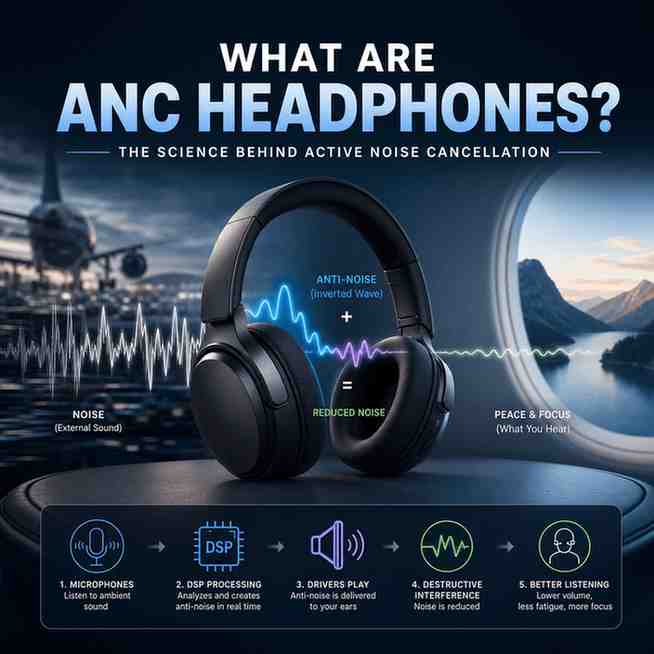
We like to explain ANC as noise math. Your headphones don’t “block” sound electronically. Instead, they create an anti-noise sound wave that counteracts incoming noise.
Here’s the core idea: sound is a wave. If you play the same wave but inverted (also called antiphase), the two waves reduce each other when they meet. That reduction is called destructive interference, and it lowers the sound pressure reaching your ear.
The process happens in milliseconds:
- Listen: Tiny built-in microphones continuously monitor ambient sounds (plane rumble, road noise, office hum).
- Process: The headphone’s DSP (digital signal processing) and algorithm analyze that sound in real time and generate an inverted waveform.
- Cancel: The speaker drivers play the anti-noise. When the original noise wave and the anti-noise wave meet at your ear, they reduce each other.
A few light physics terms you’ll see in ANC explanations are worth knowing:
- Waveform / sine wave: A simplified shape of sound energy over time.
- Inversion / antiphase: Flipping the wave so peaks become troughs.
- Destructive interference: Two opposite waves reduce the total sound.
- Sound pressure: What your ear perceives as loudness.
What makes ANC actually work well (or poorly) comes down to the hardware and tuning:
- External and/or internal microphones that capture noise accurately
- A good algorithm and strong DSP
- Real-time processing with minimal delay
- Drivers and diaphragms accurate enough to play anti-noise cleanly without wrecking your music
That’s why two headphones can both claim “ANC” and feel completely different based on our testing.
Common Types of ANC
Not all ANC is built the same. The microphone placement and processing approach affect how strong the cancellation feels, how it handles wind, and how consistent it is across different ear shapes.
Feedforward ANC
Feedforward ANC uses microphones on the outside of the ear cups or earbud shell. The idea is to catch noise before it reaches your ear.
This can work very well for commuting and travel. However, it can be more sensitive to wind noise and can be thrown off more easily by fit and seal issues, especially with earbuds.
Feedback ANC
Feedback ANC uses microphones on the inside, measuring what’s happening in the ear cup or ear canal, basically closer to what you actually hear.
That can make it more precise in some situations. Though, it can be limited by how the system avoids feedback issues and how much processing it can do without artifacts.
Hybrid ANC
Hybrid ANC combines both external and internal microphones.
For most people, this is the sweet spot and it’s common in premium models. You get broader coverage and more consistent results across different noise types and fits. If you fly often or commute daily, hybrid ANC is usually what we recommend prioritizing.
Adaptive ANC
Adaptive ANC automatically adjusts the intensity based on your environment.
This matters if your day changes a lot. Walking outside, hopping on a train, then sitting in a quiet office is exactly where adaptive systems feel the most “set it and forget it.” That said, the quality of adaptation varies a lot by brand, and some implementations can feel jumpy if poorly tuned.
What’s the Difference between ANC vs Passive Noise Isolation (PNC)?
Passive Noise Isolation (sometimes called PNC) is purely physical. It’s the acoustic seal created by:
- Ear tips filling your ear canal (in-ear earbuds)
- Ear cups sealing around your ears (over-ear headphones)
ANC is electronic and targets what passive isolation struggles with most: deep, droning, low-frequency noise.
The best real-world performance comes from stacking both. A good seal + good ANC is how you get that “the train got quieter” moment. If your seal is weak, ANC has less to work with, and it can feel underwhelming.
Fit details matter more than spec sheets:
- Over-ear: clamp force and cushion shape affect leaks
- Earbuds: tip size and material (silicone vs foam) affect seal
- Any leaks reduce the cancellation and the bass, which can make the whole sound feel thin
Ambient Sound / Transparency Mode (HearThrough)
Transparency mode (also called Ambient Sound or HearThrough) uses the same microphones, but instead of canceling the outside world, it pipes it back into your ears so you can hear what’s happening around you.
You should care about this depending on your needs:
- Commuting safety: hearing traffic while walking
- Airports and trains: hearing announcements without removing headphones
- Office life: quick conversations without constantly pausing and pulling one earcup off
That said, transparency quality varies. Some headphones sound natural. Others add a bit of hiss, or voices can sound slightly artificial because the sound is being captured and reprocessed.
Useful extras you’ll often see:
- Adjustable transparency levels
- Wind reduction modes
- In-ear detection (auto pause when you remove an earbud)
An alternative approach to consider for certain situations is using bone conduction headphones. These type of headphones transmit sound through your skull, leaving your ears open to hear ambient sounds while still enjoying your music or podcast.
Is ANC the Same as Noise-Cancelling? (And Why Some Brands Use Different Terms)
In everyday consumer language, “noise-cancelling” usually means ANC. Brands use “noise cancelling” as the umbrella marketing term because it’s simple and recognizable.
However, companies also use terms loosely, and that’s where people get confused.
A quick practical rule:
- Noise cancelling usually means active cancellation (ANC).
- Noise isolating usually means passive isolation (seal-based blocking).
Even if a box screams “noise cancelling,” you still want realistic expectations. ANC is strongest against low-frequency noise. Voices and sudden sounds are harder to cancel completely, especially in chaotic environments like cafés.
If you want a familiar reference point, a product like the Bose QuietComfort Ultra is known specifically because its tuning makes ANC feel strong and smooth in real commuting and travel. We’re not turning this into a shopping list, but it’s a useful benchmark for what “good ANC” feels like.
Which One Is Better, ANC or ENC?
ANC and ENC get mixed up because they sound similar, but they solve different problems.
ANC (Active Noise Cancellation) improves what you hear by reducing background noise in your headphones.
ENC (Environmental Noise Cancellation) usually refers to call noise suppression for your microphone, so other people hear you more clearly.
Neither is “better” overall. It depends on your use:
- Choose ANC if you fly, commute, or work in noisy spaces and want calmer listening.
- Care about ENC if you take lots of calls on busy streets, in open offices, or during travel.
There are tradeoffs. Strong ENC can make your voice sound less natural if it’s too aggressive. Strong ANC can create a mild pressure sensation for some people, and some models add a low-level hiss.
Should ANC Be On or Off?
Most ANC headphones let you toggle modes because there are real tradeoffs.
Battery life
ANC uses microphones and DSP, so it draws power. This is most noticeable with Bluetooth headphones and true wireless earbuds, where turning ANC on can shave hours off battery life. If you’re trying to get through a long day, switching ANC off in quiet places can help.
Comfort
Some people feel “ear pressure,” mild dizziness, or a sense of suction with ANC. That doesn’t mean anything is wrong. It’s a common reaction to how the brain perceives the change in low-frequency sound pressure.
If that’s you, you have options:
- Reduce ANC intensity if your model allows it
- Use a lighter ANC setting or adaptive mode
- Turn ANC off in quiet rooms
Sound quality
Based on our testing across many models, good ANC can improve perceived clarity in noisy environments because it reduces low-end masking. However, some headphones add faint hiss, and some change frequency response slightly when ANC is on.
A simple mode rule that works for most people:
- ANC on: plane, train, bus, office HVAC
- Transparency: walking outside, announcements, quick chats
- ANC off: quiet rooms, battery saving, if pressure bothers you
What ANC Is Best At (And What It Can’t Fully Fix)
ANC is best at constant, predictable, low-frequency sound, like:
- Engine rumble
- Road noise
- Train cabin noise
- Air conditioning and fans
You’ll sometimes see claims about “X dB reduction,” but in real life, the result depends heavily on fit and the exact noise source. A great seal can make average ANC feel good, while a poor seal can make excellent ANC feel mediocre.
Harder cases include:
- Sudden noises (doors, claps)
- Irregular sounds (keyboard bursts, shifting chatter)
- Wind
- Higher-frequency voices
The simple reason is the waveform changes too quickly and unpredictably. ANC has to measure, compute, and play the anti-noise fast enough, and even tiny timing errors reduce effectiveness at higher frequencies.
Also, perfect silence is unrealistic because not all sound reaches you through air. Some sound reaches you through bone conduction, meaning vibrations travel through your skull and body. Even the best ANC can’t fully erase that.
ANC Headphones vs Earbuds vs On-Ear vs Over-Ear
Form factor matters because it affects seal, comfort, and how much space the designers have for microphones and processing.
Over-ear headphones
Over-ears usually deliver the best overall ANC experience because they combine a larger earcup seal with room for more microphones and better tuning.
They’re great for travel and long office sessions. The tradeoff is portability, and some people don’t like the heat buildup around the ears.
On-ear headphones
On-ears can be more portable, but they often seal less effectively because the pads sit on your ears rather than around them.
That weaker seal makes ANC performance more variable. Even if the electronics are good, leaks can limit what you get.
In-ear / true wireless earbuds
Earbuds are the most convenient for commuting and everyday carry. That said, ANC performance depends heavily on ear tip fit.
If you get a great seal, earbuds can be impressive. If you don’t, the ANC and bass can fall apart quickly. Comfort is also more personal here because ear tip pressure varies a lot from person to person.
Inside the Tech: Microphones, DSP, Latency, and the “Real-Time” Challenge
ANC isn’t just “more mics equals better.” Placement, tuning, and processing matter.
Microphones
External mics capture ambient sound, but they’re exposed to wind and handling noise. Internal mics measure what’s happening closer to your ear, which can improve precision.
A good system balances both while avoiding weird artifacts like pulsing, whistling, or over-amplified wind.
DSP and algorithm tuning
ANC lives or dies by its tuning. Spec sheets won’t tell you how natural the cancellation feels, how it adapts, or how well it avoids adding hiss.
Based on our testing, two headphones with similar hardware can perform very differently because one has better real-world tuning for trains, cafés, and windy streets.
Latency (why “real time” matters)
Transparency mode and ANC have to be ultra-low-latency. If the sound you hear is delayed, it can feel unnatural or “laggy,” especially when you talk or when you hear footsteps and movement.
Drivers and audio engineering
The drivers have to play your music and the anti-noise at the same time. Poor implementations can add distortion or shift the sound signature when ANC is enabled.
Modern wireless headphones also stack features like EQ, spatial audio, and head tracking on top. Good products make these features coexist cleanly. Weak ones feel messy when everything is turned on.
How to Choose ANC Headphones
Most buying mistakes happen when people chase “maximum ANC” and ignore fit, comfort, and transparency. We’d prioritize it like this.
1. Fit and seal first
For over-ear headphones, check that the pad seals around your jawline and glasses. For earbuds, confirm you have the right tip size and that the seal holds when you move.
2. ANC strength and consistency
Look for hybrid ANC if you can. Consider adaptive ANC if you regularly move between different environments.
3. Transparency mode quality
If you commute or walk outside, a natural-sounding transparency mode matters more than most people expect.
4. Wind handling
If you spend a lot of time outdoors, strong wind reduction can be the difference between a usable and an annoying experience.
5. Call quality (ENC)
If you take calls daily, evaluate mic performance separately from ANC. Great noise cancellation does not guarantee great voice pickup.
6. Try before you buy, if possible
- Wear them for 1 to 2 hours.
- Check for any pressure sensation.
- Listen for hiss in quiet rooms with ANC enabled.
If you want a concrete example, the Bose QuietComfort Ultra is a well-regarded premium pick for strong ANC and travel comfort, while a budget option like the BWOO BW97 Wireless ANC Earphones can make sense if you mainly want a taste of ANC for commuting and are keeping expectations realistic.
The Real Pros and Cons of ANC Headphones
ANC is worth it for most people who deal with daily noise. It’s one of those features that can change how you feel after a commute.
Pros (what you actually get):
- Less fatigue in noisy environments
- Better focus in open offices and shared spaces
- Lower listening volume, which helps protect hearing
- Clearer perceived audio in noisy places
Cons (what people don’t talk about enough):
- More battery drain, especially on earbuds
- Possible pressure sensation or mild hiss
- Reduced awareness if you use ANC in the wrong context
- Performance varies a lot with fit and soundscape
- Wind can be a problem on some designs
A simple decision rule: if you commute, travel, or work in a noisy office, ANC is usually worth paying for. If you’re mostly in quiet rooms, strong passive isolation and comfortable tuning may be all you need, and you can save money by skipping top-tier ANC.
FAQs (Frequently Asked Questions)
What are ANC headphones and how do they work?
ANC headphones, or Active Noise Cancellation headphones, use tiny microphones and onboard processing to reduce background noise. They “listen” to ambient sounds and create an inverted sound wave (anti-noise) that cancels out steady, low-frequency noises like airplane engine rumble or HVAC hum through a process called destructive interference.
How is ANC different from passive noise isolation?
ANC actively reduces noise by generating anti-noise signals to cancel background sounds, whereas passive noise isolation simply blocks noise physically through ear cups or ear tips creating a seal. ANC reduces steady noises electronically, while passive isolation relies on physical barriers.
What types of noises does ANC effectively reduce?
ANC is most effective at reducing steady, low-frequency sounds such as airplane engine rumble, bus vibrations, and air conditioner hums. It generally lessens these rumbles and hums first but may be less effective against sudden or high-pitched noises like keyboard clicks or conversations.
What are the common types of ANC technology used in headphones?
The common types include Feedforward ANC which uses microphones outside the ear cup to catch noise before it reaches your ear; Feedback ANC which uses microphones inside the ear cup for more precise cancellation; Hybrid ANC combining both external and internal microphones for broader coverage; and Adaptive ANC which adjusts cancellation based on the environment.
What benefits can I expect from using ANC headphones in daily life?
With ANC headphones, you can listen at lower volumes since less background noise competes with your music, feel less fatigue during commuting or flying due to reduced constant noise, focus better in open offices or noisy environments, and experience improved audio clarity thanks to a better signal-to-noise ratio.
Why do different ANC headphones perform differently even if they all claim to have active noise cancellation?
Performance varies due to differences in hardware quality such as microphone placement (external/internal), the strength of the digital signal processing (DSP) algorithms, real-time processing speed, and driver accuracy. These factors affect how well the anti-noise signal is generated and how effectively it cancels ambient sounds.
