


Most people buy better headphones, switch music apps, or crank up “high quality streaming” and still feel like Bluetooth audio is a little… flat.
The surprising part is that your headphones might already be capable of better sound, and so might your phone. You just are not using the best connection they both support.
That “hidden feature” is your Bluetooth audio codec.
Once you understand what codecs are, which ones your devices support, and how to switch them, you can often get a noticeable upgrade in clarity, detail, and sometimes even volume, without buying anything new.
What are Bluetooth audio codecs?
What are Bluetooth audio codecs? In simple terms, a Bluetooth audio codec is the method your phone (or laptop) uses to compress music so it can fit through Bluetooth’s limited bandwidth, then your headphones decompress it back into audio you can hear.
That compression step is the whole game. Different codecs make different tradeoffs between:
- Sound quality (how much detail is preserved)
- Latency (delay, which matters for gaming and video)
- Stability (how well it holds up in busy areas)
- Battery life (both on the phone and headphones)
One key rule matters more than anything else:
Both the transmitting device and the receiving device must support the same codec, or they fall back to a shared option (usually SBC).
So you might own premium headphones, but if your phone cannot negotiate the same “better” codec, you are not getting the upgrade you paid for.
Why codecs can “instantly” improve music quality (the hidden feature)
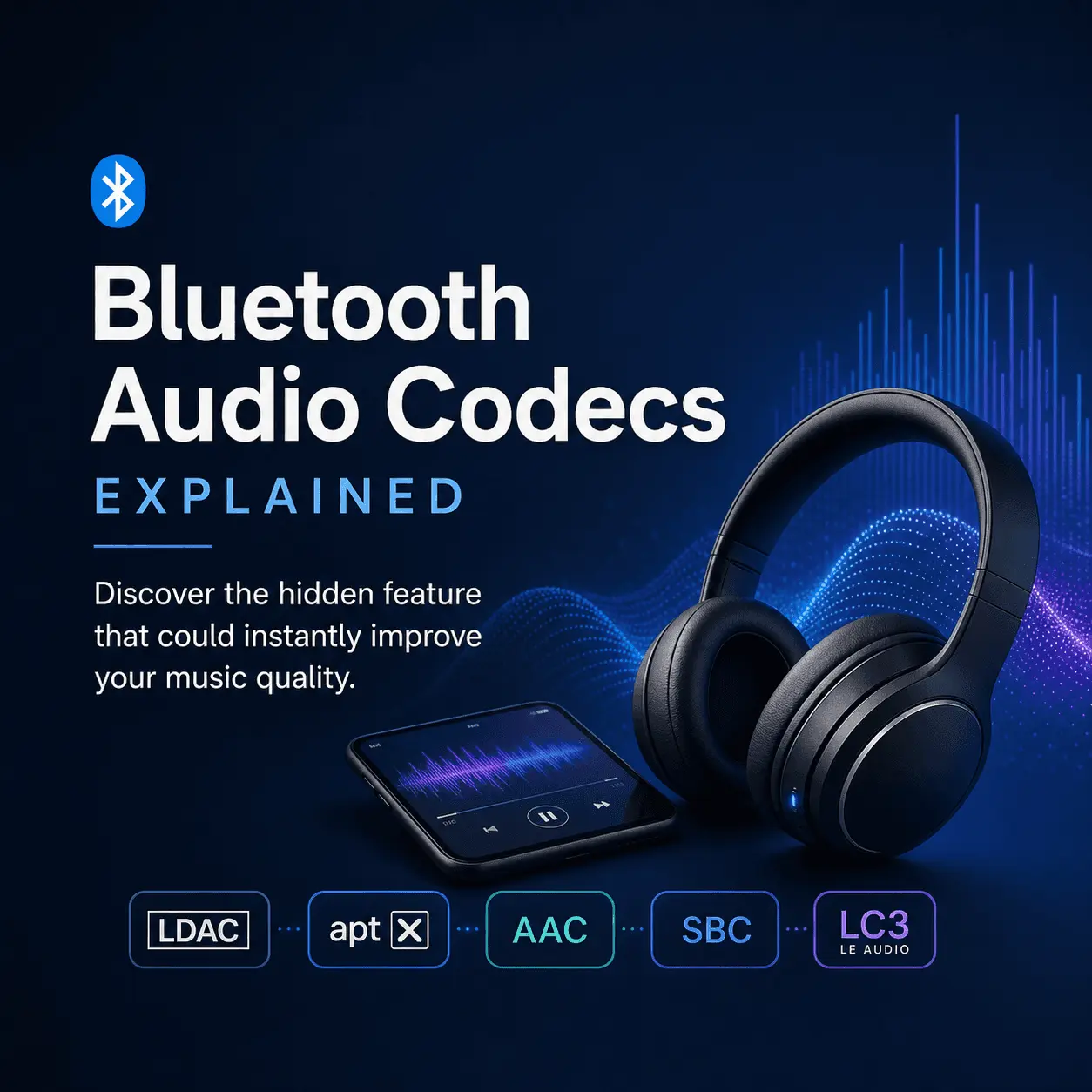
Here is the practical reason codecs can feel like a hidden upgrade: many devices support multiple codecs, but they do not always pick the best one by default.
Sometimes they choose:
- a more compatible codec
- a more stable codec for your current signal conditions
- a codec your device maker prefers (Apple vs Android differences are real)
If you can force or confirm a higher quality codec, you may hear:
- tighter bass (less “woolly” low end)
- clearer vocals (less smearing in busy songs)
- more sparkle and separation in cymbals, guitars, reverb tails
- fewer compression artifacts at higher volumes
It is not magic, and it is not the same as wired lossless, but it can be a real jump from the baseline.
Here is a breakdown of the most common codecs
Below is the plain-English map of the Bluetooth codec world, including the exact breakdown you need to make sense of what your devices are doing.
1. Universal Codecs
SBC (Subband Codec)
SBC (Subband Codec) is the baseline standard codec. Built into every Bluetooth audio device, it ensures compatibility but compresses audio heavily, which limits overall sound quality.
- Pros: works on everything, usually stable
- Cons: quality varies a lot by implementation, can sound soft or grainy
- Typical use: fallback codec when nothing else matches
AAC (Advanced Audio Coding)
AAC (Advanced Audio Coding) is the default high-quality codec for Apple devices (iPhones and iPads). It provides very good sound quality at a standard bitrate (often around ~256 kbps in many ecosystems), but it can suffer from higher latency and may be less efficient on some Android devices depending on hardware and software implementation.
- Pros: great on iPhone and iPad, widely supported
- Cons: Android performance is inconsistent across brands; latency can be noticeable
- Best for: Apple users who want consistently good Bluetooth audio
2. Premium & High-Resolution Codecs
aptX and aptX HD
aptX and aptX HD (Qualcomm) aim for better transmission efficiency and higher bitrates than SBC. aptX HD supports 24-bit audio, which is marketed as “hi-res capable,” though real-world quality still depends on the entire chain (master quality, headphones tuning, noise floor, etc.).
- Pros: often cleaner than SBC, good balance of quality and stability
- Cons: requires support on both devices; iPhones do not support aptX
- Best for: many Android phones + compatible headphones
Which audio codec is best for Bluetooth?
Which audio codec is best for Bluetooth? The honest answer is: it depends on what you care about most.
Use this simple priority list:
- If you want the most reliable “good” quality: AAC on iPhone, or aptX/aptX HD on compatible Android setups
- If you want the lowest latency for gaming/video: look for low-latency focused codecs (more on that below)
- If you want the “highest” Bluetooth codec on paper: you are usually looking at LDAC or aptX Adaptive/aptX Lossless type options, but your devices must support them
Even if you choose the “best” codec available, remember: a stable connection at a slightly lower codec can sound better than a higher codec that keeps stuttering.
Which is better Bluetooth codec AAC or aptX HD?
Which is better Bluetooth codec AAC or aptX HD? Here is the real-world way to think about it:
- On iPhone: AAC is the clear winner by default because iPhones do not support aptX HD. So the “choice” is usually AAC vs SBC, and AAC is typically better.
- On Android: aptX HD can sound better than AAC if your phone and headphones handle aptX HD well. But some Android phones do AAC poorly (higher CPU use, inconsistent tuning), and some do it fine.
A simple decision rule:
- If you are on Apple, choose AAC.
- If you are on Android and your gear supports it, try aptX HD, and compare it to AAC or standard aptX in your own environment.
If you are not sure what is active, the next sections show you how to check.
What is the highest Bluetooth codec?
What is the highest Bluetooth codec? “Highest” can mean two different things:
- Highest potential audio quality / bitrate (marketing and specs): often LDAC (commonly referenced up to 990 kbps in best conditions) or Qualcomm’s newer adaptive/lossless options on supported hardware.
- Highest consistency in your day-to-day life: the codec that stays stable where you actually listen, on your actual phone, in your actual commute.
So yes, LDAC might be the “highest Bluetooth codec” you see in menus, but if it constantly drops out in a crowded area, it is not the best experience.
The codec list that actually matters (quick cheat sheet)
If you want a fast mental model, use this:
- SBC: universal fallback
- AAC: excellent default for Apple, mixed bag on Android
- aptX: solid step up for many Android devices
- aptX HD: higher-bitrate aptX flavor, can sound cleaner
- LDAC: often the “highest” option on Android when available, can be sensitive to signal strength
- aptX Adaptive / aptX Lossless: newer Qualcomm ecosystem options (device support matters a lot)
Not every phone supports all of these. Not every headphone does either.
How to check which Bluetooth codec you are using (and switch it)
This is where the “hidden feature” becomes practical.
On Android (the easiest platform to inspect)
Most Android phones let you see and sometimes force the codec via Developer options.
- Go to Settings → About phone
- Tap Build number 7 times to enable Developer options
- Go to Settings → System → Developer options
- Find Bluetooth Audio Codec
You may see options like SBC, AAC, aptX, aptX HD, LDAC, and more.
Important notes:
- If a codec is selectable but snaps back, your headphones likely do not support it.
- Some phones change codec automatically based on signal quality.
- For LDAC, there may also be a Playback Quality setting. Higher settings can mean more dropouts.
On iPhone (less control, more consistency)
Apple does not give you a simple “force codec” toggle. In practice:
- If both devices support AAC, iPhone typically uses AAC
- If not, it falls back to SBC
The main “upgrade path” on iPhone is usually choosing headphones that implement AAC well.
How to tell if a codec change is worth it (a quick listening test)
To avoid placebo, do this:
- Pick a song you know well with busy sections (vocals + cymbals + bass at the same time).
- Listen at the same volume for 30 to 60 seconds.
- Switch codec (or reconnect if your phone changes it on reconnect).
- Listen again.
What you are listening for:
- cymbals: do they sound like “spray” or like defined metal hits?
- vocals: do “s” sounds get splashy or stay smooth?
- bass: does it stay tight or blur into the mix?
If you do not hear a difference, that is normal. Your headphone tuning matters more than codec once you are above the baseline, and some gear simply sounds similar across codecs.
Latency: the reason your video looks fine but feels off
Sound quality gets all the attention, but latency is the daily annoyance.
High latency can cause:
- lip-sync mismatch in videos
- “laggy” gunshots and footsteps in games
- delay when playing instruments or tapping in rhythm apps
General trend (not a strict rule):
- SBC and AAC can have noticeable latency depending on device processing
- Some aptX-family variants are designed to reduce latency
- True wireless earbuds also add latency due to their internal buffering and relay between buds
If gaming is your priority, codec matters, but so does the headset’s own design.
Battery life: codecs can change how long you listen
Codecs can influence battery in two ways:
- Efficiency of encoding/decoding
- Radio behavior due to bitrate and retransmissions (dropouts cause extra work)
This is why AAC can be great on iPhone (optimized) but sometimes less efficient on certain Android phones.
If you notice your phone battery dropping faster with a certain codec, it is not in your head.
Common myths that lead people to the wrong codec
Myth 1: “The highest codec always sounds best”
A stable connection at a slightly lower codec often beats a higher codec that stutters or downshifts constantly.
Myth 2: “Hi-res codec means hi-res sound”
Even if a codec supports 24-bit or higher bitrates, your actual experience depends on:
- the recording quality
- the streaming tier
- your headphone drivers and tuning
- ambient noise and fit (especially with earbuds)
Myth 3: “If my headphones support it, I’m using it”
Not unless your phone also supports it and negotiates it.
How to choose the right codec for your setup (simple recommendations)
If you use an iPhone
- Aim for headphones/earbuds known to do AAC well.
- Do not stress about aptX HD or LDAC, because iPhone will not use them.
If you use Android
- If your devices support LDAC, try it first at a balanced setting. If it drops out, lower the quality mode.
- If you have aptX HD, compare it against LDAC and pick what stays stable.
- If you are stuck on SBC, you can still improve sound more by improving fit, EQ, and source quality, but a codec-capable headphone upgrade can be meaningful.
If you mainly watch YouTube/Netflix
- Prioritize stable connection and reasonable latency over chasing the “highest Bluetooth codec.”
If you mainly listen to music
- Prioritize the best-sounding stable codec your phone and headphones both support.
- Then focus on headphone tuning and EQ, because that often creates a bigger difference than codec swapping.
A quick “do this now” checklist
If you want the fastest path to better Bluetooth audio:
- Find out what codec your headphones support (product page or manual).
- Check what codec your phone supports (spec sheet).
- On Android, check the active codec in Developer options while music is playing.
- If you see SBC but your gear supports more, switch to AAC / aptX / aptX HD / LDAC and re-test.
- If LDAC stutters, lower LDAC quality or choose aptX HD instead.
That is the hidden feature in action.
Final takeaway
Bluetooth audio codecs are the behind-the-scenes system that decides how your music is compressed, transmitted, and rebuilt in your headphones. The codec directly affects sound quality, latency, stability, and battery life, and you only get the benefits when both devices support the same codec.
If you do one thing after reading this, make it this: check what codec you are actually using. There is a good chance your setup can sound better today with a simple switch.
FAQs (Frequently Asked Questions)
What are Bluetooth audio codecs and why do they matter?
Bluetooth audio codecs are methods your phone or laptop uses to compress music for transmission over Bluetooth, which has limited bandwidth, and your headphones decompress it back into sound. Different codecs balance sound quality, latency, stability, and battery life. Using the right codec supported by both devices can significantly improve audio clarity and detail.
How can switching Bluetooth audio codecs instantly improve my music quality?
Many devices support multiple codecs but don’t always select the best one by default. By forcing or confirming a higher-quality codec, you can experience tighter bass, clearer vocals, more instrument separation, and fewer compression artifacts—resulting in a noticeable upgrade without buying new hardware.
What are the most common Bluetooth audio codecs and their characteristics?
Common codecs include SBC (baseline standard with broad compatibility but lower quality), AAC (default high-quality codec for Apple devices with good sound but sometimes higher latency), and aptX/aptX HD (Qualcomm codecs offering better transmission efficiency and higher bitrates, including 24-bit audio support). Each codec has tradeoffs in compatibility, sound quality, latency, and stability.
Which Bluetooth audio codec is best for my needs?
The best codec depends on your priorities: for reliable good quality use AAC on iPhone or aptX/aptX HD on compatible Android devices; for lowest latency in gaming or video look for low-latency codecs; for highest theoretical quality consider LDAC or aptX Adaptive/aptX Lossless if supported. Remember that a stable connection with a slightly lower codec often sounds better than an unstable higher one.
Is AAC better than aptX HD as a Bluetooth audio codec?
On iPhone, AAC is the clear winner since iPhones don’t support aptX HD—AAC typically outperforms SBC there. On Android, aptX HD can sound better if both phone and headphones support it well. However, some Android devices handle AAC inconsistently. The general advice is: Apple users should choose AAC; Android users with compatible gear should try aptX HD and compare performance.
Why do both transmitting and receiving devices need to support the same Bluetooth codec?
Both devices must support the same codec because Bluetooth audio transmission relies on compressing music on the sender side and decompressing it on the receiver side using that specific codec. If they don’t share a common supported codec, they fall back to a basic option like SBC, which may limit sound quality despite having premium headphones or phones.
