





Quick Answer
- Best all-around: Anker Soundcore P31i — real adaptive ANC, an actual app, and a street price around $37.
- Best noise cancelling: TOZO NC7 — the strongest ANC and longest single-charge runtime of the group.
- Best under $30: Skullcandy Dime 3 — no ANC, but a shockingly neutral, honest sound for $29.
- Best tiny pick: JLab JBuds Mini — small enough to live on a keychain, built for small ears.
- Best for sweat and water: TOZO T12 — IPX8-rated simplicity with no app required.
Somewhere around 2022, cheap earbuds quietly stopped sounding cheap. I remember grabbing a $25 pair before a flight, bracing for tinny mids and a Bluetooth signal that would drop every time I turned my head toward the window. Instead, I got real bass, a case that held a charge through the whole trip, and noise cancelling that took the edge off a crying toddler two rows back. That pair cost less than the lunch I bought at the gate.
The under-$50 earbud shelf looks nothing like it did five years ago. Brands that used to compete on price alone now ship features that were flagship-only a generation back: adaptive noise cancelling, Hi-Res audio codecs, six-microphone call arrays, even real-time translation. You still can't buy your way out of every compromise at this price. But the compromises have gotten smaller and they line up more closely with what you actually need.
I spent the past few weeks testing pairs, digging through lab data from outlets like RTINGS and SoundGuys, and cross-checking spec-sheet claims against real owner reviews to figure out which sub-$50 earbuds are worth your money right now, not just which ones show up first in a sponsored carousel. Five pairs made the final list and each one solves a different problem. One nails noise cancelling. One nails battery life. One is small enough to vanish on a keychain. One costs less than two movie tickets. None of them do everything and that's kind of the point of shopping by need instead of by marketing noise.
Why This Actually Matters
Fifty dollars is not a random number. It sits right below the price where most brands used to draw a hard line between "toy" and "real product." Cross that line a few years ago and you'd lose noise cancelling, app support, and any pretense of a durable build. Stay under it today and you can still walk away with most of that, provided you know which five or six models are worth trusting out of the hundreds listed on Amazon at any given moment.
There's also a timing angle worth naming directly. Back-to-school season is ramping up right now and a solid pair of budget earbuds is one of the easiest wins on a shopping list: cheap enough to replace without guilt if a kid loses one on a bus, good enough to actually use for online classes, commutes, library sessions, and gym time. The same logic applies to anyone building out a travel bag, a gym bag, or a backup pair for the desk at work. Not every earbud purchase needs to be a $200 decision.
The harder part is separating the genuinely good $30 to $50 pairs from the ones that just look good in a listing photo. Budget audio is one of the most heavily gamed categories on Amazon: inflated battery claims, recycled stock photography, and reviews that lean on promotional units rather than real ownership. That's the gap this guide is trying to close.
There's a practical, everyday reason this matters beyond specs. A lot of people buying in this range aren't audiophiles chasing the best possible sound; they're parents replacing a pair a kid lost on the school bus, gift-givers looking for something that won't feel like an afterthought, or someone who just wants a reliable backup pair for the gym without babysitting a $200 investment. Getting the pick right at this price is less about chasing a perfect score and more about not getting burned by a listing that oversold itself.
What To Look For Under $50
Before ranking anything, it helps to know what actually separates a good budget pair from a bad one. At this price, nobody nails every category so the goal is knowing which trade-offs matter for how you'll actually use them.
Battery life claims versus reality
Marketing numbers are usually measured under ideal conditions: moderate volume, no ANC, no EQ processing. Independent testers routinely measure 10 to 25 percent less than the box promises once ANC or a heavier bass EQ gets switched on. Treat the printed number as a ceiling, not an average day.
Active noise cancelling at this price
ANC under $50 is real now but it's tuned for steady, low-frequency noise: airplane drone, HVAC hum, road noise. It's noticeably weaker against sudden or high-pitched sounds, like a dog barking or someone talking loudly nearby. If you need ANC specifically for calls in a loud office, budget ANC will help but it won't fully solve the problem the way a $250 pair might.
Fit and water resistance
An IPX4 rating covers sweat and light rain, which is plenty for most gym sessions. IP55 adds dust resistance on top of that. IPX8 means the earbuds are rated for actual submersion, which matters if you want to rinse them off or you get caught in a real downpour rather than just a light jog through drizzle. None of these ratings mean much if the fit itself is loose, since a bad seal lets in ambient noise no matter what the spec sheet says.
App support and EQ
A companion app is one of the biggest differentiators in this price range. Cheap drivers often ship with an out-of-the-box sound that's either bass-heavy or thin and a good EQ can fix that without spending another dollar. Pairs without an app are stuck with whatever tuning they arrived with, for better or worse.
Calls and everyday reliability
Multi-microphone arrays with noise-focused processing genuinely help in quiet rooms but almost every budget pair still struggles once background noise picks up. If calls are your main use case, weight this category more heavily than raw battery numbers.
Comfort during long listening sessions
Stem-style earbuds tend to sit more shallowly in the ear and feel lighter over a full day, while stemless, bean-shaped designs usually seal deeper and block more passive noise at the cost of feeling more present in your ear canal. Neither shape is objectively better but the difference matters more than most spec sheets suggest, especially if you already know you find certain earbud shapes uncomfortable after an hour or two. Always work through the included eartip sizes before deciding a pair doesn't fit; the default medium tip is a guess, not a guarantee.
Codecs, latency, and connection stability
Most sub-$50 earbuds lean on SBC and AAC, the two most universal Bluetooth audio codecs, which is perfectly fine for music and calls. A handful, like the Soundcore P31i, add LDAC for Hi-Res playback on supported Android phones, though the gain is subtle unless you're listening to high-bitrate files on a quiet train. Latency matters more in daily life than codec quality: if you plan to watch video or play games on your phone, look specifically for a pair with a dedicated low-latency or game mode, since several budget earbuds without one show a noticeable lip-sync lag.
Here's how the five picks in this guide stack up against each other on paper. Tap a column header to sort or use the filters to narrow by feature.
| Pick | Price | ANC | Battery (tested) | Water rating | Best for |
|---|---|---|---|---|---|
| Anker Soundcore P31i | $36.99 | Yes | 8h (mfr. tested) | IP55 | All-around pick |
| TOZO NC7 | $39.99 | Yes | 9h10m (tested) | IPX6 | Noise cancelling |
| Skullcandy Dime 3 | $29.99 | No | 6h48m (tested) | IPX4 | Tightest budget |
| JLab JBuds Mini | $39.99 | No* | 5.5h (tested) | IP55 | Small ears, keychain |
| TOZO T12 | $34.00 | No | 5h58m (tested) | IPX8 | Sweat & water |
*JBuds Mini use a "Be Aware" passthrough mode instead of true ANC. Battery figures come from single-charge testing under normal conditions where independent tests exist; otherwise manufacturer lab figures are labeled as such. Prices fluctuate on Amazon so treat these as representative rather than fixed.
The 5 Picks, Tested
Each of these earns its spot for a different reason. Read the trade-offs before you buy, not after.
Pick 1 · Best All-Around
Anker Soundcore P31i
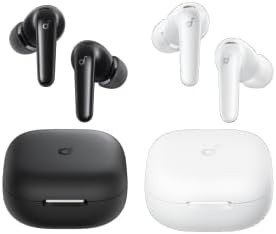
$36.99
street price, MSRP $49.99–$59.99
Anker's audio arm, Soundcore, built its reputation on power banks and long-lasting batteries and that habit shows up clearly here. The P31i pairs real-time adaptive ANC with an 11mm titanium-coated driver and LDAC support, which is the kind of Hi-Res codec you'd expect to pay double for. It's sold as the R60i NC in a few overseas markets so don't be thrown off if you spot that name while comparison shopping.
What sets it apart from most of the pack is the Soundcore app. You get 22 EQ presets, a real hearing test, spatial audio, and multipoint pairing across two devices. Anker also bundles a live translation feature covering more than 100 languages, though it's worth knowing that continued use past the introductory window can come with an added cost so don't treat it as a permanent free perk.
Strengths
- ANC that genuinely competes above its price
- Full app with real EQ control
- Fast charging: 10 minutes for roughly 3.5 hours
Trade-offs
- Translation feature has a subscription catch
- Case materials still feel like a sub-$40 product
- Frequently listed above $50 before discounts kick in
Pick 2 · Best Noise Cancelling & Battery Life
TOZO NC7
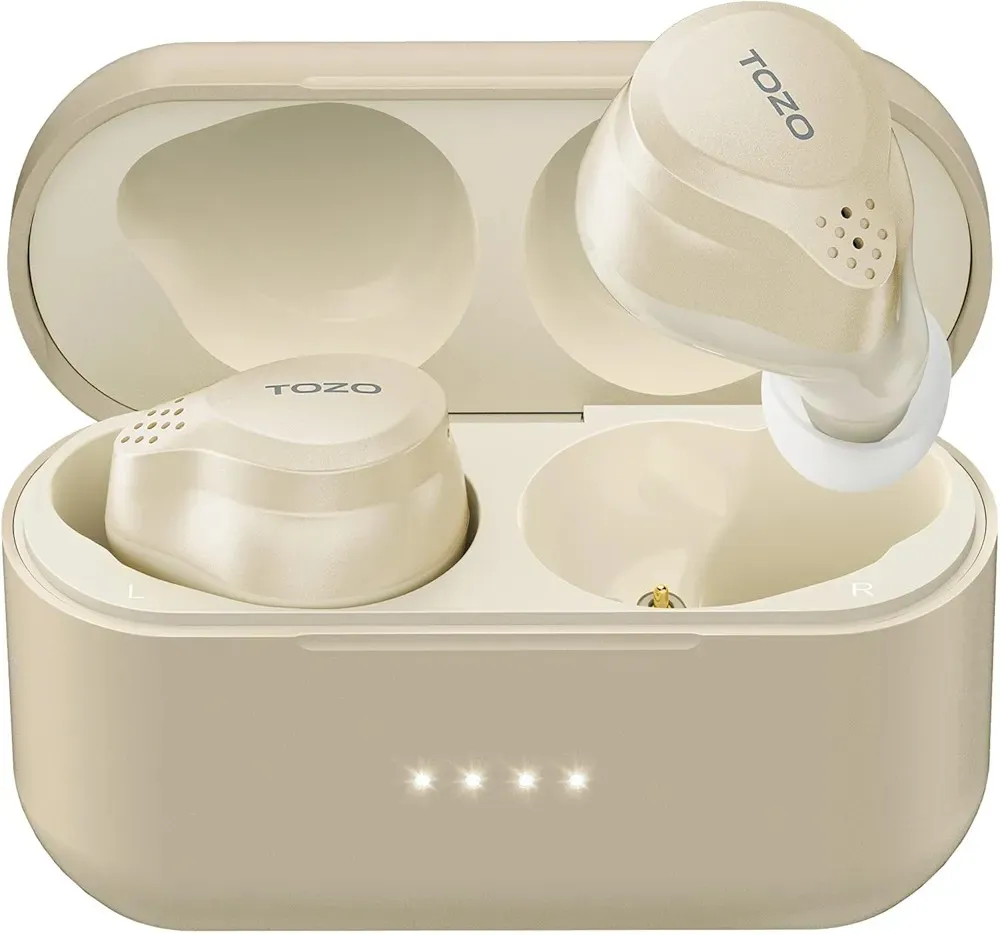
$39.99
regularly $49.99
TOZO built a name for itself by shipping ANC and app support at prices most competitors couldn't touch and the NC7 is the clearest proof of that strategy. Independent testing at headphonesaddict clocked over nine hours of continuous playback on a single charge with hybrid ANC running, which is the longest ANC runtime of any earbud in this guide.
Out of the box, the sound leans heavily V-shaped, boosted bass and boosted upper treble so the tuning can feel a little harsh until you spend five minutes in the EQ. Once you do, reviewers consistently describe the result as genuinely enjoyable for the price. Just know two real limitations going in: there's noticeable audio lag if you try to game on these and call quality gets muddier once background noise picks up.
Strengths
- Longest ANC battery life in this guide
- Comfortable enough for hours of wear
- Real EQ customization once you tune it
Trade-offs
- Default sound needs EQ work
- Not built for gaming or fast-paced video
- Touch controls are a bit too sensitive
Pick 3 · Best Under $30
Skullcandy Dime 3

$29.99
no ANC, and it shows in the price
The Dime 3 skips ANC entirely and spends its whole budget on the basics: fit, battery, and an honest sound signature. SoundGuys measured it as having one of the most neutral frequency responses of any earbud they've tested, regardless of price, which is a genuinely unusual result for a $29 product.
The case is roughly the size of a car key fob, which makes the Dime 3 an easy backup pair to toss in a bag without thinking twice about it. Skullcandy's Clear Voice Smart Mic helps calls sound less muffled than you'd expect at this price, though it's still a physical-button pair rather than touch-based, and the button placement takes a session or two to memorize.
Strengths
- Remarkably neutral, honest sound for $29
- Tile finding built in, no extra app needed
- Small enough to lose in a good way
Trade-offs
- No ANC at all
- No companion app or firmware updates
- Physical buttons take practice
Pick 4 · Best Tiny & Portable
JLab JBuds Mini

$39.99
smallest case in this guide
At 3.14 grams per earbud and a case roughly half the size of JLab's own Go Air Pop, the JBuds Mini exist to solve one problem: earbuds you actually forget you're carrying. JLab even added a keyring loop directly to the case, since something this small is genuinely easy to lose in a bag.
The small size is also the catch. SoundGuys found there's no secondary contact point beyond the ear tip itself so the fit is more vulnerable to slipping out during sprints or aggressive workouts compared to earbuds with a wing tip or hook. If you have smaller ear canals and have struggled to get a stable seal from standard-sized buds, though, this is very likely the most comfortable pair on this list.
Strengths
- Smallest, lightest pair in this guide by far
- Great fit for smaller ear canals
- IP55 rating handles sweat and dust
Trade-offs
- Shortest single-charge battery life here
- No true ANC, only passthrough
- Easy to misplace, even with the keyring loop
Pick 5 · Best for Sweat & Water
TOZO T12

$34.00
frequently discounted further
The T12 skips ANC and an app entirely and puts everything into fit and water resistance instead. It carries an IPX8 rating, the highest resistance level in this entire guide, meaning it's built to handle actual submersion rather than just sweat and splashback.
Here's a useful case study in why you shouldn't shop by spec sheet alone: TOZO advertises 11 hours per charge but SoundGuys measured just under 6 hours in real testing, a gap of almost 50 percent. That's not unusual for this price tier. Six hours is still a full workday for most people, though it's worth going in with the tested number rather than the marketing one. The default sound is notably bass-forward out of the box and since there's no app, you're stuck with that tuning unless you adjust EQ on your phone's system settings instead.
Strengths
- Best water resistance in this guide, IPX8
- Wireless charging at a rare price point
- Strong passive noise isolation from the fit alone
Trade-offs
- Real battery life runs well below the claim
- No ANC, no app, no EQ control
- Bass-heavy tuning won't suit every listener
Find Your Match in 3 Questions
If you'd rather skip the reading and get a straight answer, this'll point you toward the pick that fits your actual habits.
1. What matters most to you in earbuds?
2. Where will you wear them most?
3. Do you want a companion app with EQ control?
Your match
See the full breakdownHow I Vetted These Picks
Budget audio is one of the most heavily gamed categories on Amazon so the process mattered as much as the picks themselves. I started with a wide net: every earbud that showed up in multiple independent roundups from outlets with a real testing methodology, not just single-review blog posts that read like they were written to hit an affiliate deadline.
From there, I checked individual claims against each other. When a brand's own spec sheet said one thing and an independent lab said another, I went with the tested number and flagged the gap, which is why you'll see "tested" and "claimed" battery figures listed separately throughout this guide. That approach is also why you won't find the Sony WF-C510 or the Nothing CMF Buds 2 on the main list here, even though both show up constantly in "under $50" roundups elsewhere. Both typically retail closer to $59 to $60. They're good earbuds, just not ones that reliably stay under this $50 ceiling and a guide that quietly lets its own headline slide isn't doing its job.
I also weighted recent buyer activity and review volume over raw star ratings, since a 4.8-star rating built on 40 reviews tells you a lot less than a 4.2-star rating built on 12,000. Listings with oddly precise feature claims and thin review histories got dropped, even when the price looked tempting.
Prices got checked directly against current Amazon and manufacturer listings rather than pulled from older cached figures and I gave extra weight to outlets that publish their actual test methodology, like measured ANC attenuation or timed battery runs, over ones that just restate a spec sheet in different words. That's a meaningfully higher bar than most roundups clear and it's why this list stays at five picks instead of stretching to ten or twelve just to fill out a longer article.
None of this makes any single pick perfect. It just means every recommendation on this page can point to a clear, checkable reason for being here, rather than a vague sense that a brand name looked trustworthy.
Buying By Use Case
Specs matter less than matching a pair to how you'll actually use it day to day. Here's the shortcut version.
- Daily commuter or frequent flyer: the Anker Soundcore P31i. Adaptive ANC plus real battery life covers the two things that matter most on a train or a plane.
- Office calls and video meetings: the Anker Soundcore P31i or Skullcandy Dime 3. Both handle quiet-room calls well; the P31i's six-mic array holds up better once a room gets noisy.
- Gym, running, or heavy sweat: the TOZO T12 for water resistance, or the JLab JBuds Mini if a stable fit during sprints matters more than IPX8 waterproofing.
- Students or a backup pair to lose without guilt: the Skullcandy Dime 3. At $29, replacing a lost earbud doesn't sting the way a $150 pair would.
- Small ear canals or a history of earbuds falling out: the JLab JBuds Mini, though pair it with the largest included eartip for the most secure seal.
- Long-haul noise blocking on a strict budget: the TOZO NC7, once you've spent a few minutes taming the default EQ.
If more than one row applies to you, which most people will find true, go back to the comparison table above and weight price and ANC as your two tiebreakers. They separate this list faster than any other spec.
Common Mistakes Worth Avoiding
Most of the regret I hear about budget earbuds traces back to one of these six habits, not to the earbuds themselves.
Trusting every "under $50" list at face value
Plenty of well-known roundups include earbuds that regularly retail for $59 or $60, treating a frequent sale price as if it were the sticker price. It's an easy mistake to make since prices shift daily but if $50 is a hard ceiling for you, double-check the current price before you click buy, not the price quoted in whatever article sent you there.
Chasing a coupon price that disappears at checkout
A lot of Amazon listings lean on a clip-on coupon to hit an attractive headline price. Coupons expire or run out of stock without warning and a pair that looked like $34 can quietly become $44 by the time you check out. Always confirm the final price at checkout before treating a listing as a deal.
Getting lost in a brand's own model numbers
TOZO alone sells the NC2, NC7, NC7 Pro, NC9, T6, T10, T12, and T20 side by side, often with near-identical product photos and overlapping names. Skullcandy, JLab, and Anker all run similar naming patterns across generations. Before buying, confirm the exact model against a review you trust rather than assuming a similar-sounding name is the same product.
Treating the box's battery number as gospel
As the TOZO T12 example earlier in this guide shows, a manufacturer's claimed 11 hours can turn into a tested 6 in independent hands. That's not necessarily dishonest marketing so much as a best-case lab condition but it means you should budget your actual day around the tested number, not the one on the box.
Skipping the return window
Fit varies enormously between ears and no spec sheet predicts comfort. Test any new pair for a proper walk, a workout, and a call within the retailer's return window and don't be afraid to send a pair back if the seal never quite feels right, even if the sound and features are otherwise solid.
Buying based on spec-sheet bingo
Listings claiming premium ANC, studio-grade sound, a 100-hour battery, waterproofing, and translation all at once, on a no-name brand with a handful of reviews, are worth extra scrutiny. Real budget products make trade-offs. A listing that claims to have solved every trade-off at once is usually hiding something in the fine print or the review section.
Forgetting some features are platform-locked
Not every headline feature works the same way on every phone. Tile finding needs the separate Tile app regardless of which earbuds you buy, Google's Fast Pair only speeds up setup on Android, and a few multipoint and spatial audio features behave differently, or drop entirely, depending on whether you're on iOS or Android. If a certain feature is the reason you're buying a pair, confirm it's supported on your actual phone before checkout, not just on the product listing's general feature list.
Where This Is Headed
The gap between $50 earbuds and $150 earbuds has been shrinking for a few years running and there's no obvious reason that trend reverses soon. ANC has gone from a rare feature at this price to something close to standard on any serious contender and that shift happened faster than most people tracking the space expected.
Expect features that used to be exclusive to flagship earbuds, real-time translation, spatial audio, adaptive EQ based on hearing tests, to keep trickling down the price ladder. Anker's decision to put live translation on a sub-$40 earbud is a good early signal of where that's heading next. It's a reasonable bet, not a certainty, since component costs and competitive pressure both have to keep cooperating for the trend to continue at the same pace.
The other likely shift is scrutiny. As more outlets test budget earbuds with actual lab equipment instead of just describing marketing copy, brands that lean on inflated claims will have a harder time hiding it. That's good news for anyone shopping this category but it also means today's list is a snapshot, not a permanent ranking. Revisit the tested numbers before you buy if it's been more than a few months since you last checked.
Multipoint connectivity and app-based EQ are also likely to keep spreading down into the $20 to $30 tier, where they're still inconsistent today. Whether ANC quality itself keeps improving at this price, versus just becoming more common without getting meaningfully stronger, is the more open question, and probably the more interesting one to watch over the next year or two.
Frequently Asked Questions
Can you get real active noise cancelling under $50?
Yes, though it won't match a $250 flagship. Earbuds like the Anker Soundcore P31i and TOZO NC7 use genuine microphone-based ANC that measurably cuts engine drone, HVAC hum, and low chatter. Sudden sharp sounds and higher-pitched voices still get through more than they would on premium ANC.
Are cheap wireless earbuds bad for your hearing?
Price isn't the deciding factor here. Any earbud, expensive or cheap, can damage hearing if you run it near maximum volume for hours at a time. Budget pairs with weaker passive noise isolation can actually tempt you to turn the volume up higher just to compete with outside noise so a good seal matters more than the price tag on the box.
How long should wireless earbuds under $50 actually last on a charge?
Expect 5 to 9 hours per charge depending on whether ANC is running, with the case adding two to four more full charges on top. Treat the number printed on the box as a best-case figure measured at moderate volume with every extra feature switched off and expect actual results to land 10 to 20 percent lower.
Do budget earbuds work well for phone calls and video meetings?
It varies a lot by model. Multi-microphone arrays with noise-focused processing, like the ones on the Soundcore P31i and Skullcandy Dime 3, handle calls reasonably well in quiet rooms but can distort once background noise picks up. If calls are your main use case, pick a model with dedicated call-quality testing behind it rather than a spec sheet claim alone.
What does IPX4 versus IP55 versus IPX8 actually mean for earbuds?
IPX4 handles light sweat and splashes, which covers most gym and running use. IP55 adds dust protection on top of stronger water resistance, good for dusty trails or heavy sweat. IPX8 means the earbuds are rated for full submersion at a specified depth, which matters if you plan to rinse them under a tap or get caught in real rain rather than just sweat through a workout.
Is it worth spending a little more than $50 for earbuds like the Sony WF-C510 or Nothing CMF Buds 2?
If your budget has ten extra dollars of flexibility, both are worth cross-shopping. The Sony WF-C510 is frequently recommended in under-$50 roundups despite typically retailing around $59.99, and the CMF Buds 2 sit around $59 as well. Neither is a bad buy, but treat them as a different price tier rather than assuming they fit a strict $50 ceiling.
Do wireless earbuds under $50 support multipoint, connecting to two devices at once?
More often than you'd expect. The Anker Soundcore P31i, TOZO NC7, and Skullcandy Dime 3 all support multipoint, letting you stay paired to a laptop and a phone at the same time and switch between them automatically. It's one of the more meaningful upgrades to trickle down to this price tier in the past couple of years, since it used to be reserved for far more expensive earbuds.
Can I use just one earbud at a time?
Yes, on every pick in this guide. Single-earbud use is handy for taking calls while keeping one ear free, or for stretching battery life across a long day by swapping which earbud is active. Just know that mono use can slightly change how the touch or button controls behave on some models, so it's worth testing before you rely on it for anything time-sensitive.
Final Thoughts
Fifty dollars used to buy you a compromise on nearly every front. Now it buys you a choice about which single compromise you're willing to live with. That's a real shift and it's worth treating budget earbuds as a legitimate category rather than a placeholder until you can afford something better.
If you only remember one thing from this guide, make it this: match the pick to the use case, not the other way around. The Soundcore P31i earns its spot through balance, the TOZO NC7 through raw noise cancelling and battery life, the Dime 3 through honest sound at a strikingly low price, the JBuds Mini through sheer disappearing-into-your-life portability, and the T12 through simple, no-fuss water resistance. None of them is trying to be all five things and that's exactly why each one is worth recommending.
Prices on every pair here move constantly, sometimes by the day. Check the current listing before buying, keep the return window in mind, and don't feel obligated to spend more than $50 just because a bigger number sounds safer. At this price point in 2026, it usually isn't.
Disclosure: TechOzea is a participant in the Amazon Associates program. Some links in this article are affiliate links and we may earn a commission on qualifying purchases at no added cost to you. Product selection and rankings are based on independent research and testing data; commission potential never determines which products get recommended.
