




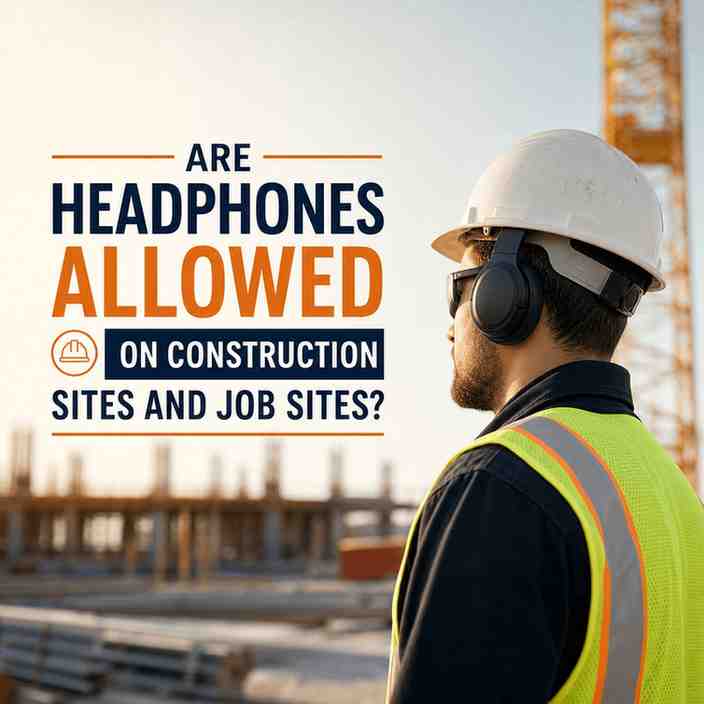
If you’ve ever worked around heavy equipment, you already know the real answer is usually simple: headphones and earbuds are almost never welcome on an active job site.
But the confusing part is the “why,” especially when people start asking things like: Can you wear headphones on a construction site? Are headphones an OSHA violation? Is it illegal to wear headphones at work? Why are AirPods not OSHA approved?
Let’s break it down in plain English, using what OSHA actually says, what most general contractors enforce, and what tends to happen after an incident.

Can you wear headphones on a construction site?
On most active construction sites: no.
Even though there’s no single federal OSHA rule that outright says “headphones are banned,” nearly all general contractors and site managers treat them as a serious safety risk and prohibit them through site policy.
Here’s what drives that decision:
- Construction sites change by the minute.
- Hazards often announce themselves by sound before you see them.
- Supervisors need instant communication and compliance.
So when someone asks, “Can you wear headphones on a construction site?” the practical answer is: almost never on an active job site, and especially not around equipment, lifts, traffic, or demolition.
Why headphones are a concern on active job sites
Headphones are not “just music” on a construction site. They change how you perceive the environment, and that environment can kill you quickly.
1) Loss of situational awareness
A big part of staying alive on a job site is hearing what you can’t see:
- A skid steer backing up
- A forklift beep
- A spotter yelling
- A reversing dump truck
- A crane signal
- “HEADS UP!”
- A falling object warning
- An evacuation horn
Even one missed sound can turn into a serious injury.
2) Communication breakdown
Job sites run on quick, clear communication, including:
- Verbal commands
- Radios
- Pre-task briefings
- Spotter instructions
- Emergency calls
Headphones add friction. Even if a worker claims they can “still hear,” supervisors and safety managers generally can’t gamble on that.
3) They are not PPE (and don’t replace hearing protection)
This is where a lot of people get tripped up.
Noise-cancelling headphones, earbuds, and AirPods are not certified hearing protection. Hearing protection used as PPE is typically:
- Earplugs (properly rated, fitted, and used)
- Earmuffs (properly rated)
If your site requires hearing protection, music earbuds don’t magically become PPE.
Are headphones an OSHA violation?
Not automatically. But they absolutely can become one, depending on the situation.
So if you’re asking, “Are headphones an OSHA violation?” the accurate answer is:
- OSHA does not have a universal federal rule that bans headphones everywhere, but…
- OSHA can cite an employer if headphone use creates a recognized hazard or contributes to an incident.
The “General Duty Clause” reality
OSHA’s General Duty Clause requires employers to keep the workplace free from recognized hazards that can cause serious harm.
If a worker is injured and headphones played a role (missed alarm, didn’t hear a warning, didn’t respond to instructions), OSHA may treat headphone use as evidence that the employer:
- allowed a foreseeable hazard, or
- failed to enforce safe work practices.
That’s why contractors often ban them outright. It reduces risk, simplifies enforcement, and helps protect the employer and the crew.
Is it illegal to wear headphones at work?
In most cases, no, it’s not “illegal” in the criminal sense.
But if you mean “Is it against the rules?” then yes, it often is.
So when people ask, “Is it illegal to wear headphones at work?” the best way to think about it is:
- It’s usually not illegal under law.
- It can be against company policy, against the site’s safety plan, or against contract requirements.
- You can still be removed from site, written up, or terminated for it.
Job site rules override personal preference
Construction sites often operate under layered requirements:
- General contractor rules
- Subcontractor rules
- Owner/client rules (refineries, utilities, government projects)
- Insurance requirements
- Site-specific safety plan
Even if your direct employer “doesn’t care,” the GC likely does. And the GC controls the site.
Why are AirPods not OSHA approved?
This is one of the most common questions, and it’s based on a misunderstanding.
OSHA does not “approve” AirPods. In fact, OSHA does not approve or certify any headphones at all.
So if you’re asking, “Why are AirPods not OSHA approved?” the direct answer is: because OSHA doesn’t approve consumer audio products, and AirPods are not certified hearing protection.
The two big issues with AirPods on job sites
- They’re built for audio and convenience, not hazard control.
- Noise cancelling can make awareness worse, especially around moving equipment and warning alarms.
Even “Transparency” or “Aware” modes don’t solve the main issue: job sites need predictable, enforceable safety practices. AirPods create too many edge cases.
What OSHA actually cares about (even if it doesn’t ban headphones)
OSHA tends to focus on whether the employer:
- identified hazards,
- trained workers,
- enforced policies,
- provided proper PPE,
- controlled risk in a reasonable way.
If headphones are causing workers to miss alarms, walk into swing zones, ignore spotters, or fail to respond to instructions, OSHA’s focus won’t be “the playlist.” It will be: why was this allowed in a high-risk environment?
Why most general contractors ban headphones and earbuds
Even on sites where it might seem “fine,” contractors often set one simple rule: no headphones, no earbuds, no exceptions.
That’s because policies need to be:
- Easy to communicate
- Easy to enforce
- Consistent across trades
- Defensible after an incident
If a GC allows headphones “sometimes,” it creates constant arguments:
- “I only use one earbud.”
- “Mine are OSHA approved.”
- “I had it on low.”
- “It’s bone conduction.”
- “I’m not near equipment.”
Most safety managers avoid all that by banning them across the board.
Are there any situations where headphones might be allowed?
Sometimes, yes, but usually only in controlled environments.
A few examples where some sites may allow limited use:
- Off the active work zone (break areas, lunch)
- Inside a closed cab (and even then many sites still ban it)
- In a low-hazard environment with no mobile equipment and clear communication protocols
- For specific tasks where noise exposure is controlled and communication is not required
Even then, permission typically comes from site management, not personal judgment.
What about bone conduction headphones?
Bone conduction models are often discussed because they leave the ear canal more open. Some companies consider them “less risky” than earbuds.
But realistically, many strict contractors still ban them because:
- They’re still a distraction.
- They still reduce attention.
- They still complicate enforcement.
So yes, bone conduction headphones may be “more acceptable” in theory, but on an active jobsite they’re usually treated the same as earbuds.
Headphones vs. hearing protection: don’t mix them up
If your site requires hearing protection, use hearing protection.
Common compliant options include:
- Disposable foam earplugs (properly inserted)
- Reusable earplugs
- Over-ear earmuffs
- Task-specific protection based on measured noise levels
If you want audio on the job, the right approach is to ask about purpose-built solutions that are designed for industrial environments and policies. But don’t assume any device is compliant just because it’s popular.
What happens if you wear headphones anyway?
On many sites, the consequences escalate quickly:
- Verbal warning
- Written warning or removal from site
- Termination (or the subcontractor gets written up)
And if there’s an incident, headphone use can complicate:
- workers’ comp claims,
- liability,
- OSHA reporting outcomes,
- and insurance investigations.
This is also why “everyone does it” is a risky argument. A lot of unsafe practices are common until the day something goes wrong.
A simple rule of thumb for workers and supervisors
If you’re deciding whether headphones are okay, ask three questions:
- Do I need to hear warnings, alarms, machines, or coworkers instantly?
- Is there mobile equipment, lifting, traffic control, or overhead work nearby?
- Would I feel comfortable explaining this choice after an injury investigation?
If any answer makes you hesitate, headphones are not worth it.
FAQ (the questions people actually ask)
Can you wear headphones on a construction site?
Usually no, because most active job sites ban them by policy due to situational awareness and communication risks.
Are headphones an OSHA violation?
Not automatically, but they can lead to OSHA action if they contribute to a recognized hazard or an incident (often through the General Duty Clause).
Is it illegal to wear headphones at work?
Usually not “illegal,” but it is often against company or site policy, and you can be removed from the jobsite for it.
Why are AirPods not OSHA approved?
OSHA does not approve AirPods (or any headphones). AirPods are consumer audio devices and are not certified hearing protection.
Bottom line
If you’re on an active construction site, assume headphones are not allowed unless site management clearly says otherwise in writing. The risk is not just distraction. It’s missed warnings, slower reactions, broken communication, and higher liability for everyone involved.
When in doubt, follow the site safety plan, ask your supervisor, and use proper hearing protection instead of personal audio devices.
FAQs (Frequently Asked Questions)
Can you wear headphones on a construction site?
On most active construction sites, wearing headphones is not allowed. Although there is no single federal OSHA rule that outright bans headphones, nearly all general contractors and site managers prohibit them through site policies due to safety risks, especially around equipment, lifts, traffic, or demolition.
Why are headphones considered a safety concern on construction sites?
Headphones reduce situational awareness by blocking critical sounds like machinery beeps, spotter instructions, and emergency alarms. They also hinder quick communication necessary for safety and are not certified hearing protection, meaning they don’t replace proper PPE like earplugs or earmuffs.
Are headphones an OSHA violation on construction sites?
Headphone use is not automatically an OSHA violation. However, if wearing headphones creates a recognized hazard or contributes to an incident, OSHA may cite the employer under the General Duty Clause for failing to maintain a safe workplace. This is why many contractors ban headphones outright to reduce risk.
Is it illegal to wear headphones at work?
Wearing headphones at work is generally not illegal in a criminal sense. However, it is often against company policies, site safety plans, or contract requirements on construction sites. Violating these rules can lead to removal from the site, disciplinary action, or termination.
Why are AirPods not OSHA approved for use on job sites?
OSHA does not approve or certify any consumer audio products like AirPods as hearing protection. AirPods are designed for audio convenience rather than hazard control and do not meet the standards required for personal protective equipment (PPE) on construction sites.
What types of hearing protection are approved for use on construction sites?
Approved hearing protection typically includes properly rated and fitted earplugs and earmuffs designed specifically as PPE. These devices protect workers from hazardous noise levels and comply with safety standards enforced on job sites.
