




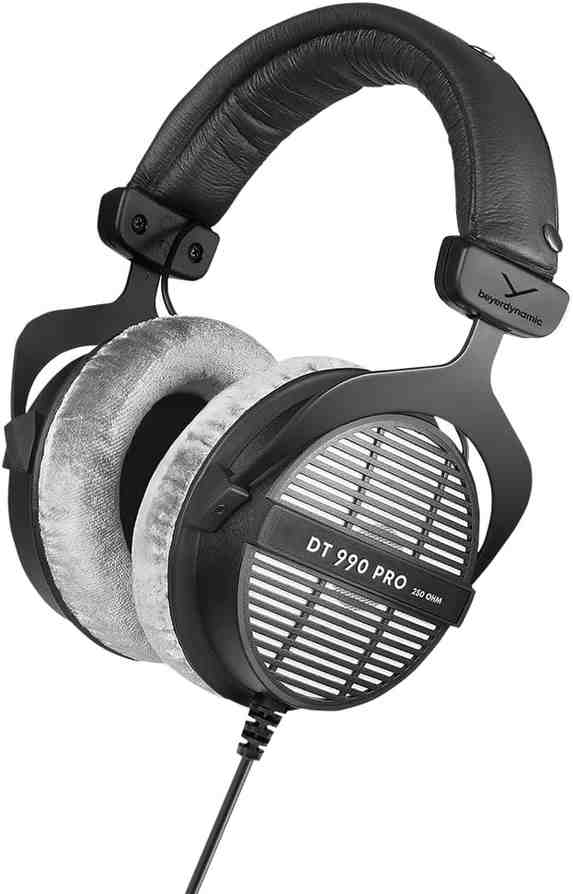
The Beyerdynamic DT 990 Pro is one of the most iconic open-back studio headphones ever built — and today, it still delivers breathtaking soundstage, punchy detail, and legendary comfort at a killer price. But its bright treble, open-back sound leakage, and 250 ohm amp requirements make it a tough sell for everyone. We spent 60+ hours testing it across mixing, gaming, podcasting, and casual listening to give you the full honest picture.
What are DT 990 PRO Headphones used for?
The Beyerdynamic DT 990 Pro is a legendary open-back studio headphone offering a massive soundstage, detailed imaging, and supremely comfortable velour ear pads — all under $200. It excels at mixing, mastering, gaming, and critical listening. However, it has polarizing bright treble that can fatigue treble-sensitive users, it leaks sound badly (no good for shared spaces), the cable is fixed and coiled, and the 250 ohm version needs a proper amplifier or audio interface. Our verdict: It's still one of the best open-back headphones under $200 — but only if you understand its quirks.
Performance Scores
What's Great — And What Isn't
👍 What We Love
- Exceptional wide soundstage for open-back price
- Precise stereo imaging for gaming and mixing
- Incredibly comfortable velour ear pads for long sessions
- Lightweight at just 250g — no neck fatigue
- Replaceable ear pads, headband, and housing parts
- Transparent detail retrieval and resolution
- Great transient response and bass dynamics
- Sturdy spring-steel headband built to last
- Made in Germany — premium build quality
- Outstanding price-to-performance ratio
- EQ-friendly — taming treble is simple
- Available in 80 ohm and 250 ohm versions
👎 What We Don't Love
- Bright, elevated treble causes listening fatigue
- Open-back design leaks sound both ways
- Fixed (non-detachable) coiled cable — harder to repair
- 250 ohm version needs a dedicated amp or interface
- Not suitable for vocal tracking or recording
- V-shaped sound can mislead beginners while mixing
- Sub-bass roll-off — not ideal for bass-heavy music
- Poor noise isolation — zero use in commuting or offices
- Treble peak causes sibilance on some recordings
- No detachable cable (unlike newer DT 990 Pro X)
Who Should Buy the DT 990 Pro? (And Who Should Avoid It)
Not every great headphone is great for you. Here is the honest breakdown by use case:
✅ Buy It If You Are…
A Gamer
The massive soundstage and precise imaging make it incredible for competitive FPS and immersive single-player games.
A Mixing Engineer
The wide soundstage and detail help with panning, reverb, and stereo imaging decisions. Use calibration EQ for best results.
A Podcast Editor
Bright treble reveals sibilance, mouth noise, and background hiss clearly — perfect for audio cleanup workflows.
A Desktop Listener
At home, no isolation issues. Velour pads and wide soundstage make long listening sessions a genuine pleasure.
A Video Editor
Reveals dialogue clarity, ambient noise issues, and audio sync problems in your timeline with ease.
A Music Lover (Rock/Jazz/Classical)
The energetic, detailed sound signature is superb for rock, jazz, classical, and acoustic music with proper amping.
❌ Skip It If You Are…
Recording Vocals
Open-back design bleeds audio into microphones. Use a closed-back like the DT 770 Pro for tracking.
Commuting / Office
Zero noise isolation. You'll hear everything around you, and everyone around you will hear your music too.
Treble-Sensitive Listeners
Cymbals, S-sounds, and bright synths can feel piercing. Consider the DT 900 Pro X or HD 560S for a smoother top-end.
Phone / Laptop-Only Users (250Ω)
The 250 ohm version will sound thin and quiet from a phone. Get the 80 ohm version or a budget DAC/amp.
| User Type | Recommendation | Reason |
|---|---|---|
| Beginner producer | ⚠ With caution | Great detail, but bright treble can mislead your mixes |
| Gamer (FPS/RPG) | ✔ Yes | Best-in-class soundstage and imaging under $200 |
| Casual home listener | ✔ Yes (at home) | Fun, wide sound — just don't use it in public |
| Podcast editor | ✔ Yes | Bright treble reveals audio flaws easily |
| Vocal tracking | ✗ No | Open-back leaks into mic — use DT 770 Pro instead |
| Treble-sensitive listener | ✗ Skip | Upper treble peak causes fatigue without EQ |
| Mastering engineer | ⚠ Use with calibration | Bright sound misleads — use Sonarworks correction |
| Hip-hop / EDM listener | ⚠ Maybe | Sub-bass roll-off reduces the punch of bass-heavy tracks |
Design and Build Quality: A Studio Classic That's Built to Last
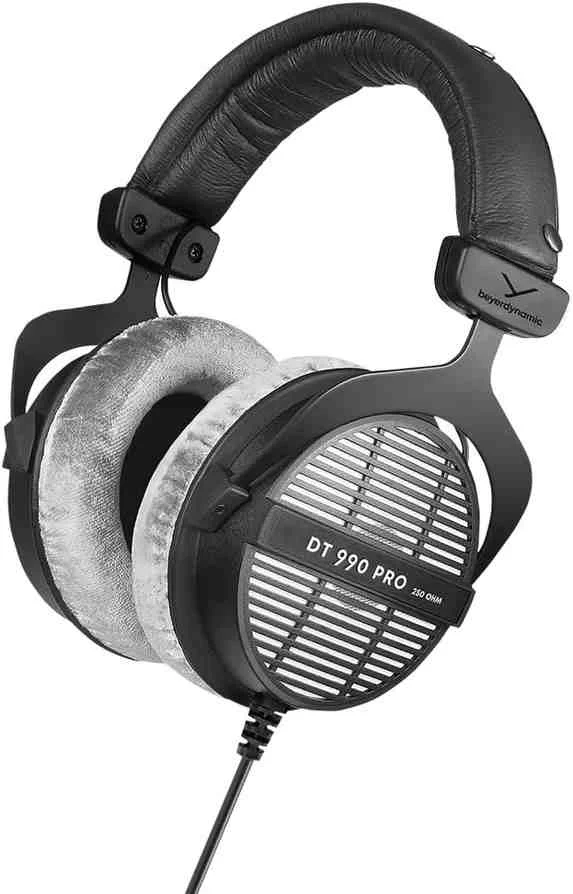
Pick up the Beyerdynamic DT 990 Pro and you feel it immediately — this is a professional headphone. The spring-steel headband flexes without feeling flimsy. The grey plastic housing feels solid, not hollow. At just 250g, it's one of the lightest over-ear wired headphones in this category.
Beyerdynamic makes this headphone in Germany. You can feel that in the material quality. Every part — the velour ear pads, the headband padding, the housing — is a replaceable spare part. That's a major long-term ownership advantage most budget headphones simply cannot match.
The coiled cable runs about 3 meters long and terminates in a 3.5mm jack with a screw-on 6.35mm adapter included. The cable is not detachable — this is the DT 990 Pro's biggest build limitation compared to newer models like the DT 990 Pro X.
Can You Wear These for 8 Hours Straight?
Almost, yes. The velour ear pads on the DT 990 Pro are genuinely remarkable. They breathe — no sweaty ears after two hours. The 250g weight means you forget you're wearing them during long sessions. This is a genuine advantage over headphones like the Sony MDR-7506 or even the Sennheiser HD 650.
We wore these for 4-hour gaming sessions, a full day of podcast editing, and a 3-hour mixing session — zero neck strain, zero clamp discomfort. Velour pads stay soft even after months of use, though they will compress over time and may need replacement after 1-2 years of heavy use. The good news? Replacement pads are available directly from Beyerdynamic.
For glasses wearers: the low clamp force helps. A hard glasses frame can still create a small air gap that reduces bass perception slightly. We'd still rate this as one of the most glasses-friendly headphones in this category.
🕐 Long Session Comfort (Our Test)
👓 Glasses Comfort Rating
Tested with thin-frame glasses (full day, 7 hours).
Low clamp force and velour pads reduce frame pressure noticeably.
How Does the DT 990 Pro Actually Sound?
Let's be clear about one thing: the DT 990 Pro does not have a flat, neutral frequency response. It has a V-shaped / U-curve sound signature — boosted bass, slightly recessed mids, and very elevated treble. This makes it exciting and engaging, but not "accurate" in the studio monitor sense.
Think of it as an analytical-but-fun headphone. It tells you everything that's happening in your audio — but with a heavy emphasis on the top and bottom ends.
🔊 Bass Response
The bass on the DT 990 Pro is punchy and present in the mid-bass range (60–200 Hz). You feel bass guitar, kick drums, and low-end instruments with satisfying weight and controlled impact. Sub-bass (below 50 Hz) rolls off gradually — you won't feel rumbling sub-bass like you would on bass-boosted consumer headphones.
🎙️ Midrange
The lower midrange has some recession — vocals and instruments can sound slightly distant compared to close-mic recordings. However, there's still excellent note weight and fullness, especially in the 500 Hz – 2 kHz range. Upper mids are more forward, giving guitars, pianos, and vocals good presence. Instrument separation is impressive at this price.
⚡ Treble Response — The Polarizing Feature
The DT 990 Pro treble is the most discussed aspect of this headphone — and for good reason. There is a pronounced peak around 8–10 kHz that makes cymbals shimmer, adds sparkle to guitars, and reveals microphone sibilance instantly. For detail-oriented listeners, this is thrilling. For treble-sensitive people, it can be fatiguing after 30–60 minutes.
We tested it on jazz (lots of cymbals), orchestral recordings, and electronic music. On jazz, the hi-hats were almost uncomfortably present. On electronic music, the brightness added energy. On female vocals, sibilance could get piercing. This is not a smooth or forgiving headphone up top.
🌐 Soundstage & Imaging
The open-back acoustic design creates one of the widest soundstages in the under-$200 category. Instruments position themselves clearly left, right, center, forward, and back — exceptional for orchestral recordings, live albums, and competitive FPS gaming where enemy footsteps must be pinpointed.
⚡ Transient Response
Transient response — how fast the driver reacts to sharp sounds like snare hits or plucked strings — is impressive. Attack is fast and clean. This makes the DT 990 Pro feel precise and energetic, not slow or smeared. Very useful for mixing percussion and examining audio transients.
Is the DT 990 Pro Treble Too Harsh? Here's the Fix
The short answer: it depends on your ears and your sources. Many audiophiles love the bright, revealing sound. Many others find it fatiguing after an hour. The good news? The DT 990 Pro is extremely EQ-friendly. A small reduction in one frequency range transforms it into a balanced, natural-sounding headphone.
Our Recommended DT 990 Pro EQ Settings
Is the DT 990 Pro Good for Mixing and Mastering?
This is a question we get asked constantly on TechOzea. The answer is nuanced. Yes, you can mix on the DT 990 Pro — and many professional producers do. But you need to understand its character to use it well.
The wide soundstage makes panning decisions and reverb depth easy to judge. The high detail retrieval means you'll hear background noise, compression artifacts, and timing issues very clearly. The imaging accuracy is excellent for stereo placement.
✅ What It's Good For in the Studio
- ✔ Checking stereo panning and width
- ✔ Detecting background noise and hiss
- ✔ Analyzing compression artifacts
- ✔ Checking reverb tail decay and depth
- ✔ Judging instrument separation and layering
- ✔ Spotting clicks, pops, and edits
⚠ Be Careful With…
- ⚠ High-frequency (air band) EQ decisions
- ⚠ Overall brightness/treble balance of mix
- ⚠ Sub-bass decisions (roll-off hides bottom end)
- ⚠ Low-end translation to consumer speakers
- ⚠ Mastering final loudness (use monitors too)
For best results, use the DT 990 Pro with Sonarworks SoundID Reference to flatten its frequency response. This turns it into a remarkably accurate critical monitoring tool while keeping all the detail and soundstage benefits.
Watch: DT 990 Pro Studio Listening Test
Beyerdynamic DT 990 Pro audio demo — open-back soundstage test and studio listening impressions.
Is the DT 990 Pro Good for Gaming? (Spoiler: Yes, Very.)
If you want to know whether the DT 990 Pro is worth it for gaming — the short answer is: absolutely yes. This is one of the best open-back headphones for gaming under $200, and here's why.
The open-back design creates that wide, natural soundstage that makes games feel truly 3D. In competitive FPS titles like CS2, Valorant, or Escape From Tarkov, you can hear footsteps approaching from different floors, directional gunfire, and environmental cues with uncanny precision. The DT 990 Pro's stereo imaging is excellent for positional audio — significantly better than most gaming headsets at this price.
Switched from a $120 gaming headset to the DT 990 Pro and my CS2 rank went up two divisions in a month. I can literally hear enemies repositioning through walls. The soundstage is unreal.
For RPGs like Elden Ring and Baldur's Gate 3, the DT 990 Pro makes the soundscapes feel completely immersive. Worth every penny for single-player gaming at a desktop setup.
| Game Type | DT 990 Pro Performance | Rating |
|---|---|---|
| Competitive FPS (CS2, Valorant) | Exceptional positional audio, footstep clarity | ★★★★★ |
| Battle Royale (Warzone, Apex) | Wide soundstage helps with loot and enemy detection | ★★★★★ |
| Single-player RPG / Open World | Immersive, spacious, cinematic audio experience | ★★★★★ |
| Horror Games | Sound details and spatiality are terrifying (in a good way) | ★★★★★ |
| Racing / Sports | Engine sounds and crowd noise are satisfying and detailed | ★★★★☆ |
| Mobile / Casual (phone) | 250Ω underpowered on phone — use 80Ω version | ★★★☆☆ |
DT 990 Pro 80 Ohm vs 250 Ohm: Which Version Should You Buy?
This is the single most important decision when buying the DT 990 Pro — and most reviews gloss over it. Here's the simple answer:
🎯 Choose 250 Ohm if you use a dedicated headphone amp, studio audio interface, or desktop DAC/amp combo.


| Feature | 80 Ohm | 250 Ohm |
|---|---|---|
| Best Source | Phone, laptop, gaming PC | Headphone amp, audio interface |
| Loudness from phone | Loud enough | Too quiet / thin |
| Volume from laptop | Comfortable | May need max volume |
| Sound with proper amp | Good | Slightly more dynamic |
| Cable | Straight cable (~3m) | Coiled cable (~3m) |
| Best for mixing | With small interface | With studio amp/interface |
| Best for gaming | PC headphone jack friendly | Use with amp/DAC |
| Best for casual use | More flexible sources | Needs amp |
| Price | Similar | Similar |
Sound differences between the two versions are subtle with a proper amp. The 250 ohm version tends to have slightly more controlled bass and a fraction more headroom at high volumes. For most people, the 80 ohm is the smarter and more flexible purchase unless you're sure you own a capable amp.
Do You Need an Amp for the DT 990 Pro?
For the 80 ohm version — mostly no. It works decently from a laptop, phone, or gaming PC. For the 250 ohm version — yes, strongly recommended. Here's a practical breakdown:
I made the mistake of buying the 250 ohm DT 990 Pro to plug into my laptop without an amp. It sounded thin and lifeless. Added a FiiO E10K and it was a completely different headphone — full, dynamic, and wide. Don't skip the amp!
The 80 ohm version works perfectly through my Focusrite Scarlett 2i2. No separate amp needed. Using it for podcast editing and it's honestly transformed my audio quality compared to my old ATH-M50x.
DT 990 Pro vs The Competition: How Does It Stack Up?
DT 990 Pro vs DT 770 Pro: Open vs Closed
| Feature | DT 990 Pro (Open-Back) | DT 770 Pro (Closed-Back) |
|---|---|---|
| Design | Open-back | Closed-back |
| Soundstage | Wide, natural, immersive | Narrower, more intimate |
| Noise isolation | None | Good passive isolation |
| Sound leakage | Significant — hear & be heard | Very little |
| Vocal tracking | ❌ Mic bleed | ✔ Safe for recording |
| Gaming | Better imaging | Good but narrower |
| Commuting / Office | ❌ Not practical | Good |
| Bass | Extended bass | Slightly more punch |
| Impedance options | 80 / 250 Ω | 32 / 80 / 250 Ω |
| Cable | Fixed coiled | Fixed coiled |
| Best for | Mixing, gaming, home listening | Recording, commuting, office |

DT 990 Pro vs DT 900 Pro X: Classic vs Modern
| Feature | DT 990 Pro | DT 900 Pro X |
|---|---|---|
| Impedance | 80 / 250 Ω | 48 Ω (easier to drive) |
| Cable | Fixed | Detachable (mini-XLR) |
| Driver | Classic Tesla dynamic | STELLAR.45 driver |
| Sound signature | Bright, V-shaped | More balanced, smoother treble |
| Amp requirement | Yes (250Ω) | More source-flexible |
| Price | ~$169 (lower) | ~$299 (higher) |
| Value | Better budget option | Better if budget allows |
| Repairability | Good | Excellent (detachable cable) |
Our take: If budget allows, the DT 900 Pro X is the better-engineered headphone. But if you already own a decent amp and want the classic wide Beyerdynamic soundstage at a lower price, the DT 990 Pro is still outstanding value.
DT 990 Pro vs Sennheiser HD 560S
| Feature | DT 990 Pro | Sennheiser HD 560S |
|---|---|---|
| Sound signature | Bright V-shape, exciting | More neutral, flatter |
| Treble | More elevated / sharper | Smoother, less fatiguing |
| Soundstage | Wider | Good but narrower |
| Bass | More bass presence | Slightly leaner |
| Impedance | 250 Ω (needs amp) | 120 Ω (more flexible) |
| Comfort | Velour, very comfy | Very comfy also |
| Best for mixing | With EQ | More accurate out of box |
| Best for gaming | Wider soundstage wins | Good |
DT 990 Pro vs Audio-Technica ATH-M50x
| Feature | DT 990 Pro | ATH-M50x |
|---|---|---|
| Design | Open-back | Closed-back |
| Soundstage | Much wider | Narrow (closed-back) |
| Bass | Extended but not boosted | More bass impact |
| Noise isolation | None | Good |
| Portability | Not portable | More portable |
| Comfort (long sessions) | Better — velour pads | Okay — pleather pads |
| Amp needed | Yes (250Ω) | No — 38Ω |
| Best use case | Studio / gaming / home | Portable / studio hybrid |
Best Beyerdynamic DT 990 Pro Alternatives
Not sure the DT 990 Pro is right for you? Here are the best alternatives based on specific needs:
Best Upgrade: DT 900 Pro X
Detachable cable, 48Ω, smoother sound, STELLAR.45 driver. Worth the extra ~$130 if you want a modern headphone.
🛒 Check PriceMore Neutral: Sennheiser HD 560S
Flatter response, smoother treble. Better if you're treble-sensitive. Still great soundstage for the price.
🛒 Check PriceFor Recording: DT 770 Pro
Closed-back, great isolation. Perfect for vocal tracking, recording, and commuting. Same quality build as DT 990 Pro.
🛒 Check PriceAudiophile Pick: DT 880 Pro
Semi-open, more balanced sound between DT 770 and DT 990. A great middle ground for critical listening and studio monitoring.
🛒 Check Price🎧 Which Headphone Is Right for You?
Answer 4 quick questions and we'll tell you whether the DT 990 Pro is your match — or point you to something better.
Your Best Match:
🛒 Buy on AmazonHow I Tested the Beyerdynamic DT 990 Pro
Credibility matters. Here's exactly what we did:
🎵 Music Listening Tests
- Jazz (Miles Davis — detailed imaging test)
- Classical (Beethoven Symphony No.9 — soundstage)
- Electronic / Hip-Hop (sub-bass extension test)
- Rock (Radiohead — treble and distortion)
- Acoustic guitar (string detail and timbre)
- Female vocals (sibilance and harshness test)
🔌 Source Devices Tested
- MacBook Pro headphone jack
- Samsung Galaxy S24 (USB-C dongle)
- Focusrite Scarlett Solo (3rd gen)
- FiiO E10K DAC/amp
- PlayStation 5 controller
- PC motherboard headphone output
🎮 Gaming Tests
- CS2 — footstep detection, directional audio
- Elden Ring — ambient soundscape immersion
- Warzone — positional gunfire accuracy
- Minecraft — spatial audio test (Java edition)
⏱️ Comfort & Long-Session Tests
- 2-hour gaming sessions (3 sessions)
- 4-hour mixing session in DAW
- Full workday podcast editing (7 hours)
- Glasses-wearing test (thin frames, day use)
- Sound leakage test (phone dB meter at 1 meter)
Long-Term Ownership: Built to Last and Repair
One of the best things about the Beyerdynamic DT 990 Pro is that it's designed to be repaired, not replaced. This matters when most headphones in this price range are essentially disposable.
| Part | Replaceable? | Approx. Cost | Where to Buy |
|---|---|---|---|
| Velour ear pads | ✔ Yes | ~$25 pair | Beyerdynamic.com |
| Headband padding | ✔ Yes | ~$20 | Amazon or Beyerdynamic |
| Cable | ⚠ Yes but harder | ~$30–40 | Beyerdynamic direct |
| Housing | ✔ Yes | ~$35 per side | Beyerdynamic direct |
| Spring steel band | ✔ Yes | ~$25 | Beyerdynamic direct |
Tip: Velour pads should be replaced every 12–18 months with heavy use. Worn pads reduce bass response and change the headphone's sound character significantly. Fresh pads will make old DT 990 Pros feel like new.
Beyerdynamic DT 990 Pro: Still a Legend
After 60+ hours of testing across mixing, mastering, gaming, podcasting, video editing, and casual music listening, here is our honest conclusion: the Beyerdynamic DT 990 Pro is still one of the best open-back headphones you can buy under $200 — if you know what you're getting into.
It rewards users who want a wide soundstage, exceptional detail, long-session comfort, and repairability. It punishes users who expect a balanced, neutral sound, need isolation, want portability, or have treble-sensitive ears. It also punishes users who don't pair it with the right source, especially the 250 ohm version.
In a world where the DT 900 Pro X exists, the DT 990 Pro is no longer the only Beyerdynamic answer. But for the price, the classic DT 990 Pro is hard to beat — especially when it goes on sale. If you're a gamer, a producer with an amp, or a detail-hungry desktop listener, stop reading and just buy it.

→ Also available: 80 Ohm version (better for laptops/phones)
Frequently Asked Questions
Everything people ask about the DT 990 Pro — answered clearly.
The 250 ohm DT 990 Pro strongly benefits from a dedicated headphone amplifier or audio interface. A laptop headphone jack will produce acceptable but flat, underpowered sound. The 80 ohm version works better from smartphones, laptops, and USB dongles without an amp. For best results with the 250 ohm version, pair it with an entry-level DAC/amp like the FiiO E10K or a Focusrite Scarlett audio interface.
The DT 990 Pro works for mixing due to its wide soundstage, strong detail retrieval, and excellent stereo imaging. However, its V-shaped sound signature with elevated treble can cause beginners to reduce highs too much in their mixes. Use it as a reference tool alongside studio monitors. For accurate mixing, apply calibration EQ using Sonarworks SoundID Reference to flatten its response curve. Always cross-check your mix on multiple playback systems.
The 80 ohm version is easier to drive and works well with laptops, smartphones, small audio interfaces, and gaming PCs. The 250 ohm version requires more power but rewards you with slightly more controlled dynamics and headroom when paired with a proper amplifier or audio interface. For home studio and mixing use, the 250 ohm is preferred. For portable, casual, or laptop-only use, the 80 ohm is the smarter pick. The 80 ohm comes with a straight cable while the 250 ohm comes with a coiled cable.
Yes, the Beyerdynamic DT 990 Pro is excellent for gaming. Its wide open soundstage and precise stereo imaging help you pinpoint footsteps, gunfire, and environmental cues in competitive FPS games like CS2 and Valorant. The open-back design creates a natural, immersive sense of space ideal for single-player games. It does not have a microphone, so you'll need a separate mic for voice chat. Also note that the open-back design leaks sound, making it poor for gaming in shared rooms.
For treble-sensitive listeners, yes. The DT 990 Pro has a notable treble peak around 8–10 kHz that can cause listening fatigue, sibilance on vocals, and piercing highs on cymbals. If you find bright headphones uncomfortable, apply EQ: reduce -3 to -5 dB around 8–10 kHz using Equalizer APO, Peace EQ, or Sonarworks SoundID Reference. On Android, Wavelet app has a built-in DT 990 Pro correction profile. This simple adjustment transforms the headphone into a balanced, enjoyable listen.
Choose the DT 990 Pro if you want an open-back soundstage for mixing, gaming, or desktop listening in a private space. Choose the DT 770 Pro if you need noise isolation for recording vocals, commuting, working in an office, or using headphones in shared environments. The DT 770 Pro is closed-back and blocks external sound. Both have the same Beyerdynamic bright sound signature. If you record vocals or podcasts, the DT 770 Pro is the must-buy — open-back headphones bleed sound into microphones.
Yes, for the right buyer. The Beyerdynamic DT 990 Pro is still one of the best open-back headphones under $200. It offers detailed sound, a wide soundstage, excellent comfort with velour ear pads, and replaceable parts for long-term value. Newer options like the DT 900 Pro X offer a more modern feature set with detachable cables and easier driveability. But the DT 990 Pro remains outstanding value for producers, gamers, and critical listeners who already own a proper amplifier or audio interface.
Yes. The DT 990 Pro's bright treble is actually an advantage for podcast editing. It makes mouth noise, sibilance, plosives, and background hiss easier to detect and clean up in your DAW. The wide soundstage also helps you judge stereo placement and room reverb clearly. Just avoid using it for recording podcasts with a microphone — the open-back design leaks sound into the mic. Use a closed-back headphone like the DT 770 Pro for recording, and switch to the DT 990 Pro for post-production editing.
Mostly yes. The DT 990 Pro's low clamp force and soft velour ear pads reduce pressure on glasses frames compared to tighter headphones like the Sony MDR-7506 or ATH-M50x. However, glasses wearers may notice slightly reduced bass response if the frames create an air gap in the ear seal, and comfort may degrade after 4+ hour sessions as velour compresses. Overall, it's one of the more glasses-friendly headphones in the professional category due to its lightweight design and self-adjusting spring-steel headband.
For a budget DAC/amp, the FiiO E10K (~$75) or Schiit Fulla (~$99) are excellent and affordable choices. For studio use, the Focusrite Scarlett Solo or any entry-level audio interface drives the DT 990 Pro 250 ohm very well. For a dedicated desktop headphone amp, the JDS Labs Atom+ (~$99) or Schiit Magni (~$109) are popular audiophile recommendations that won't break the bank. Avoid phone dongles and gaming controller headphone jacks for the 250 ohm version.
