


The Soundcore Liberty 5 Pro is arriving at exactly the right moment for the wireless audio market. Instead of promising only slightly better sound or a slightly nicer case, Anker is pitching the new Liberty 5 Pro and Liberty 5 Pro Max as earbuds that make everyday tasks easier: clearer calls, stronger adaptive noise cancellation, on-device voice commands, and even meeting transcription from the case itself.
That makes this launch more interesting than a routine earbud refresh, especially for normal buyers who use earbuds for commuting, Zoom calls, workouts, podcasts, and travel, not just audiophile listening.
That framing matters because the premium earbud market has become crowded and predictable. Sony, Bose, Apple, Samsung, and Sennheiser already dominate the conversation around ANC, comfort, and ecosystem perks. So for Soundcore to stand out in 2026, it needs more than a “better than last year” spec sheet.
Its answer is the new THUS AI chip, which the company says powers better environmental noise cancellation, smarter voice control, improved personalization, and the kind of call quality that even earned Guinness certification under an objective speech-quality test.
For Techozea readers, that opens up a more useful question than “are these good earbuds?” The better question is: do the Liberty 5 Pro and Pro Max point to where the earbud market is going next? If the answer is yes, then this launch matters even if you never buy a Soundcore product, because it hints at what shoppers may soon expect as standard: stronger call performance, less dependence on phone apps, more on-device AI, and smarter charging cases that finally do something meaningful.

What happened
Anker officially introduced two new models this week: the Soundcore Liberty 5 Pro at $169.99 and the Soundcore Liberty 5 Pro Max at $229.99. Both are built around the company’s new THUS chip, and both target the familiar premium true-wireless wishlist: ANC, better call performance, multipoint pairing, better personalization, and better controls.
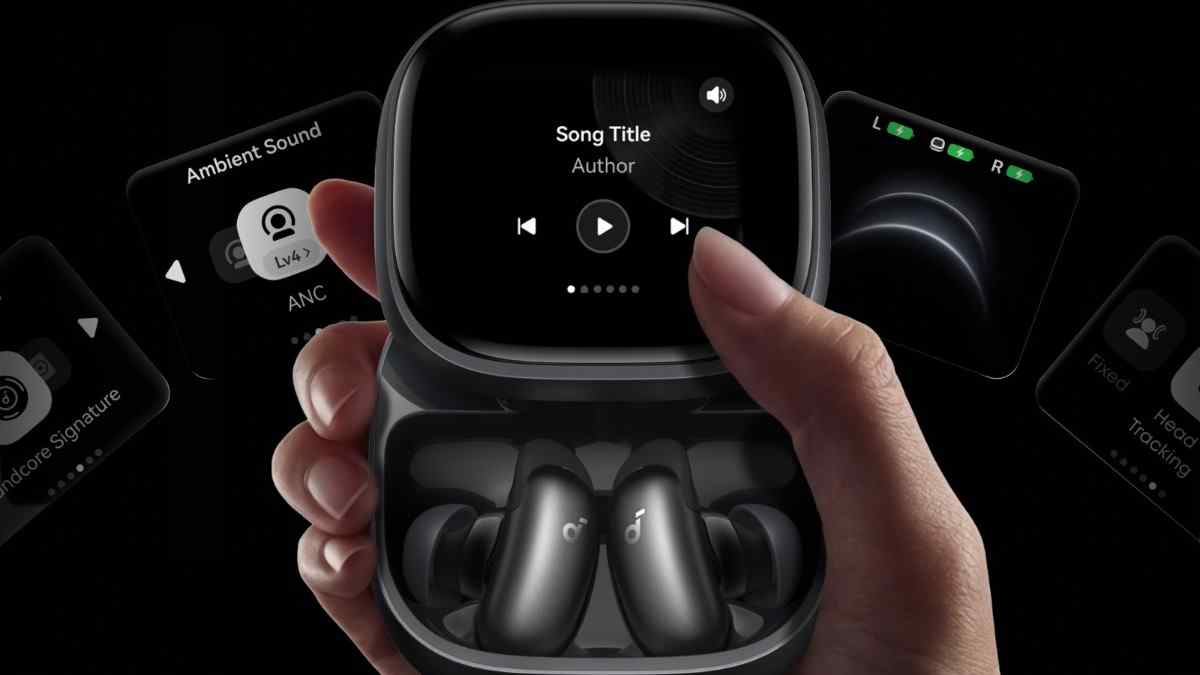
The Pro Max adds the flashier feature set, including a larger 1.78-inch AMOLED case display and an AI Note-Taker that can record meetings, generate transcripts, identify speakers, and surface action items through the Soundcore ecosystem.
The hardware story is just as important as the marketing story. Soundcore says the new earbuds combine 8 microphones and 2 bone-conduction sensors with THUS to better separate a user’s voice from surrounding noise.
That is the heart of the launch message: not just “these sound better,” but “these work better in the messy real world,” whether you are taking a call on a train platform, dictating a note, or walking through a loud street.
Engadget also notes that both models support Bluetooth 6.1, Apple Find My, Google Fast Pair, IP55, and multipoint connectivity, which helps make this feel like a serious mainstream product line rather than an experiment.
The ANC claims are aggressive. Soundcore says Adaptive ANC 4.0 processes sound data up to 384,000 times per second and can deliver up to 2x deeper cancellation than the Liberty 4 Pro. Those are clearly brand claims rather than independent comparative verdicts, but they still matter because they show what companies now believe shoppers care about.
Five years ago, earbud launches were built around codecs, battery hours, and water resistance. In 2026, brands increasingly lead with a mix of ANC, voice clarity, AI controls, and cross-device convenience.
It also helps that early coverage was not limited to press-release rewrites. CNET’s hands-on review gave the standard Liberty 5 Pro an Editors’ Choice award and praised the earbuds’ value, voice-calling ability, and feature set, while Mashable highlighted the practical appeal of using the case itself to adjust ANC, EQ, and pairing settings without always opening an app. That is exactly the kind of user-centered detail that can make a launch more than hype.
Why it matters
The biggest reason this launch matters is simple: Anker is treating call quality as a flagship feature, not a side benefit. That is a much smarter approach than many earbud launches still take. For a lot of buyers, the most frustrating thing about wireless earbuds is not mediocre bass or overly bright treble; it is that the microphones fall apart the minute the environment gets noisy.
A pair of earbuds that sounds good in a quiet room but makes you impossible to hear outdoors is not a premium experience. Soundcore is clearly betting that everyday buyers care more about that problem than tech brands sometimes admit.
That makes the Guinness angle important, even if it needs careful wording. Soundcore did not receive a fuzzy lifestyle award or vague “best of CES” recognition here. It says the Liberty 5 Pro achieved the highest objective TWS speech-quality score in Guinness testing. For consumers, that does not guarantee these will become everyone’s favorite earbuds.
But it does give the call-quality story more credibility than a normal marketing superlative. Used correctly in an article, this is a good example of how to separate a test-backed claim from generic brand puffery.
The second reason it matters is the smart case. Earbud cases have mostly done the same job for years: recharge the earbuds, show battery status, disappear into a pocket. Soundcore is pushing that formula further.
On the Liberty 5 Pro, the case display gives users easier access to settings. On the Pro Max, the case becomes part remote, part recorder, part interface layer.
That matters because companion apps are one of the most annoying parts of wireless audio. Most buyers do not want to open an app every time they want to adjust ANC or check a setting. If a case can remove friction rather than add gimmicks, that is real value.
The third reason is the broader shift toward on-device AI. Soundcore’s official THUS page emphasizes compute-in-memory design, local voice-control processing, and AI features that can run without punting every action to the cloud. That matters in two ways.
First, it can improve responsiveness: if a command works locally, it should feel faster and more reliable. Second, it shapes user expectations. Buyers are becoming more skeptical of “AI” as a buzzword, so practical use cases like better call isolation and quicker commands matter more than abstract model talk.
Finally, this matters because of price positioning. At $170 and $230, Soundcore is not trying to undercut the market with a bargain-bin play. It is trying to look like a serious alternative to Sony, Bose, Apple, and Samsung while still undercutting the highest flagship pricing.
That is a much stronger editorial angle for Techozea than another generic “best earbuds” list, because it lets you answer the real shopper question: does this launch make premium earbuds feel smarter without becoming overpriced?
Industry or market context
This launch is landing in a market where earbuds are becoming more important than over-ear headphones for the average buyer. SoundGuys, citing Bluetooth market data, reported this week that Bluetooth headphone shipments are projected to decline while earbuds continue to grow.
If that forecast holds up, it helps explain why brands are loading more and more value into earbuds rather than saving their best innovation for over-ear models. Earbuds are where growth is, and growth attracts the most aggressive feature development.
You can also see that shift in what competitors are doing. Samsung is reportedly preparing the Galaxy Buds Able, a clip-style open-ear product that would give the company a more obvious answer to Bose, Sony, Anker, and Huawei in the situational-awareness segment.
That rumor is important not because it directly competes with the Liberty 5 Pro, but because it shows the market widening into multiple earbud subcategories at once: sealed ANC buds, open-ear clip buds, gym-first buds, translation buds, and now AI-note-taking buds. The category is fragmenting, and brands need a clearer identity than “good sound.”
There is also a timing story here. Soundcore is asking consumers to think about a full-price launch during a week when Memorial Day promotions are making competing gear look very attractive.
PCMag’s current roundup features discounts on Sony, Bose, Sennheiser, and Apple audio gear, while AppleInsider is highlighting a fresh AirPods Pro 3 sale. That means Soundcore is not only competing against current products; it is competing against discounted status symbols. If the Liberty 5 Pro line still cuts through the noise under those conditions, that is a sign the launch has real traction.
For Techozea specifically, this is a useful moment to connect news to evergreen buyer intent. Readers who land on a news piece about the Liberty 5 Pro are often only one step away from broader decision-making: whether ANC matters, whether call quality matters more than soundstage, whether they should buy open-ear or in-ear models, and whether spending above $150 is really worth it.
That is why this topic naturally supports internal links to your guides on active noise cancelling, best earbuds for phone calls, and how to choose wireless earbuds.
The other important context is that “AI audio” is no longer a novelty label. We are now seeing AI framed as part of core product experience: cleaning up calls, automating transcripts, restoring audio detail, speeding voice commands, and adapting listening profiles. Some of that will prove more useful than other parts.
But the key shift is that brands are no longer pitching AI as a bonus. They are pitching it as a reason to upgrade. That is exactly why this launch deserves analysis instead of a simple specs recap.
Key risks or challenges
The first challenge is that some of the most attention-grabbing claims are still brand-framed. “150× computing power,” “2x deeper cancellation,” and the broader promise of AI-enhanced personalization all sound impressive, but they need careful context.
In a good article, these should be presented as official claims, not independent verdicts. That does not weaken the piece; it improves its credibility. Readers are far more likely to trust analysis that distinguishes between what a company says and what reviewers have actually verified.
The second challenge is feature usefulness. The AI Note-Taker on the Pro Max sounds genuinely interesting, but it also risks being the kind of feature people admire in a product demo and rarely use in practice.
Buyers will need to decide whether they actually want meeting capture and summaries from an earbud case or whether that crosses into over-designed territory. The feature is easy to market because it is unusual. The harder question is whether it becomes part of someone’s weekly routine.
Privacy is another issue. According to the PRNewswire release, the Pro Max case can record locally, but transcription is handled through a cloud workflow where audio is deleted after processing.
That is not inherently bad, but it matters. A useful article should not oversimplify that distinction. For some readers, it will be fine. For others, especially professionals handling sensitive conversations, it could be a deal-breaker or at least something they would want to evaluate before using the feature.
Then there is the competitive challenge. At $170 and $230, Soundcore is operating in a zone where shoppers can easily cross-shop other heavily reviewed products, especially when sales are live.
If someone can buy discounted Sony, Bose, or Apple gear in the same week, Soundcore needs more than a neat chipset story. It needs day-to-day convenience that is obvious enough to overcome brand inertia.
The good news for Soundcore is that the early reviews suggest it may actually have that, especially on call quality and feature depth. The bad news is that this is still a market where many consumers default to the biggest brand they already know.
What to watch next
The first thing to watch is whether more reviews confirm the microphone advantage. That is the cleanest path for the Liberty 5 Pro story to keep growing beyond launch day.
If multiple independent reviewers keep saying the same thing CNET, Mashable, and What Hi-Fi? are implying now — that these earbuds are unusually strong for calls — then Soundcore will have a durable market position that is much easier to explain than a vague “AI-powered” brand message.
The second thing to watch is whether the smart case concept spreads. JBL has already experimented with screen-equipped earbud cases, and now Soundcore is pushing the idea further into productivity.
If consumers respond positively, we may look back on 2026 as the year earbud cases stopped being battery boxes and became mini control hubs. If buyers ignore the feature, then these cases may remain interesting but niche.
The third thing to watch is competitor response. Samsung’s Galaxy Buds Able rumors show at least one big player moving toward a different answer — open-ear comfort and awareness rather than AI-heavy sealed buds.
Sony, meanwhile, is expanding upward with its newly official 1000X THE COLLEXION, showing that premium audio brands still believe there is room for higher-end positioning too. In other words, the market is not converging on one formula. It is testing several at once.
And finally, watch price pressure. If the Liberty 5 Pro performs well but the market remains discount-driven around Sony, Bose, and Apple, Soundcore may eventually have to lean harder on promotions.
That would not necessarily be bad. In fact, if these earbuds start getting reviewed as class leaders for calls and later pick up holiday discounts, they could become one of the easiest recommendations in the mainstream premium segment.
Conclusion
The Soundcore Liberty 5 Pro is not just another pair of wireless earbuds trying to sound a little better than last year’s model. It is a much clearer attempt to solve the parts of wireless audio that frustrate people most: weak call microphones, annoying app dependence, and limited usefulness outside music playback.
The Liberty 5 Pro Max goes further by turning the case into part of the product experience, not just an accessory.
That does not mean every claim should be taken at face value. Buyers should still separate official marketing from independent long-term testing, especially around ANC depth, AI performance, and how useful the note-taking workflow really feels outside demos.
But as a news story, this launch is meaningful because it captures where the earbud market is heading: less focus on raw feature counts, more focus on real-world utility.
If you are comparing options right now, the Liberty 5 Pro line looks especially interesting for buyers who care about calls, commuting, remote work, and day-to-day convenience more than brand prestige.
And if you are not buying today, it is still a launch worth watching, because it may end up influencing what the rest of the market tries next. For deeper buying context, Techozea readers should also check What Is Active Noise Cancelling?, 10 Best Earbuds For Phone Calls, and How To Choose Wireless Earbuds.
FAQS
Is the Soundcore Liberty 5 Pro officially available now?
Yes. Multiple launch reports say the Liberty 5 Pro and Liberty 5 Pro Max are available now, and official Soundcore pages are live.
How much do the Soundcore Liberty 5 Pro and Pro Max cost?
The Liberty 5 Pro is priced at $169.99, while the Liberty 5 Pro Max is priced at $229.99.
What is the difference between the Liberty 5 Pro and Liberty 5 Pro Max?
The earbuds themselves are very similar, but the Pro Max adds a larger 1.78-inch AMOLED smart case and the AI Note-Taker feature for recording, transcription, and summaries.
What is THUS in the Soundcore Liberty 5 Pro?
THUS is Anker’s new AI chip platform for on-device audio processing. Soundcore says it enables better call clarity, local voice commands, adaptive ANC, and sound personalization.
Are these really the best earbuds for calls?
The safest wording is that Soundcore says the Liberty 5 Pro achieved the highest objective speech-quality score for TWS earbuds in a Guinness World Records test. That supports the call-quality story, but it is still smart to wait for more independent long-term comparisons before declaring them universally best for everyone.
Should everyday buyers care about the AI features?
Yes, but selectively. Clearer calls, faster voice commands, and easier case-based controls could be genuinely useful. The AI note-taking feature is more situational and will matter most to students, remote workers, and people who actually record meetings or lectures.
