




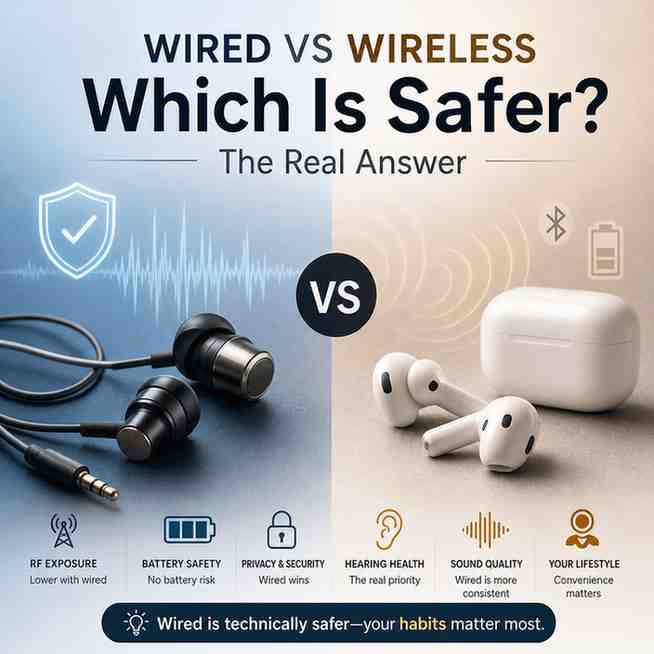
Wired headphones are technically safer than wireless ones because they remove Bluetooth RF-EMF exposure and avoid lithium-ion battery risks. But for most people, the biggest real risk is still hearing damage from loud volume and long listening.
This guide breaks down “radiation,” battery safety, privacy, hearing health, and the real-life tradeoffs so you can pick what fits your day.
The short, honest answer
Are wired headphones actually safer? Yes, wired headphones are technically safer than wireless ones in two specific ways: they do not use Bluetooth radio signals, and they do not need a battery in the headset.
But “safer” can mean a few different things, so let’s name them:
- RF-EMF (often called “radiation”): Wired eliminates Bluetooth from the headphones. Wireless uses low-power Bluetooth.
- Battery hazards: Wired has no lithium-ion battery in the earbuds or headset. Wireless does, plus a charging case.
- Privacy and security: Wired is private by nature. Wireless is encrypted, but it has more ways to go wrong.
- Hearing health: Both can hurt your hearing the same way if you listen too loud for too long.
Here’s the real takeaway: wired removes a couple of small risks, but the biggest day-to-day risk for both is noise-induced hearing loss. If you only fix one thing, fix volume and listening time first.
In this article, I’ll cover radiation and EMF exposure, batteries, security, hearing, hygiene and comfort, sound quality and latency, Gen Z’s wired comeback, and a simple decision framework.
What “radiation” from headphones actually is (and what it isn’t)
When people say “radiation,” they often imagine something like X-rays. That is not what Bluetooth is.
Bluetooth uses radiofrequency electromagnetic fields (RF-EMF). In simple terms, it is a kind of energy that travels through the air, like Wi‑Fi and radio. It is also called non-ionizing radiation.
Ionizing vs non-ionizing, in plain English
- Ionizing radiation (like X-rays and UV at certain levels) can break chemical bonds in your body. This is the kind people worry about with DNA damage.
- Non-ionizing radiation (like Bluetooth, Wi‑Fi, and cell signals) does not have enough energy to break those bonds in the same way.
Bluetooth runs in the 2.4 GHz band, the same neighborhood as Wi‑Fi. But “frequency” is not the whole story. Power level matters a lot.
What changes your exposure
Your RF exposure from a wireless headset depends on:
- Power level: Bluetooth is designed to be low power, especially for earbuds.
- Distance: Closer to your body usually means more exposure to that body part.
- Duty cycle: Bluetooth transmits in quick bursts, not as a constant blast.
- Duration: Hours per day matters more than a few minutes.
On cancer and DNA claims: you will see strong opinions online. The honest truth is this: the evidence around low-level RF and long-term health is debated, and research quality varies by study type and exposure type. But Bluetooth specifically is generally low power, and health agencies set limits with safety margins.
Are wired headphones less radiation than wireless?
Yes. If we are talking about RF “radiation” from Bluetooth, wired headphones are less radiation than wireless in a very direct way: they do not broadcast audio through the air.
Wired headphones: signals stay in the wire
With wired headphones, audio travels as an electrical signal through a cable:
- 3.5mm analog (old-school headphone jack)
- USB-C or Lightning (digital audio, usually with a tiny DAC somewhere in the chain)
The headphones themselves are not acting like a radio transmitter. So when people ask, “Are wired headphones less radiation than wireless?” the clean answer is: yes, for RF-EMF from the headset.
Wireless headphones: audio is a radio link
Bluetooth headphones must transmit and receive a radio signal to work. That signal is RF-EMF.
One important nuance: your phone is often the bigger RF device in your life anyway. It can be transmitting:
- Cellular (often higher power than Bluetooth)
- Wi‑Fi
- Bluetooth
So wireless headphones add a source near your head, but they are not the only source in the room.
Bluetooth power classes, simply
Bluetooth devices can have different power levels (often described as “class”). Most earbuds aim for low power to save battery and reduce heat. In real life, that usually means short range and modest output, not “mini cell towers in your ears.”
Are Bluetooth headphones “safe” according to health authorities and standards?
Under current guidelines, Bluetooth headphones are generally considered safe for everyday use. Bluetooth exposure is typically far below international public limits.
Different groups play different roles here:
- WHO (World Health Organization): reviews broad public health evidence and research trends.
- FDA (U.S. Food and Drug Administration): comments on consumer safety topics and coordinates with other agencies.
- IARC (International Agency for Research on Cancer): classifies hazards based on evidence strength, not personal risk in daily life.
- ARPANSA (Australia) and similar national bodies: publish practical RF guidance and explain exposure limits.
What “exposure limits” actually mean
Exposure limits are built with safety margins. They are meant to cover the general public, including people who may be more sensitive. Limits often consider:
- Localized exposure (near the body)
- Whole-body exposure
- Conservative assumptions about use
This is why you’ll often hear the “within limits” phrasing. It means: based on what we know and how limits are set, typical Bluetooth use is not expected to cause harm.
Common claims: “Bluetooth causes cancer” or “DNA damage”
For low-power Bluetooth specifically, there is no solid, widely accepted evidence that typical use causes cancer. That does not mean “nothing is worth studying.” It means the loudest claims online usually run far ahead of what the evidence can actually prove.
If you still feel uneasy, you do not need to panic. You can lower exposure with simple habits, which brings us to the practical part. For instance, embracing wearable technology like Bluetooth headphones can be a safer alternative while still enjoying the benefits of modern tech.
Simple ways to reduce RF exposure (without panic)
If your main worry is RF-EMF, you can reduce it fast without turning your life upside down.
Use wired mode when it’s easy
Clear opinion: If you do long calls or long work sessions, wired is the simplest “set it and forget it” choice. Practical reason: no Bluetooth link near your head. Buyer context: great for students, remote work, and anyone who wears headphones for hours.
Use airplane mode for offline listening (when it fits)
If you’ve downloaded your music or podcast, you can:
- Turn on airplane mode
- Use wired headphones
Note: airplane mode matters for RF only if it actually turns off the radios you care about. Also, Bluetooth must be off if your goal is “no Bluetooth.”
If you stay wireless, do the easy stuff
- Don’t sleep with earbuds in every night.
- Take breaks on long listening days.
- During calls, avoid pressing the phone to your head. Use speakerphone or a wired mic if that’s your concern.
Low-EMF “air tube” headphones and marketing traps
Air tube headsets use a small air tube near the ear to reduce metal wiring close to your head. Some people like them for peace of mind.
But be careful with “anti-radiation headphone” marketing. Clear opinion: If a product promises to “block all radiation” without tradeoffs, be skeptical. Practical reason: blocking RF usually changes how signals work, and wild claims often come without good test data.
Big tradeoff reminder: reducing RF is easy, but hearing protection matters more day to day.
Battery safety: the underrated reason wired can be safer
This is the safety topic that gets less attention, but it is very real.
Wired: no battery, fewer failure modes
Wired headphones do not need lithium-ion batteries inside the earbuds or headset. That means you avoid risks like:
- Battery swelling
- Overheating during charging
- Charging case failures
Wireless: rare problems, but they can be serious
Wireless earbuds pack small lithium-ion cells in:
- Each earbud
- The charging case
Most of the time, this is fine. But failures can happen, and when lithium-ion fails, it can fail fast.
Practical safety habits that actually help:
- Buy reputable brands and avoid obvious fakes.
- Do not use damaged cables, cases, or chargers.
- Do not charge on a bed, couch, or pillow where heat gets trapped.
- If anything swells, smells odd, or gets unusually hot, stop using it.
Also, battery dependence can cause a weird behavior issue: when people only have one earbud left or the battery is low, they sometimes crank volume to “make it count,” especially in noisy places. That is a hearing risk, not a battery risk, but it happens.
Privacy and security: wired wins by design
Clear opinion: wired is safer for privacy because it does not broadcast. Practical reason: you would need physical access to intercept it. Buyer context: great for commuters, office work, and anyone who just wants fewer settings to manage.
Wireless is not “unsafe,” but it is a bigger target surface:
- Pairing mistakes
- Firmware bugs
- Occasional Bluetooth vulnerabilities
- Companion apps that collect data
Realistic vs theoretical: most people will never be “hacked through earbuds.” Still, sloppy pairing in public places is not impossible.
Simple Bluetooth hygiene:
- Keep headphone firmware updated.
- Reject random pairing requests.
- Turn off Bluetooth when you are not using it.
- Be picky with companion apps and permissions.
Which is better for your health, wired or wireless headphones?
Which is better for your health, wired or wireless headphones? If we are talking about what sends people to hearing doctors, the answer is not about cables. It is about volume and time.
How hearing damage actually happens
Noise-induced hearing loss is mostly about:
- How loud
- How long
- How often you do it
The tricky part is that your ears adapt. So you might think, “It doesn’t feel that loud.” In a noisy gym, train, or street, that feeling can fool you.
ANC can be a safety tool (when it’s good)
Active noise cancellation (ANC) and passive isolation can help because they reduce background noise. Clear opinion: good ANC can make wireless headphones safer for hearing in loud places. Practical reason: you do not need to blast volume to hear details. Buyer context: commuters and travelers get the biggest win here.
But there’s a flaw: weak ANC can frustrate you and push volume up anyway. Fit matters too.
Over-ears often help people listen quieter
Over-ear headphones often seal better and feel less harsh at lower volumes. Earbuds can be fine, but only if they fit well. A leaky fit makes you raise volume.
Practical habits that protect hearing:
- Use a volume limiter on your phone.
- Take short breaks each hour on long sessions.
- Avoid “one earbud only” in noisy places. People often turn the single ear louder.
- For kids, set hard limits and use headphones that fit well.
Hygiene, comfort, and ear health: earbuds vs over-ears matters more than wired vs wireless
Ear health problems often come from the shape and wear style, not the connection type.
Earbuds: more moisture, more gunk, more irritation
In-ear earbuds can trap moisture and warmth. That can raise the risk of irritation and infections, especially if you:
- Work out in them
- Wear them all day
- Reuse dirty tips
Cleaning basics that work:
- Wipe silicone tips often with a slightly damp cloth and let them dry.
- Replace foam tips when they get worn.
- Clean over-ear pads too. They hold sweat and skin oils.
Comfort also changes how loud you listen. If earbuds create pressure, the occlusion effect can make your own voice and footsteps sound boomy. That can increase fatigue.
Safety angle: do not share earbuds. If you must, swap to fresh tips and clean them.
Sound quality and reliability
Clear opinion: wired still wins on predictability. Practical reason: no wireless compression or signal dropouts. Buyer context: best for people who hate fuss, or who want consistent sound every time.
Wired audio
With wired, you avoid:
- Codec limitations
- Wireless interference
- Random dropouts
- Multi-device switching glitches
You also get a consistent audio path, whether it is analog (3.5mm) or digital (USB-C/Lightning).
Wireless audio
Bluetooth typically uses codecs like:
- SBC (basic)
- AAC (common on phones)
- aptX family (varies by device)
- LDAC (higher bitrate options)
Even when it sounds great, it often involves compression. “Hi-Res” claims can be real in a technical sense, but many people will not notice on a subway or in a busy office. The flaw is that marketing can make it sound like a night-and-day upgrade when it is sometimes a small one.
Still, some modern wireless headphones sound excellent. The difference is this: wired is consistent, wireless is variable.
Latency and pro use-cases
Latency is the tiny delay between what happens on screen and what you hear.
- For casual video, you may not care.
- For gaming, editing, and music work, you absolutely will.
Wired is close to zero-latency and stable. Wireless “low latency” modes can help, but results depend on the codec, the device, and the environment. Dropouts and delay spikes are annoying, and they can push people to turn volume up out of frustration. That is not a huge effect, but it is real in long sessions.
Why does Gen Z like wired headphones?
Why does Gen Z like wired headphones? Part of it is style, but a lot of it is practical.
- Fashion and identity: wired earbuds are visible. They look intentional.
- Plug-and-play: no pairing, no “where did my earbuds connect?” moments.
- No charging: they work when you grab them.
- Cheaper to replace: especially basic wired buds.
- Perceived health angle: some people want less Bluetooth near the head, even if the risk is low.
- Creator life: wired is simple for filming, monitoring, and quick setups.
The big downside is modern phones. Many need a USB‑C or Lightning adapter since the headphone jack is gone. Some people hate that. Others accept it because the trade feels worth it.
Wired vs wireless: which is better for your health in real life?
If you want a clean way to decide, match the headset to your main worry.
If your #1 concern is RF-EMF exposure
Choose wired, or use wireless less. Wired is the straightforward solution for long sessions.
If your #1 concern is hearing protection
Pick the option that helps you listen quieter: strong passive seal or good ANC, plus a comfortable fit you will actually wear.
If your #1 concern is charging and battery safety
Wired wins. Wireless can still be safe, but only if you charge smart and replace damaged gear.
If your #1 concern is privacy and security
Wired minimizes risk. Wireless requires basic Bluetooth hygiene and sane app permissions.
If your #1 concern is lifestyle
Wireless is great for commuting, workouts, and travel. Fewer snags, easier movement. Wired is simpler and reliable, but cables can be annoying in motion.
Hybrid and “best of both” options
You do not have to pick one forever. Hybrid setups are often the sweet spot.
Dual connectivity
Many over-ear wireless headphones also support a cable. That lets you:
- Go wireless outside
- Plug in at home or at work for long sessions
Important caveat: “wired mode” is not always the same thing.
- True passive wired means the headphones work like normal wired headphones even if the battery is dead.
- Active wired means the cable is connected, but the headphones still use internal electronics (sometimes even still powered on).
If your goal is “zero RF from the headset,” passive wired is cleaner. If your goal is “no dropouts and less hassle,” active wired can still help.
A realistic example
People search models like QCY H3 Pro, so here’s how I’d think about it without pretending one model fits everyone.
Check:
- Does it support wired listening, and is it passive or active?
- Does it support the codecs you care about (AAC, aptX, LDAC), if you care at all?
- Is ANC strong enough for your commute, or just “light”?
- Is it comfortable after 2 hours, not just 5 minutes?
- How’s the mic in real rooms, not lab tests?
Buying checklist that saves regret:
- Comfort and clamp force
- Seal quality (huge for bass and hearing safety)
- ANC quality (if you commute)
- Codec support (only if you’re picky)
- Mic quality for calls
- Durability and easy-to-find replacement pads
- Battery behavior and charging case build (for earbuds)
- Return policy
Bottom line
Wired headphones are technically safer than wireless ones because they eliminate Bluetooth RF-EMF from the headset and avoid lithium-ion battery risks in the headphones themselves. Wireless headphones are still considered safe for typical use under current exposure limits, according to major health and standards bodies.
But the #1 safety move for almost everyone is simple: protect your hearing. Lower the volume, limit long sessions, and use isolation or ANC so you do not fight background noise.
If EMF worries are on your mind, go wired for long sessions and sleep. If convenience keeps you listening calmer and more comfortably, pick solid wireless and use it wisely. That’s the real answer.
FAQs (Frequently Asked Questions)
Are wired headphones safer than wireless ones?
Yes, wired headphones are technically safer than wireless ones in two specific ways: they eliminate Bluetooth radiofrequency electromagnetic field (RF-EMF) exposure and do not contain lithium-ion batteries, thus avoiding battery-related risks. However, for most users, the primary safety concern remains hearing damage from loud volume and prolonged listening.
What kind of radiation do Bluetooth headphones emit?
Bluetooth headphones emit non-ionizing radiofrequency electromagnetic fields (RF-EMF), which are low-power radio waves similar to those used by Wi-Fi and cell phones. Unlike ionizing radiation such as X-rays, this type of radiation does not have enough energy to break chemical bonds or cause DNA damage.
How does RF-EMF exposure from wireless headphones compare to wired ones?
Wired headphones do not emit RF-EMF because audio signals travel through a physical cable rather than over the air. Wireless headphones use Bluetooth technology that transmits low-power RF-EMF signals near your head. Despite this, the overall exposure is generally low and within safety limits set by health authorities.
Are Bluetooth headphones considered safe by health organizations?
Yes, Bluetooth headphones are generally considered safe for everyday use according to health authorities such as the World Health Organization (WHO), U.S. Food and Drug Administration (FDA), and other international agencies. The exposure levels typically fall well below established public safety limits.
What are the main risks associated with wireless headphone batteries?
Wireless headphones contain lithium-ion batteries both in the earbuds and often in charging cases. These batteries carry potential risks such as overheating, swelling, or fire hazards if damaged or improperly handled. Wired headphones do not have batteries in the headset, eliminating these specific risks.
What is the biggest real risk when using either wired or wireless headphones?
The most significant risk for both wired and wireless headphone users is noise-induced hearing loss caused by listening at loud volumes for extended periods. Managing volume levels and limiting listening time are crucial steps to protect hearing health regardless of headphone type.
