




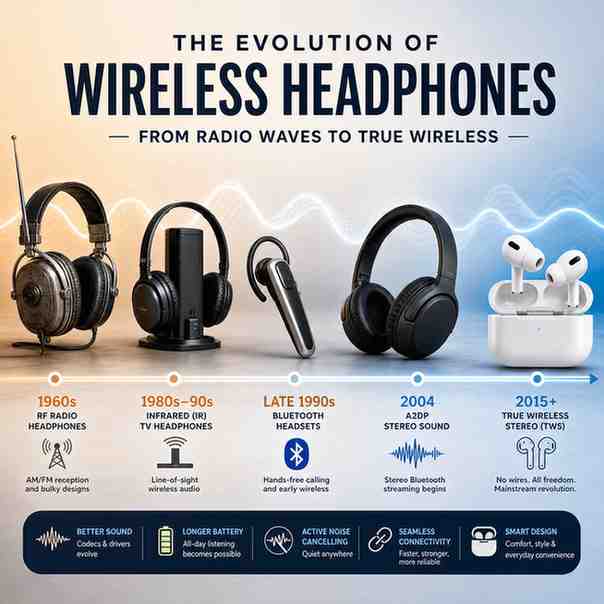
Wireless headphones were “invented” in different eras depending on what you mean by wireless. If you mean headphones that receive audio without a cable from the source, the earliest consumer-style wireless headphones show up in the 1960s as bulky over-ear AM/FM “radio headphones” using radio frequency (RF) reception.
If you mean Bluetooth wireless headphones, those arrive in the late 1990s for calls, then become practical for music in 2004 when A2DP enables stereo Bluetooth streaming. If you mean true wireless earbuds (no wire between left and right), that category takes off in 2015+ and hits its mainstream moment with Apple AirPods in 2017.
Based on our testing of modern wireless models, the “real breakthrough” wasn’t the first RF headset, it was when wireless became easy, stable, and good enough for everyday music and calls.
Before wireless: the headphone origins that made it possible (late 1800s to 1950s)
Wireless headphones didn’t start with radio. They started with the basic idea that you could put a small speaker close to your ear and get private sound.
In the late 1800s and early 1900s, listening devices grew out of telephone and medical concepts. Early “stethoscope-like” listening and telephone-era earpieces helped shape what we now call headphones, especially the idea of a transducer turning electrical signals into sound right at your ear.
A few names matter here because they reflect how incremental the invention was:
- Ernest Mercadier is often cited for early in-ear style concepts and miniaturized earpieces in the telephone era.
- Ezra Gilliland is linked with early telephone listening equipment and headset-style ideas.
- Nathaniel Baldwin is famous for early high-quality headphone designs that were used in military contexts, proving headphones could be more than a novelty.
This period matters because “wireless” is only useful if the headphone itself is good enough. Early designs struggled with what we now take for granted: usable loudness, decent clarity, and consistent tuning.
A quick, practical audio-engineering lens helps explain why. Early headphones were limited by:
- Impedance: how hard a load the headphone is for the source to drive. Early sources were inconsistent and weak.
- Sensitivity: how loud the headphone gets for a given power level. Low sensitivity made early designs feel quiet.
- Frequency response: how evenly headphones reproduce bass, mids, and treble. Early drivers were rarely balanced, so “hi-fi” wasn’t the goal yet.
By the 1950s, headphone drivers and manufacturing improved enough that the next step made sense: remove the cable.
1960s–1980s: the earliest wireless headphones (radio frequency + AM/FM “radio headphones”)
The earliest widely cited wireless headphones category is the 1960s-era RF “radio headphones”. These weren’t “wireless” the way we use the word now. They often had a radio receiver built into the headphones, sometimes with an AM/FM antenna, turning the headset into a self-contained radio you wore on your head.
They were wireless from a source cable perspective, but not from a device ecosystem perspective. You weren’t streaming from a phone. You were wearing the radio.
The trade-offs were obvious:
- Interference and noisy reception were common, especially in crowded RF environments.
- Many models were mono, and even stereo units rarely sounded “hi-fi.”
- Range depended on signal strength, not a clean digital link like modern Bluetooth.
- Comfort was a challenge because early designs were often bulky circumaural (over-ear) builds with heavy clamps and simple padding.
Still, the use case was real. These products matched a particular buyer: someone who wanted portable listening without carrying a separate radio and wired headphones.
This era also pushed early thinking about form factor:
- Over-ear vs on-ear (supra-aural) affected comfort and leakage.
- Closed-back vs open-back affected isolation. Closed designs helped block outside noise but could sound boxy if poorly tuned. Open designs felt airy but leaked sound and offered little isolation.
Even if these weren’t mainstream music headphones, they established the basic promise: audio without a cable.
1980s–1990s: infrared (IR) wireless headphones for TV—and why they didn’t take over music
In the 1980s and 1990s, infrared (IR) wireless headphones became common in home setups, especially for TV. The system was usually simple: a base station connected to a television sent audio via IR light, and the headphones received it.
IR solved some RF problems. You usually got less radio interference, and the link could be stable in the right room. However, IR came with limitations that made it a poor fit for portable music:
- Line of sight mattered. Block the path, and audio could cut out.
- Walls stopped the signal, so whole-home use was limited.
- Sunlight and bright lighting could cause interference.
- You needed the transmitter base, so it wasn’t “grab-and-go.”
This is where “connectivity” became the real missing piece. For wireless headphones to replace wired headphones for most people, you needed a universal, low-power standard that phones, computers, and music players would all support.
Around this time, passive isolation improved through better ear pads and early in-ear tips. Active noise cancelling ideas existed, but it still wasn’t a mainstream consumer feature.
1990s–early 2000s: Bluetooth is born (Bluetooth SIG, early headsets, and the Hands-Free era)
Bluetooth was created to solve a practical problem: short-range, low-power wireless communication between devices.
The Bluetooth Special Interest Group (Bluetooth SIG) formed in 1998, with major companies aligning around a shared standard. The early consumer success wasn’t stereo music. It was hands-free calling.
Early Bluetooth “headphones” were mostly single-ear headsets built around:
- A headset profile / hands-free calling experience
- A pairing process that often felt clunky by today’s standards
- Basic controls: call answer/end, volume, sometimes mute
The limitations were real:
- Bandwidth was limited, so audio quality was usually fine for voice but not for music.
- Early codec performance (often SBC) could sound thin or artifact-heavy.
- Battery life was short, and standby behavior was inconsistent.
- Latency wasn’t a big deal for calls, but it mattered for video and games.
On the industry side, Ericsson played a foundational role in early Bluetooth development, and ecosystems like CSR (Cambridge Silicon Radio) chips helped Bluetooth accessories scale by making it easier for manufacturers to build compatible products.
For buyers at the time, Bluetooth was a convenience feature. If you mostly wanted calls, it was useful. If you cared about music quality, wired still won.
2004 is the turning point: A2DP makes stereo Bluetooth headphones practical
2004 is the year wireless headphones start to look like “modern” wireless headphones, because A2DP (Advanced Audio Distribution Profile) enables stereo Bluetooth streaming.
This matters because it shifted Bluetooth from “phone accessory” to “music listening option.” Not perfect yet, but finally pointed in the right direction.
Codecs became the next bottleneck. A2DP made stereo possible, but what you heard depended on compression and device support:
- SBC is the baseline Bluetooth codec. It works everywhere, but quality varies by implementation.
- AAC can sound very good depending on your phone and headphones, and it became important in certain ecosystems.
- AptX (and later variants) targeted better sound and latency, but support depends on both source and headphones.
In practice, the perceived sound quality was shaped by the whole chain: codec + drivers + tuning + DSP. Even now, based on our testing, a well-tuned headphone on a basic codec can beat a poorly tuned headphone with a “better” codec.
Early stereo Bluetooth also had stability quirks. Many designs used a kind of master–slave relay where one side received the signal then forwarded it to the other ear. That design could cause dropouts in challenging environments, especially with body blockage and crowded radio space.
Did Bluetooth headphones exist in 2007? (Yes—here’s what they were like)
Yes, Bluetooth headphones existed in 2007, including both call-focused headsets and some stereo Bluetooth models. However, the day-to-day experience was nothing like what you expect today.
Typical 2007 drawbacks included:
- Pairing that felt like a mini-ritual: hold buttons, watch blinking LEDs, hope the device shows up
- Noticeable compression artifacts on music, especially in busy tracks
- Connectivity that could be unstable in pockets, on the street, or near other wireless devices
- Shorter real-world battery life and slower charging
- Bulkier designs with awkward controls and stiff earpieces
That’s why many people stuck with wired headphones. The 3.5mm jack was universal, reliable, cheap, and frictionless. You plugged in and pressed play.
The context also matters. The iPod era was still dominant, and early smartphones were growing but not yet the always-streaming slabs we have now. Wireless was a niche upgrade, not the default.
2000s–2010s: the portable music revolution (Walkman → iPod) sets the stage for wireless
Wireless adoption wasn’t just about radio standards. It was about behavior.
The Sony Walkman normalized private portable listening. The iPod scaled that habit globally. Then smartphones made audio an always-on layer, tied to messages, calls, videos, and work.
In that world, the 3.5mm jack became the universal standard because it was simple and compatible across brands. That said, its later removal from many mainstream phones changed buyer math overnight. If your new phone didn’t have a headphone port, wireless stopped being optional for many people.
This period also pushed in-ear design forward:
- Basic earbuds gave way to in-ear monitors (IEMs) with silicone tips.
- A better seal improved perceived bass and isolation.
- Comfort and fit became part of “sound quality” because a poor seal can make any earbud sound thin.
A couple wired milestones are worth mentioning for context. Koss helped popularize stereo headphones for consumers, and models like the Sennheiser HD 414 showed that lighter open designs could be comfortable for long listening. These wired gains created expectations that wireless eventually had to match.
Noise cancelling evolves: from Bose to modern Active Noise Cancelling (ANC)
Active Noise Cancelling (ANC) became a key reason wireless headphones stopped feeling like a compromise.
ANC works by using microphones and digital signal processing (DSP) to create “anti-noise” that reduces steady sounds like engine rumble and HVAC. It’s different from passive isolation, which is just physical blocking from ear cups or ear tips.
Bose is a major historical anchor here, especially with early noise-cancelling designs aimed at travel and aviation-style environments. ANC started as a specialist feature. It became mainstream when wireless headphones gained enough battery and processing headroom to run ANC without terrible downsides.
That’s also the trade-off: ANC costs power, and it can change the sound if tuning is poor. Based on our testing, the best wireless models balance three things at once: quiet, stable connectivity, and a tuning that still sounds natural with ANC on.
Voice tech improved too. Call-focused noise reduction systems (often marketed with terms like CVC) helped microphones isolate speech, which matters if you take calls on the street or in open offices.
2015–present: True Wireless Stereo (TWS) arrives (Bragi Dash → AirPods)
True Wireless Stereo (TWS) means no cable between the earbuds. Each earbud is its own device, and they coordinate wirelessly for left-right audio and controls.
An early signal of the category was The Bragi Dash (2015). TWS existed before it was polished, and early models often struggled with stability, fit, and battery reliability. Still, it proved the form factor could work.
The mainstream inflection point was Apple AirPods (2017). AirPods didn’t invent TWS, but they made it feel effortless for mainstream buyers:
- Pairing became simple and fast inside a phone ecosystem
- Connection stability improved in real-world use
- The charging case made battery management practical
- The form factor became socially normal, not geeky
TWS also forced design trade-offs into the open. In-ear fit can be secure and isolating, but it can also cause pressure or fatigue depending on your ears. That’s why modern brands offer multiple tip sizes, venting, and different shapes depending on your needs.
When did wireless headphones get popular? (2016–2020: the adoption curve)
Wireless headphones became popular well after they were invented. For most people, mass adoption really accelerated around 2016–2020.
This wasn’t one magic product feature. It was multiple improvements landing at the same time:
- Better Bluetooth stability and power efficiency
- Better small batteries and charging cases
- Smoother user experience and faster pairing
- ANC becoming mainstream in over-ear Bluetooth headphones
- Phone ecosystem pressure, including headphone jack removal
Culture mattered too. Beats and the broader “headphones as fashion” trend helped normalize spending more on headphones, not only for sound but also for lifestyle positioning.
Category split is still important for buyers:
- Over-ear Bluetooth became the go-to for ANC, travel, and long listening sessions.
- TWS earbuds became the default for portability, calls, and daily carry.
Depending on your needs, the “popular” moment may have looked different. Commuters often adopted ANC over-ears early. Students and office workers often moved faster to TWS.
Bluetooth 5.0 and modern wireless: what actually improved (range, stability, latency)
Bluetooth kept getting better, but Bluetooth 5.0 is a convenient marker for the modern era because it improved the basics most people actually feel day to day.
In plain terms, newer Bluetooth generations generally brought:
- More robust connectivity and fewer dropouts in real environments
- Better power efficiency, which translates to smaller earbuds and longer battery life
- Better range in some scenarios, though walls and interference still matter
It also helps to understand the audio pipeline at a high level. What you hear is shaped by: Bluetooth link + codec + headphone DSP + driver quality. If any part is weak, the experience suffers.
Latency is the other modern concern. Video and casual listening usually hide latency well enough, but gaming and some music workflows expose it. “Low latency” only works if both your source device and headphones support the right codec and settings, so it’s something you should check before buying.
Device switching got better too. Multipoint and smoother handoff features can be a quality-of-life upgrade if you bounce between a laptop and phone all day, even if brand implementations still vary.
Why are Gen Z ploughing their headphones in? (culture + convenience + identity)
Gen Z didn’t invent wireless headphones, but they’ve made them a default public accessory.
Headphones now work as a social signal. They can mean “do not disturb,” even in busy spaces. They also create micro-privacy in public, which matters when you’re commuting, studying, or just trying to decompress.
Convenience is the practical reason. TWS earbuds are always with you, charging cases are easy, and you can take a call or play a video without thinking about cables.
Features align with modern habits:
- Seamless connectivity matters when your phone is your main computer.
- ANC helps in cafés, trains, and shared homes.
- Transparency modes (the concept of letting outside sound in) help you stay aware while still wearing earbuds.
- Comfort matters because people wear headphones for hours, not minutes.
Design shifted to fit that identity. Smaller earbuds, more colors, stronger branding, and the expectation that you can leave the house with enough battery for the whole day changed what “good” looks like.
Wireless vs wired: audio quality, codecs, and the 3.5mm jack debate (audiophile perspective)
A fair comparison comes down to trade-offs.
Wired still wins on fundamentals:
- Consistent bandwidth with no wireless interference
- No lossy Bluetooth compression
- No battery anxiety
- Easy integration with dedicated amps and DACs
Wireless wins for most people because it bundles the modern features:
- Convenience and mobility
- ANC and transparency integration
- Built-in mics and call processing
- Practical everyday usability across devices
Codecs are the usual flashpoint. SBC vs AAC vs AptX differences can be audible, but it depends on your phone, your headphones, and what you listen to. Some people hear artifacts immediately. Others don’t care, especially on podcasts and casual playlists.
High-resolution audio claims need context. Some wireless setups can deliver very good quality, but “hi-res” depends on codec support, implementation, and the headphone’s tuning. Even in 2026, the fundamentals still matter more than marketing:
- Driver type (dynamic, planar magnetic, electrostatic)
- Tuning and DSP (sound signature often matters more than specs)
- Impedance and sensitivity (more critical for wired with amps)
- Open-back vs closed-back trade-offs in staging, isolation, and leakage
If you’re buying for sound first, wired remains the simplest path. If you’re buying for daily life, wireless is usually the better fit depending on your needs.
Other wireless branches: bone conduction and niche form factors
Not all wireless headphones follow the Bluetooth earbud lineage.
Bone conduction headphones send vibrations through your cheekbones, bypassing the ear canal. The practical reason to care is safety and awareness. You can hear traffic and conversations more naturally, which is why they’re popular for running and cycling.
A recognizable mainstream name here is AfterShokz, now commonly known as Shokz.
The trade-off is sound. Bass perception is typically weaker, and isolation is minimal. Still, they’re part of the broader wireless evolution because they show how “wireless audio” keeps expanding into different needs, not only music fidelity.
The evolution in one clean timeline (inventors, standards, and product milestones)
- 1890s–1910s: Early headphone concepts and listening devices (Mercadier, Gilliland, Baldwin)
- 1960s: Earliest consumer-style wireless “radio headphones” using RF/AM/FM reception
- 1980s–1990s: Infrared (IR) wireless TV headphones become common in homes
- 1998: Bluetooth SIG formed
- 1999: Early Bluetooth headsets appear for hands-free calling
- 2004: A2DP enables practical stereo Bluetooth headphones for music
- 2007: Bluetooth headphones exist but are still niche and clunky
- 2015: Bragi Dash helps define early mainstream TWS category
- 2017: AirPods mainstream moment for true wireless earbuds
- 2019–present: ANC, Bluetooth 5.x maturity, better batteries, and better UX drive mass adoption
A helpful note: “who invented the first headphones” and “who invented wireless headphones” don’t have one clean inventor. This history is mostly incremental engineering plus a few big standardization moments.
Wrap-up: so, when were wireless headphones invented—and what counted as the real breakthrough?
Wireless headphones arrived in three big phases. The earliest wireless headphones appeared in the 1960s as RF-based radio headphones. Modern wireless headphones arrived in the late 1990s to early 2000s with Bluetooth, with 2004 (A2DP) as the turning point for stereo music. True wireless became the new default in 2015+, with AirPods in 2017 serving as a mainstream catalyst, making it clear that wireless technology was here to stay.
If you’re really asking when wireless headphones became a normal purchase for most people, that popularity wave hit in the late 2010s as Bluetooth, batteries, and user experience finally got effortless. The next improvements will keep coming, but the biggest leap was making wireless feel as reliable as a cable.
FAQs (Frequently Asked Questions)
When were wireless headphones first invented?
Wireless headphones were first introduced in the 1960s as bulky over-ear AM/FM radio headphones using radio frequency (RF) reception, allowing audio without a cable from the source.
What distinguishes early wireless headphones from modern Bluetooth models?
Early wireless headphones in the 1960s used radio frequency reception and often included built-in AM/FM radios, whereas modern Bluetooth headphones, arriving in the late 1990s and becoming practical for music by 2004 with A2DP stereo streaming, connect digitally to devices without cables.
What are true wireless earbuds and when did they become popular?
True wireless earbuds have no wires between the left and right earpieces. This category gained traction after 2015 and reached mainstream popularity with Apple’s AirPods launch in 2017.
What were some limitations of early headphone designs before wireless technology?
Early headphone designs faced challenges such as high impedance making them hard to drive, low sensitivity resulting in quiet sound levels, and uneven frequency response that limited audio fidelity before improvements in the 1950s enabled better quality and paved the way for wireless adoption.
How did infrared (IR) wireless headphones work and why weren’t they suitable for portable music use?
Infrared wireless headphones used a base station connected to a TV that sent audio via IR light to the headphones. Their limitations included requiring line-of-sight, signal blockage by walls, interference from sunlight or bright lighting, and dependence on a transmitter base, making them unsuitable for portable music listening.
Why was the development of universal connectivity standards important for wireless headphones?
Universal, low-power connectivity standards like Bluetooth were essential for wireless headphones to replace wired ones broadly because they allowed easy, stable connections across various devices such as phones and computers without bulky transmitters or interference issues.
