


Key Takeaways
- The Teenage Engineering EP/BC-1 is a new CD player with Bluetooth, Auracast, USB audio, and CD ripping capabilities.
- Its current official price is $329, making it a premium CD player rather than a budget option.
- Auracast lets compatible receivers join a shared audio broadcast, potentially making CD listening a group experience.
- The product reflects renewed interest in physical music experiences, but US CD sales data does not show a broad CD comeback.
Table of Contents
What Teenage Engineering announced
Bluetooth and Auracast explained
Listening with wireless headphones
USB ripping and digital music ownership
Limitations and unanswered questions
What Teenage Engineering announced
Teenage Engineering has introduced the EP/BC-1, its first dedicated CD player. The product gives compact discs a new home in a design that looks more like a piece of creative audio equipment than a conventional living-room CD deck.
The player has an exposed disc design, physical controls, digital displays, and modern connectivity. It is built around more than simply pressing Play. The device can change playback speed, locate sections of a recording, synchronize tempo with compatible equipment, rip music from CDs, and send audio to headphones or other listening equipment.
The EP/BC-1 is part of Teenage Engineering’s Broadcast Series. The company says the series is intended to bring classic audio formats into modern setups. That philosophy is particularly interesting because CDs are usually associated with older stereos, portable disc players, and computer drives rather than modern wireless headphones.
The new player is available through the company’s official store. Its current US listing is $329.
The design is deliberately visible and tactile. Instead of hiding the CD inside a traditional enclosure, the player displays the disc while it spins. That gives the device a more physical character than a streaming app, where music begins with a tap and disappears into the background.
Teenage Engineering’s official EP/BC-1 product listing describes a CD player with Bluetooth, Auracast, USB output, a rechargeable battery, and several playback controls. The launch has also been covered by The Verge, Engadget and Gizmodo.
The important question is not whether a CD player can play a CD. It is whether the new features make a physical music collection more convenient, enjoyable, or useful in a modern home.
Teenage Engineering EP/BC-1 specifications
The official specifications reveal that the EP/BC-1 is designed for playback, creative control, and digital output.
| Feature | Specification |
|---|---|
| Product | EP/BC-1 Professional CD Player |
| Current official price | $329 |
| Playback | Standard CDs |
| Data discs | MP3 playback |
| Playback control | Variable speed, 50–150% |
| Track navigation | Numpad selector |
| Search | Jog control, forward and reverse |
| Cueing | Cue markers |
| Performance feature | Built-in beat detection |
| Synchronization | Tempo sync output |
| Wireless | Bluetooth and Auracast |
| Display | Track, index, and time information |
| Audio monitoring | Digital VU meters |
| Analog output | Stereo line out |
| Headphone output | Yes |
| Digital output | USB 2.0 digital audio |
| CD ripping | USB storage, 44.1 kHz/16-bit WAV |
| Power | Built-in rechargeable battery, USB charging |
These are manufacturer-listed specifications, not independent performance results. They tell us what the hardware is designed to do, but not how reliably it performs during extended use.
For example, the product has beat detection, but the feature list does not tell us how accurately it detects tempo across different musical genres. It supports Bluetooth, but the official listing reviewed does not identify which Bluetooth audio codecs are supported. It has a rechargeable battery, but no verified runtime is stated in the specifications.
Those missing details matter because a premium audio device should be evaluated by more than its feature list.
Why does it cost $329?
The EP/BC-1 is not positioned as an inexpensive way to play compact discs. At $329, it is a specialized audio device aimed at people who appreciate physical media, creative controls, and the Teenage Engineering design language.
The company is selling a complete experience around CD listening.
You are paying for several things that a basic CD player may not provide in one device:
- Variable-speed playback
- Cue points
- A jog control
- Beat detection
- Tempo synchronization
- Bluetooth audio
- Auracast broadcasting
- USB audio output
- Direct CD ripping
- Rechargeable power
- A distinctive industrial design
This makes the EP/BC-1 closer to a creative audio tool than a simple CD transport.
However, buyers should separate features they will actually use from features that look interesting in a product video. If you only want to listen to albums on a shelf, many of the playback tools may be unnecessary. If you own a large CD collection, regularly digitize music, or experiment with playback and tempo, the additional functionality may be more meaningful.
The price also creates a different buying decision. At $329, you need to ask whether the experience of using this specific device is worth the premium over equipment you already own.
A computer with an optical drive, an older CD player, or another compatible digital music setup may already handle the basic job of playing or ripping CDs. The EP/BC-1 is more interesting when its physical controls, broadcast capabilities, and design are part of the reason you want to listen.
There is also a price discrepancy in launch coverage. The Verge’s article lists $299, while the current official store listing and other coverage show $329. We could not establish why the difference exists, so buyers should use the manufacturer’s current checkout price rather than assume the lower figure is still available.
Are CDs making a comeback?
Physical music has become more interesting to consumers who want something beyond a streaming subscription. Vinyl has been the strongest example of that trend, with listeners purchasing records for their artwork, collecting, gifting, and the experience of playing an album.
CDs have some of those advantages, but the numbers tell a different story.
The RIAA’s 2025 recorded-music revenue report shows that US CD sales declined from 33.3 million units in 2024 to 29.5 million in 2025. CD revenue also declined from $338.9 million to $312.4 million.
Vinyl, meanwhile, sold 46.8 million units in 2025 and generated approximately $1.04 billion in US revenue. Vinyl revenue grew 9.3% year over year.
Streaming continued to dominate recorded music revenue, representing roughly 82% of the US market in 2025.
That is important context for the EP/BC-1. The launch does not prove that consumers are returning to CDs in large numbers. It shows that a manufacturer sees a niche market for modern equipment that makes an older format more interesting.
A physical music collection has several advantages that streaming cannot completely replicate. You can own the disc, display it, lend it, play it without relying on a subscription, and access an album even when your internet connection is unavailable.
There are also limitations. CDs take up space, can be damaged, and require compatible hardware. They do not offer the instant access to millions of albums that a streaming service provides.
The EP/BC-1 may appeal to collectors who already own music rather than trying to convince streaming-first consumers to start building a new collection from scratch.
That distinction matters. A niche product can be successful without the underlying format becoming mainstream again.
CD playback versus streaming
Streaming and CDs solve different problems.
Streaming is designed for discovery and convenience. You can search for a song, create playlists, move between artists, and access music from different devices. For most people, it is the easiest way to listen throughout the day.
A CD is a physical product. It provides a specific album, a fixed track list, and a sense of ownership. You are not browsing a catalog of millions of songs. You are listening to the music you chose to buy.
The EP/BC-1 makes that experience more flexible by allowing the CD to connect to modern audio systems.
Streaming is better for convenience
If you listen to music while working, commuting, exercising, or moving between devices, streaming is usually easier. You do not need to carry discs, change albums manually, or organize a physical collection.
Streaming also makes discovery simple. Recommendations, playlists, search, and personalized mixes can introduce you to music you may not have purchased.
CDs are better for ownership and offline access
A CD does not require a streaming subscription to play. Once you own the disc and a compatible player, you can listen without an internet connection.
That makes the format appealing for music collectors, people who prefer buying albums, and listeners who want to maintain their own library.
CDs can also be ripped to a computer or storage device. That means a physical collection can become part of a digital music library rather than remaining tied to one player.
The EP/BC-1 combines these advantages with modern connectivity. You can start with a physical disc, then listen through a headphone output, connect an external audio system, or use wireless audio features.
The device does not replace streaming. It adds another way to access music.
Bluetooth and Auracast explained
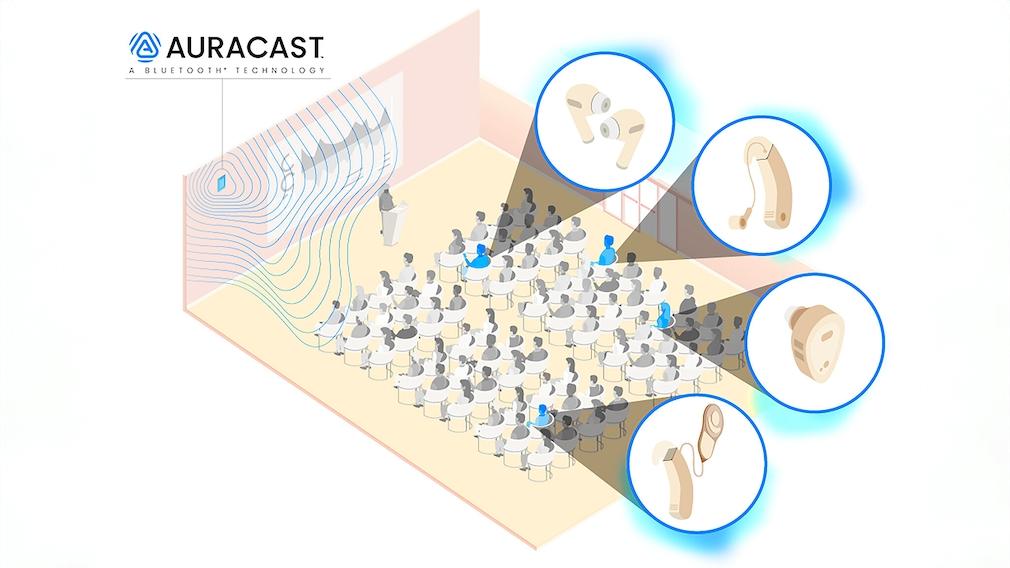
One of the EP/BC-1’s most interesting features is Auracast.
Most Bluetooth headphones work through a familiar one-to-one connection. You pair a phone, computer, or audio source with your headphones, and the devices communicate with each other.
Auracast is different. It uses Bluetooth broadcast audio, allowing a transmitter to broadcast an audio stream that compatible receivers can join.
The Bluetooth SIG’s Auracast explanation describes how a transmitter advertises a broadcast, receivers discover it, and users select the stream they want to hear. The official Auracast FAQ explains that the broadcast does not depend on a separate one-to-one connection for every listener.
In practical terms, this could make listening to a CD more flexible.
Imagine playing an album in a living room. Instead of routing the music through one speaker, multiple people could potentially listen using their own compatible wireless headphones or earbuds. Each person could choose their own volume while hearing the same program.
The same technology has applications in public spaces. Airports, theaters, lecture halls, museums, and other venues can potentially broadcast audio to compatible hearing devices or headphones.
That is why Auracast is more than a headphone feature. It can be used for shared audio and assistive listening, depending on the equipment and installation.
But it is important to understand the limits.
Auracast does not mean that every Bluetooth headphone can receive a broadcast. The receiver must support the appropriate Auracast technology. The transmitter and receiver must also operate within range, and real-world performance depends on the hardware and environment.
Bluetooth SIG describes the system as capable of supporting an unlimited number of in-range receivers, but that should not be interpreted as unlimited distance, unlimited reliability, or guaranteed compatibility with every audio device.
Listening to CDs with wireless headphones
 For headphone users, the EP/BC-1 has two different wireless approaches: conventional Bluetooth streaming and Auracast.
Bluetooth is the familiar option. A compatible headphone connects to the player, and music is sent wirelessly. That makes the CD player easier to use with modern headphones that no longer include a traditional audio cable.
Auracast provides a different use case. It can allow several compatible receivers to join a broadcast instead of creating a separate conventional Bluetooth connection for each listener.
The difference is useful when you want to share music without passing headphones around or connecting multiple headphones individually.
However, headphone compatibility should be checked before purchasing the player.
Do not assume that your Sony, Bose, Apple, Samsung, JBL, or Soundcore headphones can join the EP/BC-1’s Auracast broadcast simply because they support Bluetooth. Standard Bluetooth audio and Auracast broadcast reception are not interchangeable features.
Google has also described LE Audio and Auracast audio-sharing features on Android, but support varies by device and implementation. The phone, transmitter, and receiving headphones or earbuds must have the required capabilities for the particular listening setup.
If your headphones do not support Auracast, conventional Bluetooth may still be the practical way to listen, assuming the player supports the required connection.
This is one of the biggest things buyers should verify before spending $329. A wireless feature is only valuable when the devices you already own can use it.
USB ripping and digital music ownership
The EP/BC-1 is not limited to playback. It can also rip CD tracks directly to USB storage as 44.1 kHz, 16-bit WAV files.
That is useful because it allows you to create a digital copy of music you already own without needing to use a computer’s optical drive.
WAV is a widely supported audio file format, and the specified 44.1 kHz/16-bit output corresponds to the standard CD audio resolution. This provides a straightforward way to move your music into a digital library.
The workflow is simple in principle:
- Insert the CD.
- Choose the tracks you want to copy.
- Connect compatible USB storage.
- Rip the music into WAV files.
- Transfer the files to your computer or other compatible playback devices.
The advantage is convenience. You can preserve your music collection in digital form and play it through other systems.
However, ripping does not automatically make your files better than the original CD. The output format and resolution are not a reason to expect higher sound quality than the source contains.
A digital copy can also be useful for backup purposes, but it is not a substitute for responsible storage. If the USB drive fails, the files can be lost. Backing up the resulting music library to another storage device is still a sensible practice.
The product’s USB ripping feature is particularly appealing to people who have collections of albums that are difficult to find on streaming services or who prefer to keep music files under their own control.
Creative playback features for music lovers
The EP/BC-1 includes controls that are more unusual than those found on ordinary consumer CD players.
Variable-speed playback
The player offers variable-speed playback from 50% to 150%. This gives listeners control over how quickly a track plays.
Slowing a song can make it easier to study a musical passage, follow an instrument, or experiment with a different feel. Increasing speed can be useful for practice, performance experiments, or DJ-style workflows.
The specification describes playback speed control. It does not establish how pitch is handled across every speed setting, so buyers should not assume that all speed changes preserve pitch.
Cue markers
Cue markers can help users return to specific parts of a recording.
That may be useful when practicing a song, examining a musical passage, or working with a particular section of an album. It gives the listener a way to move beyond the usual track-by-track playback experience.
Jog control
The jog control is intended to provide forward and reverse searching. It offers more direct interaction than repeatedly pressing skip or searching through a conventional player menu.
This may appeal to music enthusiasts who enjoy controlling playback rather than treating the CD as a passive source.
Beat detection and tempo synchronization
The EP/BC-1 also includes built-in beat detection and tempo sync output.
That feature is more relevant to music production, DJing, and creative audio setups than to someone who simply listens to albums while relaxing.
Beat detection can help the player work within a broader music workflow, but we would need hands-on testing to determine its accuracy with complex, live, or rhythmically unusual music.
The feature list is promising, but it is not a substitute for testing.
Who should buy the EP/BC-1?
The EP/BC-1 makes the most sense for people who already have a reason to use CDs.
CD collectors
If you own dozens or hundreds of albums, the player provides a modern way to listen to your collection. The USB ripping feature could also help digitize albums for use on other devices.
Music enthusiasts
Listeners who enjoy physical music, album artwork, track sequencing, and the ritual of choosing a disc may appreciate the design.
The visible spinning CD makes the listening process more tactile. That is a subjective benefit, but it is part of the product’s appeal.
DJs and music hobbyists
Variable speed, cue markers, beat detection, and tempo synchronization make the player more interesting for creative use.
These tools may help someone experiment with playback and music synchronization, although professional DJs should verify that the device fits their workflow before buying.
People who want shared wireless listening
Auracast could make the device useful in situations where several people want to listen to the same audio through compatible headphones.
This is potentially more flexible than the traditional arrangement of one CD player feeding a single headphone connection.
Who should skip it?
The EP/BC-1 is not for everyone.
Streaming-first listeners
If you rarely buy CDs, the player may not solve a problem you have. Streaming services offer far more convenient access to large music catalogs.
Budget-conscious buyers
The $329 official price is substantial for a device whose primary function is CD playback. If you only need to play discs occasionally, an existing CD player or a more basic option may be more sensible.
Buyers expecting a complete speaker system
The verified feature list includes headphone and line outputs, but it does not list built-in speakers. You should plan to use compatible headphones, external speakers, or another audio system.
Buyers who need long battery runtime
The player has a rechargeable battery, but the official specification listing reviewed does not provide a battery-life figure. If portable listening is your priority, wait for independent battery testing or more detailed documentation.
Limitations and unanswered questions
A product can have an impressive feature list while leaving important buying questions unanswered.
The EP/BC-1 still needs independent testing to answer several questions:
- How long does the battery last during real CD playback?
- Does the device remain reliable during extended use?
- Which Bluetooth codecs are supported?
- How well does it maintain a wireless connection?
- How does it behave with different Auracast receivers?
- Is the USB digital audio output compatible with the devices buyers commonly use?
- How accurately does beat detection work?
- Does variable-speed playback introduce unwanted artifacts?
- How well does the player read older, scratched, or imperfect discs?
- How easy is it to operate in everyday listening conditions?
We also need to distinguish audio quality from connectivity.
A CD contains digital audio, but the sound you hear can be affected by the player, its output, the connected equipment, wireless transmission, headphone tuning, fit, and listening environment.
The product’s specifications do not prove that it sounds better than a streaming service, another CD player, or a different audio source.
Without independent measurements and controlled listening comparisons, claims about superior sound quality would be premature.
The same caution applies to Auracast. Its broadcast architecture is promising, but the actual user experience depends on compatible hardware, implementation, range, and the way listeners join the stream.
What to watch next
The EP/BC-1 is worth watching because it combines several trends that are appearing in consumer audio.
First, physical media remains relevant to a group of listeners who value ownership and collecting. That market does not need to be huge for specialized products to exist.
Second, wireless audio is moving beyond traditional one-to-one pairing. Auracast can create shared listening experiences, and its potential uses extend beyond music players to public spaces and accessibility.
Third, manufacturers are increasingly treating audio equipment as part of an experience rather than simply a specification list. Design, interaction, portability, connectivity, and software can all influence whether consumers choose a product.
The next important step is independent testing. We need battery measurements, compatibility testing, reliability testing, and real-world use before making stronger recommendations.
If the EP/BC-1 performs well, it could become an interesting option for collectors and creative audio users. If its limitations outweigh its features, the $329 price will make it difficult to recommend to mainstream buyers.
Conclusion
Teenage Engineering’s EP/BC-1 is an unusual CD player that combines physical music with modern wireless technology.
Bluetooth makes it easier to listen with contemporary headphones, Auracast opens the possibility of shared listening, and USB ripping allows CDs to become part of a digital library. The playback controls also give the device a creative role beyond ordinary album listening.
But the launch should not be mistaken for proof that CDs are experiencing a mass-market comeback. US CD sales declined in 2025, and streaming remains dominant.
At $329, the EP/BC-1 is best viewed as a premium niche product for collectors, enthusiasts, and creative users—not a universal recommendation for everyone.
Its real value will depend on how well its features work in everyday use and whether buyers actually use the physical-media experience it is designed to preserve.
FAQS
How much does the Teenage Engineering EP/BC-1 cost?
The current official US store listing is $329. Some coverage reports a different price, so check the manufacturer’s store before purchasing.
Does the EP/BC-1 support Bluetooth headphones?
Yes. The official product specifications list Bluetooth audio streaming. The specific codec support is not disclosed in the specification listing reviewed.
What is Auracast on the EP/BC-1?
Auracast is Bluetooth broadcast audio. It allows compatible receivers to join a shared audio broadcast rather than requiring a separate one-to-one connection for every listener.
Can the EP/BC-1 rip CDs?
Yes. The manufacturer lists CD ripping to USB storage as 44.1 kHz/16-bit WAV files.
Does it support MP3 CDs?
Yes. The official specifications list MP3 data-disc playback.
Does the EP/BC-1 have a battery?
Yes. It has a built-in rechargeable battery with USB charging. The verified product listing does not provide a battery-runtime figure.
Does Auracast work with all Bluetooth headphones?
No. A headphone or receiver must support Auracast. Standard Bluetooth compatibility alone does not guarantee broadcast-audio support.
Is the EP/BC-1 worth buying?
It may be worth considering if you own CDs, value physical music, want USB ripping, or plan to use the playback controls and Auracast features. For someone who mainly streams music, $329 is likely difficult to justify.
