




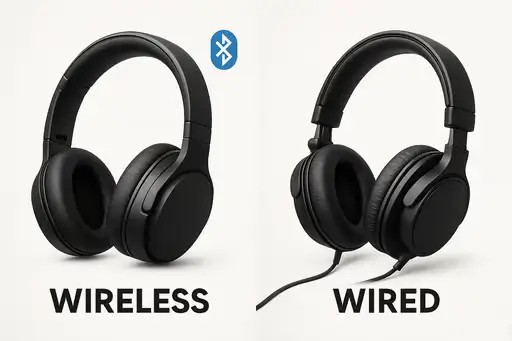
The wired vs wireless headphones debate is no longer black and white. Sound quality gaps have narrowed, latency has dropped, and wireless features have exploded. Here's what you actually need to know before spending a cent.
⚡ TL;DR — Quick Verdict
What's the Difference Between Wired and Wireless Headphones?
At their core, the difference comes down to how audio travels from your device to your ears. One uses a physical cable. The other uses radio waves. But the engineering inside each type tells a more interesting story.
What Are Wired Headphones?
Wired headphones connect through a cable, typically via a 3.5mm audio jack, USB-C, a TRRS connector, or balanced cables like XLR. The audio signal — whether analog or digital — travels through an oxygen-free copper cable directly to the driver (the tiny speaker inside each ear cup).
Because there's no conversion step to wireless, the analog signal arrives clean. No battery, no pairing, no firmware updates required. You plug in, hit play, and you're done. That simplicity is genuinely hard to beat.
Most wired headphones use dynamic drivers, though audiophile-grade options include planar magnetic drivers and even electrostatic designs that draw power through the cable itself. Things like impedance, frequency response, total harmonic distortion (THD), and signal-to-noise ratio become especially relevant here — all of which you can dig into on sites like RTINGS.
What Are Wireless Headphones?
Wireless headphones receive a digital signal through Bluetooth, a 2.4GHz USB dongle, or RF (Radio Frequency) transmission. Inside the headphone, a built-in DAC converts that digital signal to analog, an internal amplifier boosts it, and the drivers produce sound. Everything happens inside the earcup.
That means wireless headphones carry more hardware — a lithium-ion battery, a Bluetooth transceiver, DSP chip, and sometimes ANC circuitry. That added complexity is both the strength and the weakness of wireless audio in 2026.
Wired vs Wireless — Complete Comparison Table
| Feature | 🔌 Wired | 📶 Wireless |
|---|---|---|
| Sound Quality | ✅ Lossless signal | ⚠️ Compressed (LDAC helps) |
| Audio Latency | ✅ Near zero (<1ms) | ⚠️ 10–300ms depending on codec |
| Battery Required | ✅ None | ❌ Yes (charge regularly) |
| Convenience | ❌ Cable management required | ✅ Total cable freedom |
| Portability | ⚠️ Tangling risk | ✅ Highly portable |
| ANC / Features | ❌ Rare in wired models | ✅ ANC, EQ apps, transparency mode |
| Price Per Quality | ✅ Better value at same tier | ⚠️ Premium for tech overhead |
| Long-term Durability | ⚠️ Cables fray (most common failure) | ❌ Battery degrades (2–4 yr lifespan) |
| Gaming (Competitive) | ✅ Preferred by esports pros | ⚠️ 2.4GHz dongle is acceptable |
| Studio / Professional | ✅ Industry standard | ❌ Generally avoided |
| Sustainability / E-waste | ✅ Simpler, more repairable | ❌ Battery disposal is an issue |
| Compatibility | ⚠️ Needs 3.5mm jack or adapter | ✅ Works with most devices |
Sound Quality — Which One Actually Sounds Better?
Here's the uncomfortable truth: wired headphones don't automatically sound better. According to SoundGuys, sound quality depends far more on driver quality, tuning, and source file quality than whether a cable is attached. That said, wired connections do have a technical edge — and here's why that matters.
Why Wired Headphones Have the Fidelity Edge
A wired connection carries a lossless audio signal. There's no encoding, no decoding, no signal compression — the audio hits your drivers exactly as the source intended. This matters enormously if you're listening to high-resolution audio (like Hi-Res audio FLAC files at 24-bit/192kHz) through a quality DAC and amplifier setup.
For audiophile-grade headphones from brands like Sennheiser, the signal chain is what separates a $400 experience from a $400 purchase. Proper mastering details — the faint reverb on a snare, the breath before a vocal phrase — survive the wired trip intact. They don't always survive Bluetooth compression.
Wireless Codecs in 2026 — Closing the Gap Fast
Bluetooth codecs have made enormous progress. SBC (the old default) sounds noticeably compressed at high volumes. But modern codecs have changed the game significantly. Here's how they stack up by bitrate:
The new Bluetooth LE Audio standard with its LC3 codec also promises better audio at lower power, plus the exciting Auracast broadcast feature. If you're on Android with an LDAC-capable phone and headphone, the gap between wired and wireless is genuinely small for most listening scenarios.
I switched from my old wired Sennheisers to Sony's WH-1000XM6 with LDAC. Honestly? On my daily Spotify commute, I can't tell the difference. But the moment I sat down with a FLAC file and my old amp, the wired cans reminded me what I was missing.
Audio Latency — Are Wireless Headphones Actually Slower?
Audio latency — the delay between a sound being triggered and you actually hearing it — matters far more for some users than others. If you're watching Netflix or listening to music, your brain compensates for small delays automatically. You'll never notice 40ms. But gaming and video editing? That's a different story.
Wired: The Gold Standard for Zero-Lag Audio
A wired headphone connected via 3.5mm jack or USB-C has essentially zero audio processing delay. The signal travels at the speed of electricity. For competitive games like CS2 or Valorant, where hearing a footstep 20ms earlier can mean the difference between winning a duel and not, wired remains the pro choice. Most professional esports players still use wired headsets at LAN events for exactly this reason.
Wireless Latency — It Depends Heavily on the Connection Type
Standard Bluetooth audio codecs introduce anywhere from 40ms to 300ms of delay. That's noticeable in games and videos. But 2.4GHz wireless USB dongle connections — found in gaming headsets from Turtle Beach and Jabra — cut that down to just 10–25ms. At that level, even competitive players struggle to detect the lag in real testing.
Convenience & Portability — Where Wireless Dominates
This is where the wireless argument becomes overwhelming. No cable means no tangling in your jacket zipper during your morning commute. No cable means you can wander to the kitchen while still hearing your Zoom call. No cable means you can pace during a phone call without dragging your laptop off the desk.
Wireless Is Built for Modern Life
Features like active noise cancellation (ANC), transparency mode, multi-point pairing (connecting to your laptop and phone at once), and voice assistant integration exist almost exclusively in wireless headphones. The Sony WH-1000XM6 even uses DSP to adapt its noise isolation to your ear shape in real time. That kind of intelligence simply doesn't exist in passive wired cans.
Wireless headphones also work beautifully with phones that no longer have a 3.5mm audio jack — which is most flagships in 2026. No dongle, no Lightning connector adapter to lose, no USB-C to 3.5mm cable dangling awkwardly from your device.
When Wired Still Makes Practical Sense
At a fixed desk setup, cables stop being inconvenient. You plug in once, the headphone sits there all day, and you never think about battery. For long work-from-home sessions — remote work, teleconferencing, Zoom calls — wired headphones are actually less friction. There's no pairing mode song every morning. No moment where the battery hits 10% mid-call.
Battery Life vs No Battery at All
Battery is the wireless headphone's original sin. The technology has matured enormously — many flagships now hit 30–40 hours of battery life, and fast charging via USB-C charging gives you hours of playback from 10 minutes plugged in. Qi wireless charging appears on premium models. Still, the fundamental dependency remains.
✅ Wireless Battery Upside
- 30–40 hrs on premium models (over-ear)
- Fast charging: 10 min → 3–5 hrs play
- Qi wireless charging on some models
- Many support wired fallback when battery dies
❌ Wireless Battery Downside
- Battery degrades after 300–500 cycles
- 2–4 yr lifespan before significant drop-off
- Planned obsolescence: few brands offer replacements
- E-waste concern with lithium-ion disposal
The battery degradation issue is real and under-discussed. A pair of wireless headphones you buy today might offer 35 hours of battery life. After two years of daily charging, that could drop to 18–20 hours. After four years? Maybe 10. Wired headphones, by contrast, will function just as well in 2036 as they do today — assuming the cable doesn't fray (which it might). That's a genuine repairability and longevity advantage for wired.
Wired vs Wireless for Gaming — The Real Answer
Sound quality and competitive gaming are deeply linked. A footstep you hear a split second earlier can win rounds. So let's be direct about this one.
🎮 Competitive Gaming → Wired
- ⚡ Zero latency, no audio lag
- 🎯 Precise positional audio (ping, footsteps)
- 🏆 Used by most esports pros at LAN events
- 🔌 No connection dropouts mid-match
- 🎧 Models: Audio-Technica ATH-M50x, Beyerdynamic MMX 300
🛋️ Casual Gaming → Wireless Works
- 📶 2.4GHz dongle: 10–25ms (barely noticeable)
- 🎮 Console gaming: wireless is common and fine
- 🎧 Models: SteelSeries Arctis Nova Pro Wireless
- 🕹️ Freedom to move on couch or across the room
- ✅ 7.1 Channel surround via DSP processing
The clearest rule: avoid Bluetooth for gaming. Standard Bluetooth audio at 100–300ms latency will visibly desync footsteps and gunshots from what you see on screen. A dedicated 2.4GHz wireless gaming headset is different — the low gaming latency here is nearly imperceptible. Think of it as "wireless, but not Bluetooth."
Switched from my HyperX wired to the SteelSeries Nova Pro Wireless with the 2.4GHz dongle. My kill stats didn't drop at all. The latency on that dongle is a non-issue. I only miss my wired setup when I forget to charge.
Wired vs Wireless for Music Lovers
Your listening habits define everything here. Finding the best-sounding headphones is about matching the tool to the task.
Audiophiles — Wired, No Contest
If you sit down, close your eyes, and actually listen — not just hear background music while working — you want wired. A proper wired setup with a quality DAC and external amplifier, driving planar magnetic drivers or electrostatic transducers, gives you a soundstage and imaging depth that no Bluetooth headphone can match in 2026. The dynamic range, micro-detail retrieval, and high-fidelity experience of critical listening through something like the Sennheiser HD 800 S is another level entirely.
Casual Listeners — Wireless Is Probably Right for You
If music plays while you cook, commute, or work out, wireless is simply better. Active noise cancellation blocks out gym noise and subway rumble that wired passive noise isolation can't match. Brands like Sony, Bose, and Soundcore make wireless headphones with excellent audio quality at reasonable prices. The compression from LDAC or aptX codecs is totally inaudible at Spotify's bitrate.
The Hybrid Option — Best of Both Worlds?
In 2026, several premium wireless headphones ship with a 3.5mm or USB-C cable, letting you run them wired when the battery dies or when you want the purest signal. The Beats Studio Pro is one example — wireless with ANC normally, wired with lossless USB-C audio when you need it.
The catch? When you use most "wireless" headphones in passive mode via cable, they still route through their internal circuitry differently than a true wired headphone. Some bypass the DSP chain. Others don't. Check reviews on RTINGS for the specific model you're eyeing.
Health & Safety — What You Should Know
Wireless headphones emit low levels of electromagnetic fields (EMF) and Radio Frequency (RF) radiation — the same class as your smartphone, Wi-Fi router, and microwave oven. This is non-ionizing radiation, which means it doesn't carry enough energy to damage DNA or cells the way X-rays can.
The WHO (World Health Organization) and the FCC (Federal Communications Commission) both set SAR (Specific Absorption Rate) limits for consumer electronics. Bluetooth devices operate well below those limits. The Bluetooth safety consensus among health agencies is clear: everyday use poses no established health risk.
Hearing damage is the more pressing ear health concern regardless of which type you use. The WHO estimates that 1.1 billion young people risk hearing loss from unsafe listening practices. Volume, not cable type, is what damages your brain health and auditory system over time. Keep it under 80dB for no more than 90 minutes a day if you want to protect yourself long-term.
Which Should You Actually Buy? (Interactive Quiz)
Answer honestly — this takes 10 seconds.
🎧 Find Your Headphone Type
Pick what describes your main use case. We'll tell you what to buy.
Your Pick: —
Select an option above first.
Complete Pros and Cons Summary
Wired Headphones
Pros
- Lossless, uncompressed audio signal
- Near-zero audio latency
- No battery — unlimited listening time
- Better sound quality per dollar spent
- More repairable — just replace the cable
- No pairing issues or dropouts
- Works with any device via 3.5mm or adapter
Cons
- Cables tangle and fray over time
- Needs headphone jack or USB-C adapter
- Limited freedom of movement
- Rarely include ANC or smart features
- High-impedance models need a separate amp
Wireless Headphones
Pros
- Total cable freedom
- ANC, transparency mode, spatial audio
- Multi-point pairing across devices
- Works with jacless modern smartphones
- 30–40 hr battery on premium models
- Inline controls, app EQ, voice assistant
Cons
- Battery degrades over 2–4 years
- Higher price at equivalent performance tier
- Bluetooth latency unsuitable for competitive gaming
- Signal dropouts in congested RF environments
- Environmental interference from walls, devices
- E-waste and planned obsolescence concerns
The Final Verdict for 2026
There's no universal winner — but the right answer based on how you actually live is clear. According to market data from 2026, wireless holds 80% of revenue — yet wired sales jumped 20% in early 2026. Both are thriving. Both have a place.
Frequently Asked Questions
Wired headphones are technically superior in two areas: sound fidelity (lossless signal, no Bluetooth compression) and audio latency (near zero vs 10–300ms wireless). For audiophiles and competitive gamers, wired is still the gold standard.
However, wireless headphones have closed the gap dramatically. Modern codecs like LDAC and aptX Adaptive deliver near-lossless quality at bitrates that exceed most streaming services. For everyday listening, commuting, or working out, wireless headphones are the smarter choice for most people in 2026.
Not necessarily. As SoundGuys notes, sound quality depends far more on driver quality and tuning than whether a cable is attached. With LDAC streaming at 990 kbps and aptX Adaptive hitting up to 1 Mbps, wireless headphones now exceed the bitrate of most popular streaming platforms.
The difference becomes audible mainly when listening to lossless, high-resolution audio (24-bit FLAC) through a dedicated DAC and amplifier. For Spotify or Apple Music listeners, wireless quality is more than adequate.
No. In fact, wired headphone revenue jumped 20% in early 2026. Studios, audiophiles, competitive gamers, and professionals still depend on wired connections daily.
The removal of the 3.5mm audio jack from smartphones created friction, but USB-C adapters and Lightning adapters keep wired audio alive. IEMs (In-Ear Monitors) for studio use, reference over-ear monitors, and gaming headsets all remain firmly wired markets. Wired audio isn't going anywhere.
Both are considered safe. Wireless headphones emit non-ionizing RF radiation at SAR levels well below FCC and WHO guidelines. The WHO states that no adverse health effects have been established from EMF exposure at these levels.
The bigger hearing health risk for both types is volume. Listening above 85dB for extended periods causes gradual hearing damage. Use your device's volume limit feature and take regular breaks — that's what actually protects your long-term ear health.
LDAC from Sony (990 kbps) and aptX Adaptive (up to 1 Mbps) are the current quality leaders. AAC works best for Apple device users. The emerging Bluetooth LE Audio standard with its LC3 codec is gaining momentum, offering better quality at lower power — plus the new Auracast broadcast feature.
For gaming specifically, skip Bluetooth codecs entirely and go for a headset with a dedicated 2.4GHz USB dongle. The gaming latency improvement over any Bluetooth codec is enormous. Check our best headphones guide for codec-verified picks.
Standard Bluetooth headphones introduce anywhere from 40–300ms of audio delay, depending on the codec and device. SBC is typically the worst offender. AAC and aptX manage 40–80ms. Gaming on standard Bluetooth is noticeable and frustrating.
Dedicated 2.4GHz wireless connections via a USB dongle achieve just 10–25ms — imperceptible for most use cases. Wired headphones sit at under 1ms. For casual music and media consumption, any modern Bluetooth codec is fine. For gaming and video editing, go 2.4GHz dongle or wired.
Battery degradation is the main lifespan issue. Lithium-ion batteries typically hold their capacity for 300–500 full charge cycles. With daily use, that's roughly 2–4 years before noticeable drop-off. A headphone rated for 35 hours might deliver 18–20 hours by year three.
The mechanical parts (drivers, headband, earcups) often outlast the battery. Check whether the manufacturer offers battery replacement — some do, most don't. This is a real sustainability and e-waste concern. For maximum longevity, consider headphones with replaceable batteries or strong repair programs.
Many premium wireless headphones include a 3.5mm audio jack or USB-C cable for backup wired use. This is genuinely useful when the internal battery dies. However, the audio chain in wired mode varies significantly by model.
Some headphones bypass the internal DSP and DAC in wired mode for a purer analog signal. Others still route through all internal processing. Check the specific model's specs — sites like RTINGS often test this specifically. If wired sound quality matters to you, look for models that explicitly state they bypass internal processing in wired mode.
