




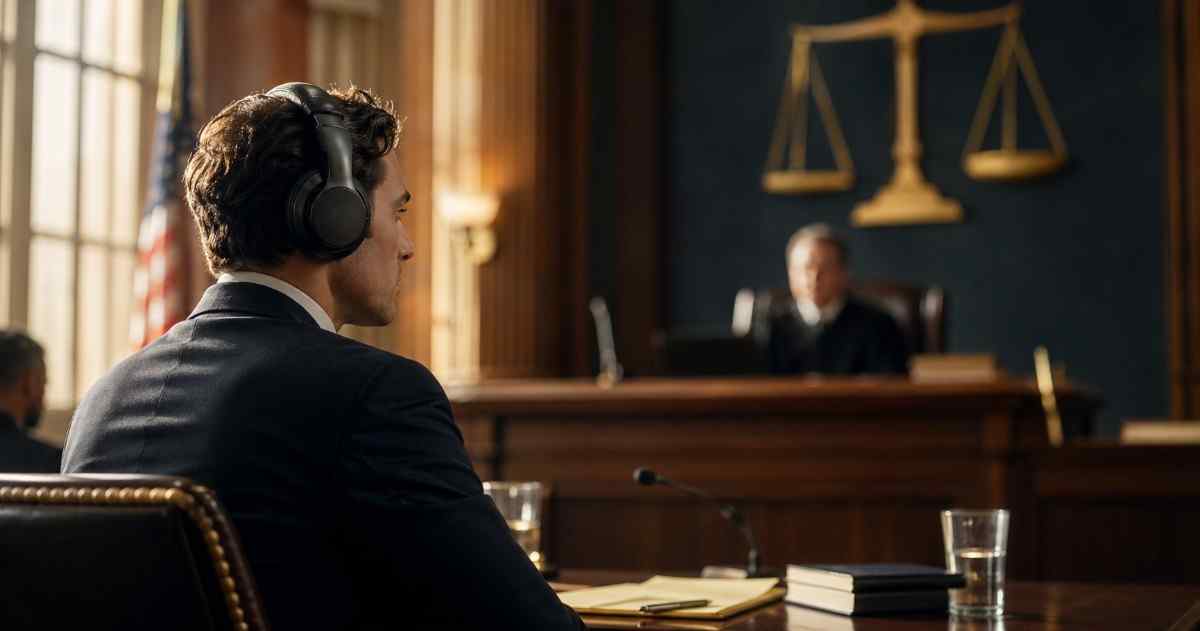
People wear headphones in court mainly for real-time language interpretation, hearing assistance, audio evidence review, private communication with attorneys, or remote/hybrid proceedings. These headphones connect to the court's central audio system. They are approved by the judge, provided by the court, and used by defendants, witnesses, jurors, and judges alike. They do not indicate guilt.
You're watching a high-profile trial on TV. The defendant leans forward and slips on a pair of headphones. You wonder: what are those for? Are they hiding something? Is there a secret channel? Is this some kind of legal trick?
The answer is far more straightforward — and more interesting — than you might think. Headphones in court are a critical accessibility and communication tool. They show up in courtrooms across the United States, at the International Criminal Court, and everywhere in between. Let's break down exactly why.
The 5 Main Reasons People Wear Headphones in Court
Understanding why headphones appear in court matters for fairness, transparency, and the law. Here are the five reasons, from most common to least common.
Real-Time Language Interpretation
This is the biggest reason. When a defendant, witness, or party does not speak the court's language, a certified interpreter translates in real time. The spoken words travel through the court's audio system directly into the headphones — so the person hears every word in their own language, with zero delay.
You see this constantly at the International Criminal Court, the International Court of Justice, and federal courts across the U.S. when defendants speak limited English. Courts provide headsets so any party can directly hear the interpreted word without interrupting proceedings. Interpreters sit in a booth or call in remotely. There are often multiple audio channels — one per language.
Why does this matter? Without language interpretation, a fair trial is impossible. Every person has the right to understand the charges against them and the evidence presented.
Hearing Assistance for Hard-of-Hearing Participants
Judges, jurors, defendants, and witnesses with hearing loss wear headphones connected to the court's assistive listening system (ALS). The Americans with Disabilities Act (ADA) legally requires courts to provide these accommodations to anyone who needs them.
A well-known recent example: during the 2024 trial of James Crumbley (father of the Oxford High School shooter), he wore courtroom headphones throughout due to hearing difficulties. Several jurors in that same case also used hearing-assistive headphones.
Without clear audio, participants may miss critical testimony — which could jeopardize the entire trial. Courts take this very seriously. If you're looking for guidance on how headphones work for different needs, the principles aren't that different from assistive listening tech.
Listening to Audio Evidence
Courts often present audio evidence: recorded phone calls, surveillance audio, wiretaps, 911 calls, prison call recordings, and more. Playing these out loud in a courtroom can cause confusion, echo, or poor clarity. Headphones solve this.
The U.S. District Courts provide headsets — such as Sennheiser in-ear devices — specifically for jurors reviewing audio evidence. Each juror can hear the same audio feed at the same time, clearly, with no background noise interfering.
This is also similar to how noise-isolating headphones work in professional audio review settings — isolation without active cancellation.
Private Communication Between Lawyers and Clients
In some courts — especially in complex, high-stakes cases — attorneys can communicate with clients via a secure, private audio channel. This protects attorney-client privilege while the trial is in session, allowing real-time legal counsel without stepping out or passing paper notes.
Think of it like a private sidebar — except the defendant doesn't have to leave their seat. It keeps proceedings smooth and ensures the client always has access to their legal team.
Remote and Hybrid Court Proceedings
Since 2020, video hearings have become common. Judges, attorneys, and witnesses now appear via platforms similar to Zoom. Headphones are essential in these settings — they reduce echo, improve audio quality, and prevent feedback loops that make everything hard to understand.
Even in hybrid courts (some people in the room, some remote), headphones ensure the remote participants' voices come through clearly to everyone in the courtroom. Post-pandemic, this has become a permanent feature of the legal system.
Who Exactly Wears Headphones in Court?
It's not just defendants. Every role in the courtroom can use headphones, depending on the situation. Here's a quick breakdown:
| Role | Primary Reason | Frequency |
|---|---|---|
| ⚖️ Defendant | Translation · Hearing assistance · Attorney communication | Very Common |
| 👥 Juror | Audio evidence review · Hearing assistance | Common |
| 🗣️ Witness | Understanding questions in a foreign language | Moderate |
| 👨⚖️ Judge | Reviewing evidence · Sidebar communications | Less Common |
| 📝 Court Reporter | Hearing audio clearly for accurate transcription | Often Required |
| 🌐 Interpreter | Receiving source audio to translate simultaneously | Always |
Notice something? Every single role in the courtroom can have a legitimate reason to use headphones. This is why seeing someone in headphones tells you absolutely nothing about guilt or innocence.
Are Headphones Allowed in All Courts?
This depends on the jurisdiction and the judge's discretion. Here's how it generally breaks down:
- U.S. Federal Courts: Headphones for translation and ADA accommodations are standard and legally required under the ADA and the Court Interpreters Act.
- International Courts (ICC, ICJ): Headphones are mandatory for every participant. Multiple language channels run simultaneously.
- State and Local Courts: Most provide assistive listening devices and interpreter headsets on request. Availability varies by courthouse size.
- The judge controls it: All headphone use must be sanctioned by the presiding judge. Unauthorized audio devices are never permitted.
Bottom line: headphones are welcome in court — but they must be the court's own approved equipment. You cannot bring your own personal or consumer headphones and plug them into anything.
Do Headphones Mean the Person Is Guilty?
Myth: "Wearing headphones = suspicious behavior"
This is one of the most common courtroom misconceptions you'll find online — especially after high-profile trials where viewers notice a defendant wearing headphones and assume it must mean something sinister.
The reality? Headphones are a purely functional, technical tool. They're worn by judges, jurors, interpreters, court reporters, and innocent witnesses every single day. The legal system goes out of its way to ensure headphone use is neutral — jurors are specifically instructed not to draw conclusions from courtroom accommodations.
In fact, denying someone a headset they need — for hearing or language — would be a serious violation of their rights. So if anything, headphones signal that the court is doing its job properly.
What Kind of Headphones Are Used in Court?
Court headphones are nothing like the consumer headphones you use for music. They are purpose-built for courtroom audio systems. Here are the key specs:
Unlike the active noise-cancelling headphones you'd use on a plane, courtroom headphones simply receive and amplify audio — no digital processing, no Bluetooth pairing, no app required. Simple, reliable, legally compliant.
How Court Headphone Systems Actually Work
The technology behind courtroom audio is more sophisticated than most people realize. Here's the step-by-step flow during a simultaneous interpretation session:
This is the same core technology used at the United Nations, which manages simultaneous interpretation in six official languages for every major session. Courts adapted this system decades ago.
What People Said in 2026
"I was called for jury duty in January 2026 and they handed us headphones before playing the wiretap recordings. Total game-changer — the audio was crystal clear. I had no idea courts were this well-equipped."
"My client speaks no English. The headset system meant they heard every word of their trial in their native language, in real time. That's not a luxury — that's basic justice."
"People online kept saying the headphones my cousin wore meant he was hiding something. That's completely wrong. He's hard of hearing and the court provided them so he could follow his own trial. It's literally the law."
"After the pandemic, our hybrid court model became permanent. Headphones aren't optional anymore — they're how we ensure remote witnesses are heard clearly in the room. Courts without them struggle daily."
Quick Poll: What Did You Think?
Before reading this article, why did you think people wore headphones in court?
Frequently Asked Questions
Still curious? These are the questions people ask most about courtroom headphones.
Defendants wear headphones in court for two main reasons: real-time language interpretation and hearing assistance. If a defendant doesn't speak the court's language, an interpreter translates proceedings live through the headset. If they have hearing loss, the headphones amplify courtroom audio. Both situations are fully legal and protected.
The Americans with Disabilities Act (ADA) mandates that courts provide assistive listening devices to anyone who needs them. Without this, a defendant may not fully understand the charges and evidence — which makes a fair trial impossible and violates due process. Courts take this requirement seriously.
Yes — jurors use headphones regularly, especially when audio evidence is being played. Recorded phone calls, surveillance audio, prison call recordings, and wiretaps are all presented through the courtroom's audio system. Jurors receive headsets — often Sennheiser in-ear devices in U.S. District Courts — so they can hear clearly without public disturbance.
Jurors with hearing difficulties can also use assistive listening headphones throughout proceedings. This is standard practice across federal and state courts. According to the U.S. Courts, juror technology sheets are provided in advance to explain all equipment available to jurors.
No. Courtroom headphones are passive playback devices — they receive audio from the court's central system. They do not record, transmit, or store anything. Think of them like a radio receiver: they pick up a signal, they don't send one.
Official court recording is handled by the court's own transcription and audio systems — not by anything connected to participant headphones. If you're curious about how headphone technology differs across use cases, that's a great read. In court, the key design goal is clarity and passivity — no active processing at all.
No. You cannot use personal consumer headphones in court. Courts provide their own approved, standardized equipment that physically connects to the court's audio distribution system. Your personal headphones — whether noise-cancelling over-ears or wireless earbuds — would have no way to receive the court's audio feed.
Beyond technical incompatibility, bringing unauthorized audio devices into court raises serious security and confidentiality concerns. Courts tightly control all audio equipment. If you have a genuine need for hearing assistance, you notify the court clerk in advance, and they will provide the appropriate approved device.
Absolutely not. Wearing headphones in court has zero legal or moral connection to guilt. They are used by defendants, jurors, judges, witnesses, and court reporters — for purely technical reasons like translation and hearing access. There is no courtroom rule, legal precedent, or common sense interpretation that links headphone use to culpability.
In high-profile trials, media viewers sometimes misread this as suspicious. But jurors are explicitly instructed by judges not to draw any conclusion from accommodations provided to parties in the courtroom. Headphones are a tool of fairness — not a signal of wrongdoing. Period.
Courts use wired, noise-isolating headphones — not the consumer-style active noise-cancelling headphones like those in our best headphones guide. Common brands include Sennheiser (used in U.S. District Courts) and systems from Williams Sound and Listen Technologies for assistive listening.
These devices use physical wired connections to the court's audio jack points. They are fitted with disposable sanitary ear covers that are replaced between users. International courts often use in-ear monitors with channel selectors. The focus is on reliability, clarity, and hygiene — not audio fidelity or features.
Final Verdict: Why Headphones in Court Are a Sign of Fairness
Here's what we know for sure: headphones in court are never about secrecy, guilt, or privilege. They are about one thing — making sure every single person in that courtroom can fully hear, understand, and participate in the legal process.
- Language: Real-time interpretation ensures non-English speakers get a fair trial. Without headphones, this is impossible.
- Accessibility: The ADA requires courts to provide assistive listening systems. Hearing loss cannot be a barrier to justice.
- Clarity: Audio evidence, remote proceedings, and attorney communication all demand clear, private audio channels — headphones deliver exactly that.
Next time you see someone in court wearing headphones — whether it's a high-profile celebrity trial or a quiet local hearing — you'll know exactly what's going on. It's the legal system working the way it should: accessible, fair, and built for every single person in that room.
Want to understand more about how headphone technology works in everyday life? Check out our guides on how to choose headphones, the best noise-cancelling headphones, and how noise cancellation actually works.
