




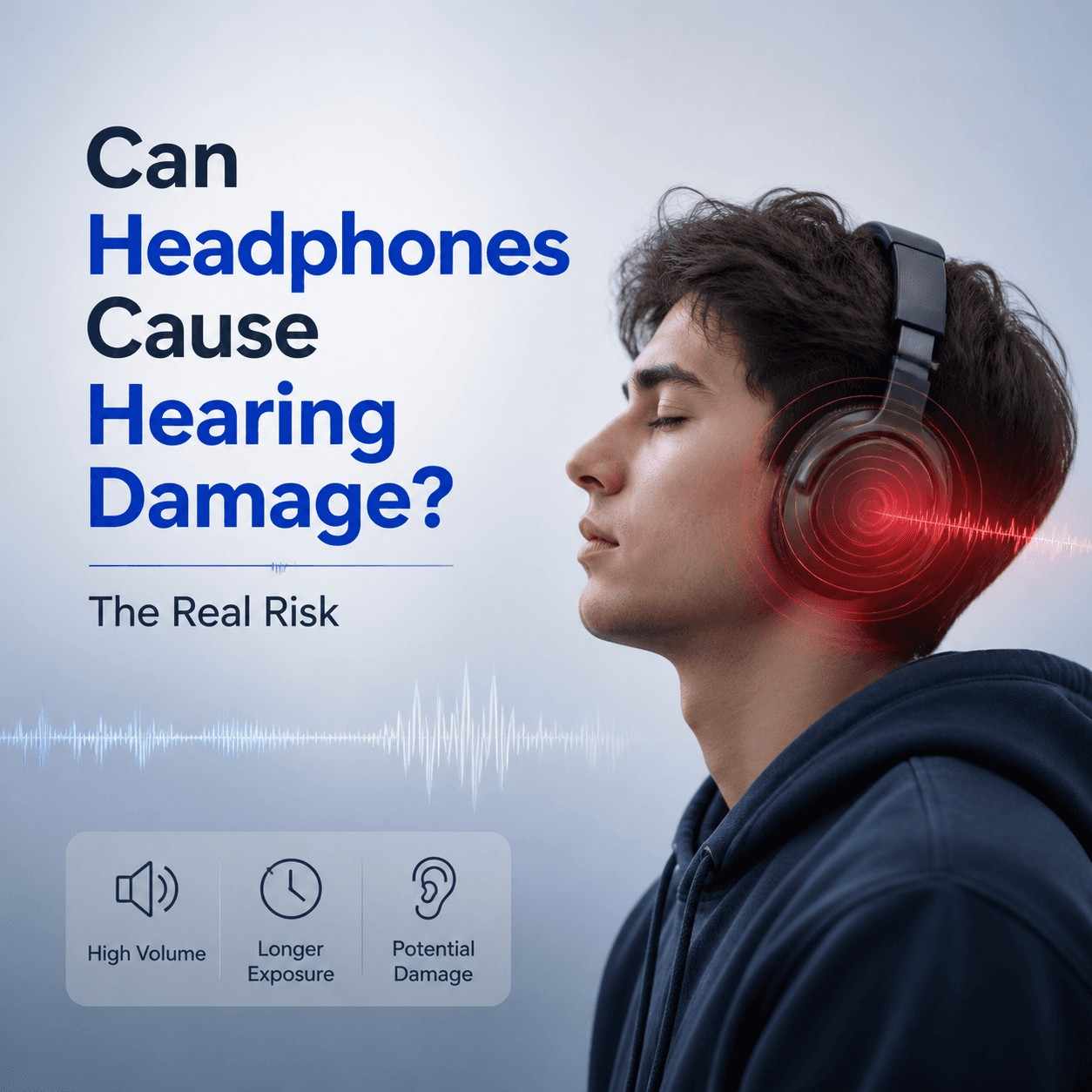
You can probably guess the answer, but I still want to say it plainly.
Yes, headphones can cause hearing damage.
But it’s not as simple as “headphones are bad” or “AirPods will make you deaf.” The real risk is about how loud, how long, and how often. Plus a few sneaky things most people do without realizing, like turning the volume up to fight background noise.
This article is basically the practical, real life version of what audiologists have been saying for years. No fear mongering. Just what’s actually happening to your ears, what’s risky, what’s fine, and how to keep listening without paying for it later.
The short version
If you do any of these regularly, you’re in the “higher risk” zone:
- You listen above 70 percent volume most days.
- You listen for hours at a time without breaks.
- You listen in noisy places (gym, train, street) and crank the volume.
- You use in-ear buds with poor seal and keep turning up to compensate.
- You finish a session and notice ringing, muffled hearing, or a dull feeling.
If none of that is you, and you keep things moderate, you’re probably fine.
But let’s unpack what “fine” even means.
What hearing damage from headphones actually is
When people say “hearing damage,” they’re usually talking about noise induced hearing loss. That’s damage to the tiny sensory cells in your inner ear called hair cells.
These hair cells convert sound vibrations into signals your brain understands.
Here’s the annoying part.
Hair cells don’t really regenerate in humans. Once they’re damaged, they’re damaged. Sometimes symptoms show up fast, but often it’s slow. You adapt. You don’t notice until you do.
And the classic moment is… you realize people “mumble” now. Restaurants feel impossible. You start saying “what?” a lot. Or you hear ringing in silence.
That ringing is tinnitus, and it’s very commonly linked with noise exposure.

The real villain is not “headphones.” It’s exposure.
Sound risk is usually measured as a mix of:
- Intensity (volume)
- Duration (time)
- Distance (how close the sound source is)
Headphones take the “distance” part and make it extreme. The speaker is basically right next to your eardrum.
So even if you’re not maxing out the volume, you’re still closer to the source than, say, a TV across the room.
That doesn’t automatically mean danger. It just means your habits matter more.
How loud is “too loud” with headphones?
Volume percent is tricky because “50 percent” on one device can be totally different on another. So the better way is thinking in decibels (dB).
Rough guide:
- 60 dB: normal conversation
- 70 dB: vacuum cleaner-ish distance dependent
- 80 to 85 dB: busy traffic, loud restaurant
- 90 dB: motorcycle, very loud music
- 100 dB+: club, concert peaks
Most hearing safety guidance treats 85 dB as the point where risk starts becoming meaningful with repeated exposure.
A common standard (used in workplace noise rules) is:
- 85 dB for 8 hours is the upper limit before you should be getting serious about protection.
- Every 3 dB increase roughly cuts safe time in half.
So in that framework:
- 85 dB: 8 hours
- 88 dB: 4 hours
- 91 dB: 2 hours
- 94 dB: 1 hour
- 97 dB: 30 minutes
- 100 dB: 15 minutes
That’s not meant to be a perfect personal calculator. It’s a reality check.
Because a lot of people unknowingly listen around 90 to 100 dB when they’re trying to overpower noise.
And that’s where headphones become a problem.
“But I only listen to music.” Yep. Music can be loud.
Your ears don’t care if the sound is a chainsaw or a beautiful song. They only care about the energy hitting those hair cells.
Also, music is dynamic. Even if the average isn’t crazy high, peaks can still be damaging if you’re riding the edge daily.
And there’s another weird modern issue.
A lot of music today is mastered to sound loud even at lower volume. Heavy compression. Constant intensity. Less quiet space. That can lead to longer “high exposure” time without you feeling like it’s that loud.
The sneakiest risk factor: listening in noisy places
This is where most damage happens for normal people, not professional DJs.
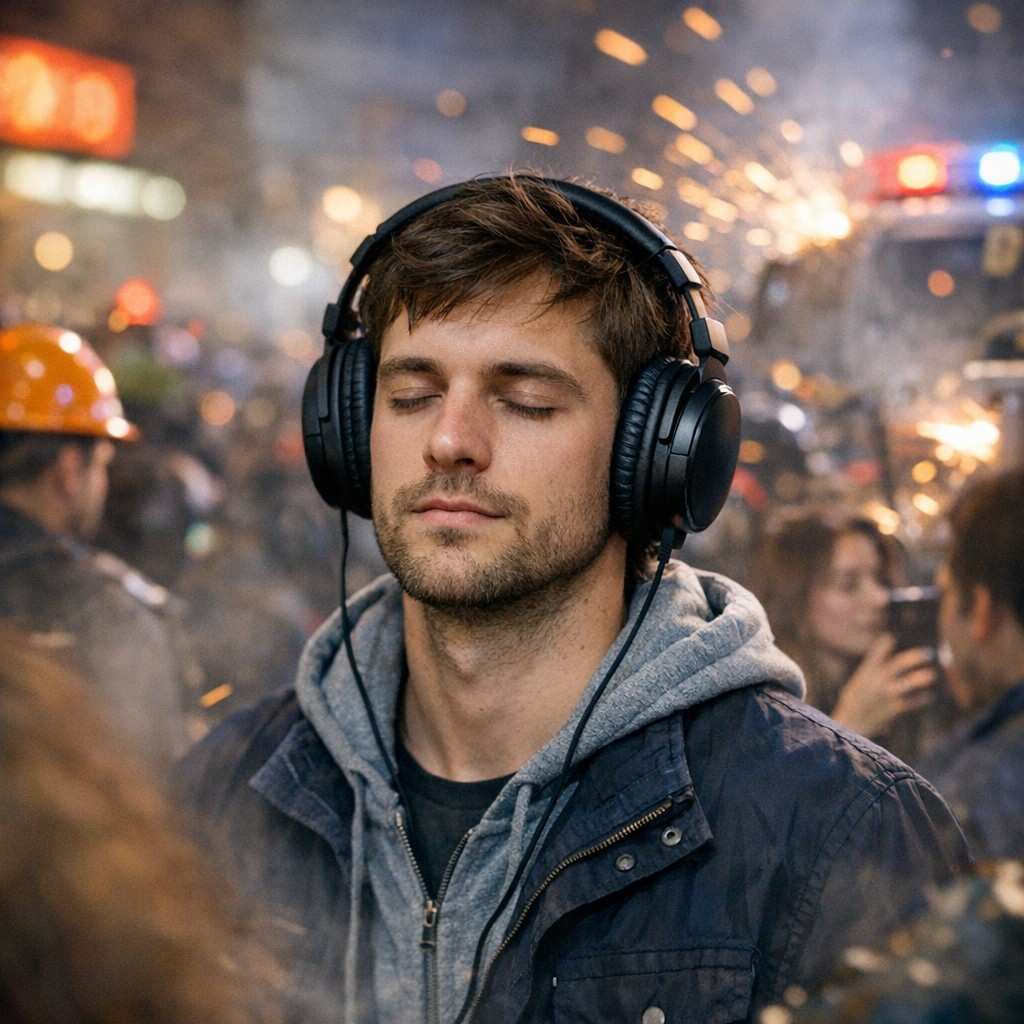
You’re on the train. You put on earbuds. The train is roaring. You crank the volume to hear vocals. Then you forget it’s cranked and keep it there after you get off.
Or you’re at the gym. Loud speakers. Clanking weights. Fans. You turn up to “lock in.” An hour later your ears feel tired, like you need a reset.
That fatigue feeling is not imaginary. It’s basically your auditory system saying, hey, chill.
If you regularly listen in noisy environments, noise canceling isn’t just a luxury. It’s prevention.
Earbuds vs over-ear headphones: which is safer?
This is one of those questions where people want a simple winner.
The honest answer: it depends, but with a clear pattern.
Over-ear (especially closed-back) often helps you listen quieter
Because they block some outside sound naturally. That means you’re less likely to crank the volume.
Earbuds can be fine, but they often lead to higher volume
Not always. But commonly. Especially cheaper ones with a poor seal or weak bass. People turn them up to feel the music.
In-ear with a good seal can actually be safer than you think
If you use silicone tips or foam tips that seal well, you can listen lower. Good seal equals less outside noise leakage.
Open-back headphones are a special case
They sound amazing, but they leak sound in and out. In a quiet room, fine. In a noisy place, you’ll probably raise volume.
So the rough takeaway:
- Quiet room: many types are fine
- Noisy environment: closed-back or active noise canceling wins for safety
Can headphones cause tinnitus?
They can contribute, yes.
Tinnitus is complex. Stress, jaw issues, medications, earwax, hearing loss, and noise exposure can all play roles. But repeated loud headphone listening is a very common trigger.
Two patterns I see people describe:
- Ringing after listening that fades later.
- Ringing that becomes more frequent over months or years.
If you ever finish listening and your ears are ringing, treat that as a bright red warning. It means the sound level was too high, for too long, for your ears.
Temporary vs permanent hearing changes (and why “temporary” still matters)
Sometimes after loud sound you get:
- muffled hearing
- dullness
- ringing
- sensitivity to sound
That can be a temporary threshold shift, basically your hearing temporarily worsens. It might recover after rest.
But repeated temporary shifts can add up. The underlying hair cell stress and damage can accumulate.
So if your ears keep needing “recovery time” after your normal listening routine, that routine isn’t normal. It’s just your baseline.
What about kids and teens with headphones?
This is worth calling out because younger ears are not magically protected. And kids often don’t self-regulate volume well.
Plus they have more years ahead to accumulate exposure.
If you’re a parent, two practical moves:
- Use devices with volume limiting (or system settings that cap loudness).
- Prefer over-ear for younger kids when possible, because it’s easier to control fit and passive isolation.
Also, watch for the obvious sign: if you can clearly hear what they’re listening to from a distance, it’s probably too loud.
How to tell if your headphone volume is risky (without special gear)
You don’t need a decibel meter to make smarter choices. Use these checks.
1. The “arm’s length” rule
If someone at arm’s length can hear your music clearly, turn it down.
2. The “can you hear me?” test
If you can’t hear someone speaking to you in a normal voice nearby, you’re likely too loud, or your environment is too noisy for safe listening without cancellation.
3. Post-listening symptoms
Any ringing, muffled hearing, or ear fullness after listening equals: too loud.
4. Your default volume keeps creeping up
If you notice you keep raising your “normal” volume over months, that can be a sign of early hearing changes. Or just a habit. Either way, it’s worth interrupting.
The 60/60 rule. Useful, not perfect.
You’ve probably heard it: listen at 60 percent volume for 60 minutes, then take a break.
It’s not a scientific law. Devices vary. Headphones vary. Your “60 percent” could still be loud.
But it’s a decent training wheels guideline because it forces two important behaviors:
- volume moderation
- breaks
And breaks matter. They give the auditory system time to recover.
Noise canceling: does it protect hearing or just make things weird?
Noise canceling doesn’t protect your hearing by itself. It doesn’t block the sound you choose to play.
What it does is reduce background noise, so you’re less tempted to crank up the volume.
That’s the big win.
It can also reduce listening fatigue for some people, though a few people feel pressure or discomfort from ANC. If that’s you, you can often use lower ANC settings or use passive isolation instead.
Are some frequencies more damaging than others?
Hearing loss often shows up in higher frequencies first. That’s why speech clarity gets worse, especially consonants like S, F, T, K.
But for headphone safety, don’t overthink frequency charts.
The main driver is still total exposure. Volume and time.
That said, harsh treble at high volume can feel “painful” sooner. And pain is a signal you should respect.
What about “bone conduction” headphones?
Bone conduction headphones sit outside the ear and transmit vibration through your cheekbones.
They can reduce the “speaker in ear canal” effect and keep ears open to the environment, which is great for outdoor awareness.
But they can still be loud enough to cause hearing issues because the cochlea still gets stimulated.
So they’re not automatically safe. They’re just different.
If you use them, same rules apply: keep volume moderate, avoid long loud sessions.
Interestingly, these headphones are also being explored as a potential solution for hearing aid users, providing an alternative way to experience sound without putting additional strain on their hearing.
Can headphones cause ear infections or earwax issues?
Separate from hearing damage, headphones can cause:
- ear canal irritation
- more trapped moisture (especially with in-ear buds)
- pressure and micro abrasion
- sometimes worsened earwax blockage because earbuds can push wax inward
If your ears feel itchy or sore, or you get frequent infections, give your ears more “open air” time, clean earbuds regularly, and consider switching styles.
Also, don’t deep clean your ears with cotton swabs. That usually makes wax issues worse.
The real risk, in one sentence
Headphones cause hearing damage when they make it easy to do high volume + long duration without realizing it.
That’s it.
And modern life makes that combo super easy.
Work calls, podcasts, focus playlists, commuting, gym. It’s not one loud moment. It’s the daily total.
What’s a “safe” listening routine that still feels normal?
Here’s a routine that works for most people without turning life into a hearing safety spreadsheet.
1. Use noise canceling or good isolation when you’re outside
This alone can drop your listening volume a lot.
2. Keep your default volume lower than you think you need
If you start low, you rarely need to go high.
3. Take small breaks
Even 5 minutes of quiet here and there helps. Especially after long sessions.
4. Don’t fall asleep with headphones blasting
If you need something to sleep, use a low volume timer or a speaker at very low volume. Falling asleep with earbuds at your normal listening level can turn into a 6-hour exposure.
5. Protect your ears at concerts so your daily listening can stay normal
This part is underrated. If you nuke your ears at a concert twice a month, you’ll be chasing clarity all week by turning your headphones up.
A pair of musician’s earplugs can change that.
Signs you should take seriously
If you notice any of these, don’t just power through.
- Ringing in one or both ears that comes back often
- Trouble understanding speech in noisy places
- Needing subtitles more than before
- Sounds feel distorted or “sharp”
- Your usual volume feels too quiet lately
- Ear fullness, pain, or sudden hearing change
An audiologist hearing test is quick and honestly kind of eye opening. Even a baseline test is useful.
Also, sudden hearing loss is a medical urgency. If you wake up and one ear is suddenly muffled or gone, don’t wait it out.
FAQs (Frequently Asked Questions)
Is it safe if I listen at low volume all day?
Lower volume helps a lot, but “all day” can still add up. Think in totals. If you’re doing hours, build in breaks, and keep volume comfortably low.
Do expensive headphones reduce damage?
Not directly. But good headphones often sound better at lower volume, and better seal plus ANC can reduce the need to crank. That indirectly helps.
Can I ‘train’ my ears back after damage?
You can adapt, and you can protect what remains. But true noise-related hair cell damage is usually permanent. That’s why prevention matters.
Is one loud day enough to cause damage?
Sometimes, yes. A concert, a club, a max volume headphone session for long enough. One event can trigger tinnitus or noticeable change. More often it’s cumulative.
So, can headphones cause hearing damage?
Yes.
But the real risk is not the headphone itself. It’s the habit.
If you keep volume moderate, use noise canceling in noisy places, take breaks, and treat ringing like the warning sign it is, you can use headphones for years and be fine.
And if you’re reading this with your volume at 90 percent right now… just bump it down a little. Not to be dramatic. Just, you know. Future you will appreciate it.
Can headphones cause hearing damage?
Yes, headphones can cause hearing damage, but it depends on factors like how loud the volume is, how long you listen, and how often. The risk increases with high volume levels, prolonged listening sessions without breaks, and frequently using headphones in noisy environments where you might crank up the volume.
What exactly is hearing damage from headphones?
Hearing damage from headphones typically refers to noise-induced hearing loss caused by damage to the tiny sensory hair cells in your inner ear. These hair cells convert sound vibrations into signals your brain understands. Unfortunately, these hair cells don’t regenerate in humans, so once damaged, the effects can be permanent and may include symptoms like muffled hearing or ringing (tinnitus).
How loud is too loud when using headphones?
Volume is best measured in decibels (dB) rather than percentage volume because device outputs vary. Generally, 85 dB is considered the threshold where hearing risk becomes meaningful with repeated exposure. Listening at 85 dB for up to 8 hours is generally safe, but every 3 dB increase halves the safe listening time. For example, at 94 dB you should limit listening to about 1 hour to protect your hearing.
Why is listening in noisy places risky for your ears?
Listening in noisy environments like gyms, trains, or busy streets often leads people to increase headphone volume to overpower background noise. This elevated volume can expose your ears to dangerously high sound levels (often 90-100 dB), increasing the risk of hearing damage especially if you keep the volume cranked even after leaving the noisy setting.
Does it matter what kind of headphones I use regarding hearing health?
Yes, headphone type matters. In-ear buds with poor seals often cause users to turn up the volume to compensate for background noise leakage, which can increase risk. Over-ear headphones that block outside noise better can help you listen at lower volumes and reduce exposure risks.
How can I protect my hearing while enjoying music on headphones?
To protect your hearing: keep volume below 70% most days; take regular breaks during long listening sessions; avoid cranking up volume in noisy places; use well-sealing over-ear headphones or quality earbuds; and pay attention if you notice ringing or muffled sounds after listening sessions as signs to reduce exposure.
