


Dolby Atmos is an object-based audio technology that adds a dimension of height to traditional surround sound, making sounds appear to come from above, below, and all around you.
According to Dolby’s official explanation of Dolby Atmos, the technology allows creators to position individual sounds precisely within a three-dimensional soundscape.
It creates a more immersive listening experience by treating individual sounds as audio objects that can be positioned and moved through three-dimensional space, rather than being restricted to specific audio channels.
Key Takeaways
- Dolby Atmos is an object-based audio format, not just a channel-based one.
- It adds a crucial height dimension to audio, unlike standard surround sound.
- Requires compatible hardware: A/V receivers, soundbars, or speakers with up-firing drivers.
- Content must be mixed in Dolby Atmos to deliver the full effect.
- It’s available on streaming services, Blu-ray, and some video games.
- The experience varies significantly based on room acoustics and speaker placement.
- While offering superior immersion, it often comes with a higher price point.
- Not all devices claiming “Dolby Atmos support” deliver the same quality.
- Consider your room size and budget when deciding on a setup.
What is Dolby Atmos and How Does it Work?
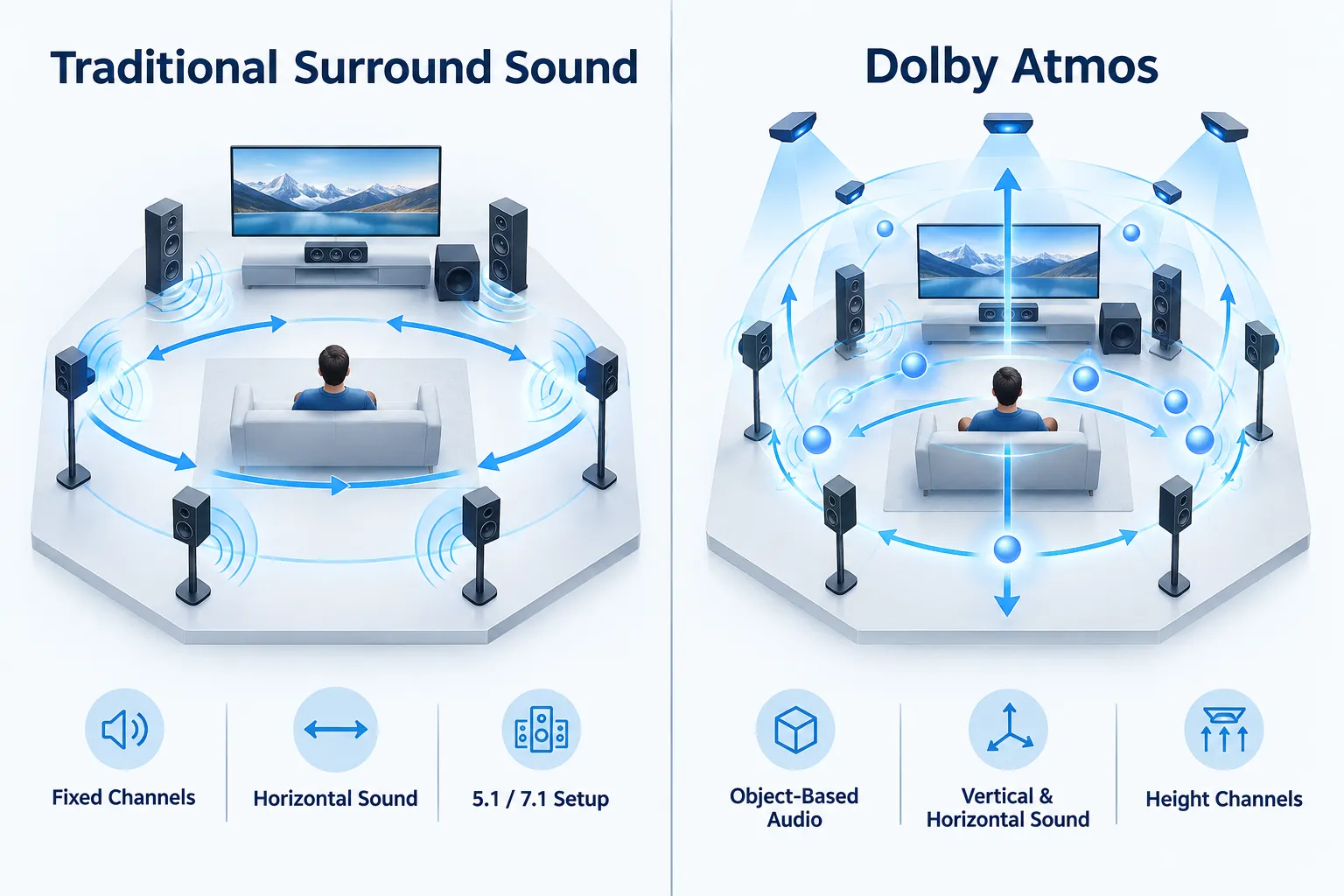
Dolby Atmos is an audio technology that extends traditional surround sound by enabling a more flexible, three-dimensional listening experience. Instead of relying exclusively on fixed channels such as front left, front right, and rear surround, it allows sound designers to position individual audio objects within a three-dimensional environment.
According to Dolby’s explanation of object-based audio, creators can position and move individual sounds around and above the listener. For example, a helicopter in a movie can appear to travel overhead, while rain or other environmental effects can create a stronger sense of height and space.
Traditional surround sound formats, such as 5.1 and 7.1, organize audio around a defined set of channels. Each channel is assigned to a particular speaker or speaker group. These systems can produce convincing directional effects, but their spatial capabilities depend on the channel layout and the speakers available.
Dolby Atmos adds object-based positioning and associated metadata to the audio presentation. A compatible receiver or soundbar uses this information, together with the capabilities of the connected speaker system, to render sounds appropriately for the available configuration.
For example, a 5.1.2 home theater system has five traditional surround channels, one subwoofer channel, and two height channels. A 7.1.4 system adds more surround and height channels for a potentially more detailed spatial presentation.
The resulting experience depends on the original mix, the playback equipment, room acoustics, and speaker placement.
Dolby Atmos can create a more enveloping soundstage, particularly in movies and games with carefully designed spatial effects, but the improvement varies by content and system.
What Do You Need for a Dolby Atmos Setup?
To experience what Dolby Atmos can truly offer, you need a chain of compatible equipment, from the content source to your speakers. This isn’t a feature that magically enhances any audio; it requires specific hardware and content. Based on our testing, investing in a complete setup makes the most sense if you prioritize audio quality for movies and games.
Here’s what you’ll typically need:
- Dolby Atmos Content: Start with movies, television shows, music, or games that support the format. Services including Netflix, Disney+, Apple TV+, and other streaming platforms offer selected Atmos content, subject to device compatibility and subscription requirements. You can check Dolby’s official guide to experiencing Dolby Atmos for supported services and setup requirements. Compatible 4K Blu-ray releases can also provide Atmos
- soundtracks.
- An AV receiver or compatible soundbar: Your audio system must support Dolby Atmos decoding and playback.
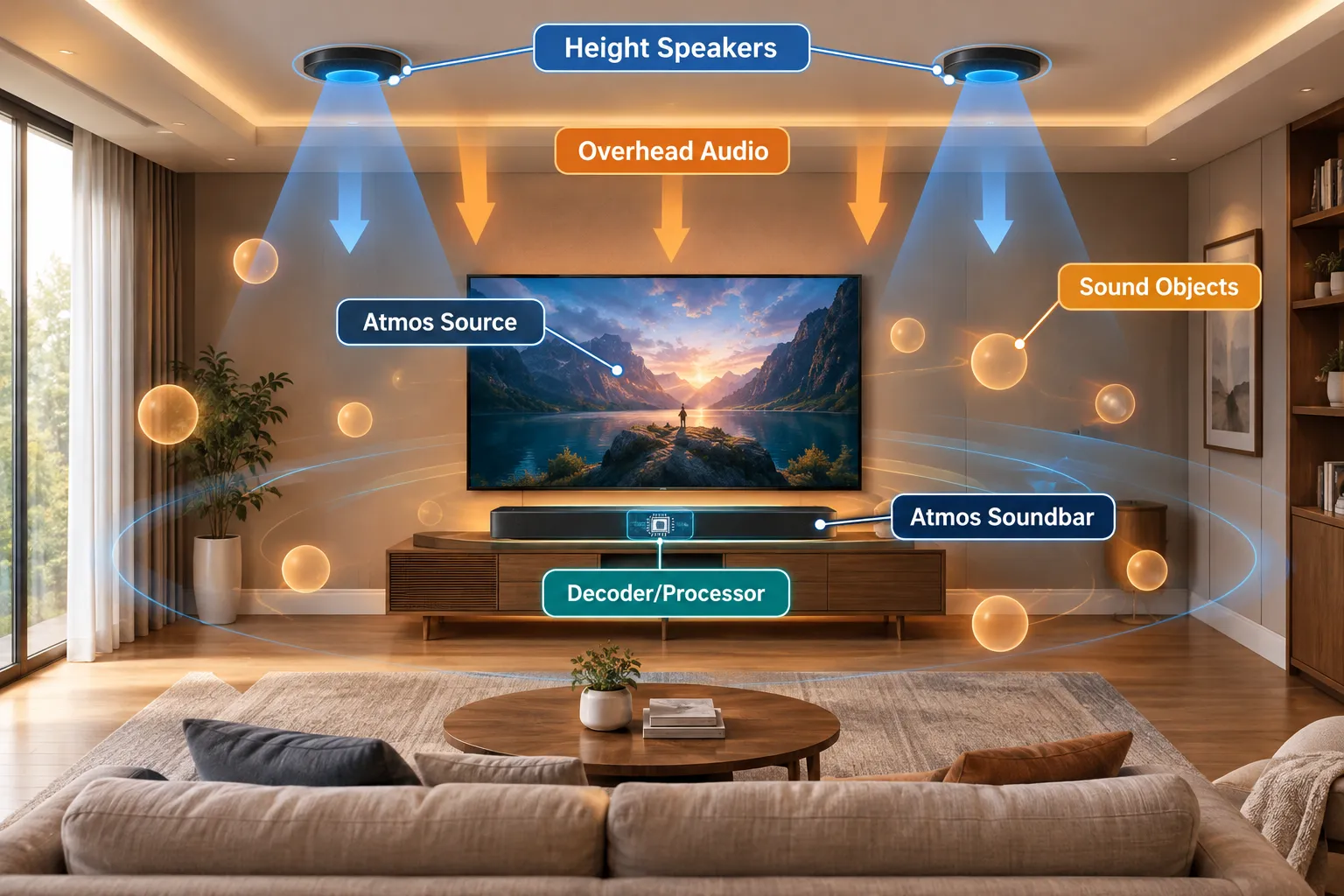
- AV receiver: A home theater receiver with Atmos support can power a multichannel speaker system, including dedicated height speakers or compatible up-firing modules. Check the receiver’s supported channel configurations and processing capabilities before purchasing.
- Soundbar: Many Dolby Atmos soundbars use upward-firing drivers, digital processing, or a combination of techniques to reproduce spatial effects. The effectiveness depends on the design and room. For information about how Dolby Atmos is implemented in soundbars, consult Dolby’s professional soundbar documentation.
- Speakers capable of reproducing height effects: Dedicated height channels help create the overhead dimension.
- Ceiling-mounted speakers: These provide direct sound from above the listening position and can deliver precise height cues when installed and calibrated correctly.
- Up-firing speakers: These direct sound toward the ceiling, where it reflects toward the listener. They offer a practical alternative to installing speakers overhead, although the results depend on ceiling height, surface characteristics, and room layout.
- Integrated height drivers: Some floor-standing speakers and soundbars incorporate upward-firing drivers into their designs.
- A compatible source device: Your streaming player, television, Blu-ray player, computer, or gaming console must support the required Atmos playback and output configuration. Verify compatibility for the specific content and connection you plan to use.
- Suitable HDMI connectivity: HDMI ARC or eARC can transmit audio from a compatible television to a receiver or soundbar. However, support for particular audio formats varies by device and connection. The official HDMI eARC specification overview explains how Enhanced Audio Return Channel supports high-bitrate audio formats, including Dolby Atmos. Check the specifications of both your TV and audio system before buying new cables or equipment.
Why Should You Care About What is Dolby Atmos?
You should care about Dolby Atmos if you’re looking for a significantly more immersive and engaging entertainment experience than standard stereo or traditional surround sound can provide. The main drawback of older audio formats is their limitation to a horizontal soundstage; Atmos breaks through this ceiling.
When we test various audio systems, the difference is often stark. With Atmos, scenes feel more realistic because audio cues are placed with greater precision in the 3D space around you.
Imagine a scene where a helicopter flies overhead, or rain pours down; with Atmos, these sounds aren’t just coming from speakers around you, but also above you. This added dimension helps to pull you into the scene, blurring the line between watching and experiencing.
For gamers, especially, this can be a potential dealbreaker when comparing new consoles or PC builds. The ability to pinpoint the location of an enemy above or below you through sound alone provides a competitive edge and a deeper sense of presence in the game world. Even if you just want the quick answer, Atmos aims to make you feel like you’re inside the action, not just observing it.
Dolby Atmos in Headphones: What is Dolby Atmos on the Go?
While Dolby Atmos is most impactful in a multi-speaker home theater setup, you can also experience a version of it through headphones. This is known as “virtual” Dolby Atmos or “spatial audio.” It’s important to understand the tradeoffs here, as it’s a different experience from a dedicated speaker system.
For headphones, the Atmos processing algorithm creates a simulated 3D sound field using advanced digital signal processing (DSP). It takes the object-based Atmos track and processes it to make sounds appear to come from different directions and heights, even though you only have two drivers directly next to your ears. We’ve seen this feature implemented across a range of headphones, from what are the best headphones under 200 to more premium audio devices.
This virtualized experience can be surprisingly effective at creating a sense of space and directionality. We’ve found it enhances immersion when watching movies or playing games on a laptop or mobile device.
However, it typically doesn’t replicate the distinct overhead presence as accurately as a physical speaker setup with height channels. The effect can also vary significantly between different headphones and audio processing implementations.
You don’t necessarily need special Dolby Atmos-branded headphones. Many standard stereo headphones can work with virtual Atmos processing from a compatible device (like a smartphone, PC, or Xbox).
The main drawback is that the effectiveness is highly subjective and depends on the quality of the virtualization engine. If you’re looking for a true “in-the-room” Atmos experience, speakers are still the way to go, but for personal listening, virtual Atmos is certainly worth considering.
Conclusion
Dolby Atmos offers a significant upgrade to your audio experience by adding a crucial dimension of height and object-based sound. It moves beyond traditional channel limitations, creating a more immersive and engaging soundscape for movies, games, and even some music.
To truly appreciate what Dolby Atmos is, you’ll need compatible content, an Atmos-capable receiver or soundbar, and speakers that can deliver those overhead effects. While the full impact is best realized with a dedicated home theater setup, virtualized Atmos for headphones provides a compelling, albeit different, taste of the technology for personal listening.
When making your buying decision, consider your room size, budget, and how much you prioritize audio immersion. A quality Dolby Atmos system requires an investment, but based on our testing, it delivers a tangible improvement that enhances your overall entertainment. If you’re serious about home cinema or gaming audio, a Dolby Atmos setup is a strong contender for your next upgrade in 2026.
FAQS
Is Dolby Atmos truly better than regular surround sound?
Yes, Dolby Atmos is generally considered better because it adds a vertical dimension and object-based audio, creating a more immersive 3D sound field than traditional channel-based surround sound.
Do I need special speakers for Dolby Atmos?
You need speakers that can produce height effects, either dedicated ceiling speakers or up-firing speakers that reflect sound off the ceiling. Many soundbars integrate up-firing drivers.
Can I get Dolby Atmos with just a soundbar?
Yes, many soundbars feature built-in up-firing speakers that simulate overhead sound for Dolby Atmos. The quality of the effect varies by soundbar and room acoustics.
Is Dolby Atmos available for music?
Yes, a growing number of music tracks are mixed in Dolby Atmos, offering a more spatial and immersive listening experience on compatible systems and streaming services.
Does Dolby Atmos work on all headphones?
Most stereo headphones can process virtual Dolby Atmos (spatial audio) from compatible devices like PCs or smartphones, but it simulates the 3D effect rather than true object placement.
What is the minimum setup for Dolby Atmos?
The minimum setup often involves a 5.1.2 configuration (five traditional surround speakers, one subwoofer, and two height channels), though some soundbars can create a virtualized effect with fewer physical speakers.
Do I need a new TV for Dolby Atmos?
Not necessarily. Your TV needs to pass through the Dolby Atmos signal, typically via an HDMI eARC port, to an Atmos-compatible soundbar or A/V receiver. The TV itself doesn’t need to decode Atmos.
Is Dolby Atmos worth the extra cost?
For dedicated home theater enthusiasts and avid gamers, the enhanced immersion and realism of Dolby Atmos often justify the investment in compatible hardware and content. For casual listeners, an Atmos soundbar can be a more budget-friendly entry point.
How is Dolby Atmos different from DTS:X?
Both Dolby Atmos and DTS:X are object-based audio formats that add height channels. DTS:X is often more flexible with speaker placement, while Atmos is widely adopted in content production and streaming. The practical difference for most users is often subtle.
Can I add Dolby Atmos to my existing surround sound system?
Yes, if your A/V receiver supports Dolby Atmos and has available amplifier channels, you can often add dedicated height speakers or up-firing modules to your existing 5.1 or 7.1 setup.
References
- Dolby Laboratories. (2026). Dolby Atmos: The New Dimension in Sound. https://www.dolby.com/technologies/dolby-atmos/
- Sound & Vision. (2023). Dolby Atmos: Everything You Need to Know. https://www.soundandvision.com/content/dolby-atmos-everything-you-need-know
