


Noble Audio’s Astrid is a $539 pair of true wireless earbuds built around an unusual three-driver design: an 8.3mm dynamic driver, a 6mm planar driver and a balanced-armature driver in each earbud. It also supports LDAC, aptX Adaptive, active noise cancellation, two-device multipoint and Audiodo Personal Sound.
The specification list is ambitious, but the bigger question for US buyers is whether the engineering and personalization justify a price well above established premium earbuds. There is not enough independent testing yet to answer that.
Key Takeaways
- Astrid costs $539 in the US. Noble’s direct store currently lists the earbuds as sold out, although the company says authorized dealers may have availability.
- The three-driver system is technically interesting, not proof of better sound. Driver integration, acoustic tuning, fit and DSP matter as much as the number or type of drivers.
- Buyers should wait for independent tests. ANC strength, microphone quality, comfort, real-world battery life and the value of Audiodo personalization have not yet been independently established for Astrid.
Table of Contents
- What Noble announced
- Why three driver types matter
- Audiodo Personal Sound explained
- Bluetooth 6.0, LDAC and aptX Adaptive
- ANC, transparency and call quality
- Battery life, charging and durability
- How the $539 price compares
- Who should consider Astrid—and who should wait
- What independent testing needs to answer
- The bottom line
- Frequently asked questions
What Noble announced
Noble Audio has added Astrid to its true wireless range, bringing a driver arrangement more commonly associated with enthusiast in-ear monitors into a cable-free earbud. The product was covered by What Hi-Fi? on November 12, which reported a US price of $539 and availability through Noble and selected retailers.
Noble’s own product page confirms the price and specifications, but currently marks direct sales as sold out. The company says its authorized dealers may still have stock.
The most unusual part of Astrid is the hardware inside each earpiece. Noble lists three driver technologies:
- An 8.3mm dynamic driver
- A 6mm planar magnetic driver
- A balanced-armature driver
That combination is often described as a tribrid design. In a multi-driver earphone, different driver types can be used together to reproduce sound across the audible range. However, Noble does not publish the crossover frequencies, the exact frequency range assigned to each driver, or a detailed explanation of how the three drivers are blended.
That missing information matters. A three-driver configuration is not automatically better than a well-designed single-driver earbud. The drivers need to work together without unwanted peaks, dips, phase problems or audible changes as sound moves between them. The quality of the acoustic design and digital signal processing can matter more than the raw driver count.
Astrid is not only a hardware announcement. Noble has also included Audiodo Personal Sound, app-based equalization, active noise cancellation, a Hear Through mode, multipoint connectivity and several Bluetooth codec options. The idea is to combine an enthusiast-style driver platform with the convenience expected from a modern premium wireless earbud.
The company’s official specification sheet lists a frequency response of 20Hz to 20kHz, an impedance of 29 ohms at 1kHz and a sensitivity of 106dB SPL/mW at 1kHz. These are manufacturer specifications, not independent measurements. They do not show how evenly Astrid reproduces sound, how much distortion it produces, or how its tuning compares with other earbuds.
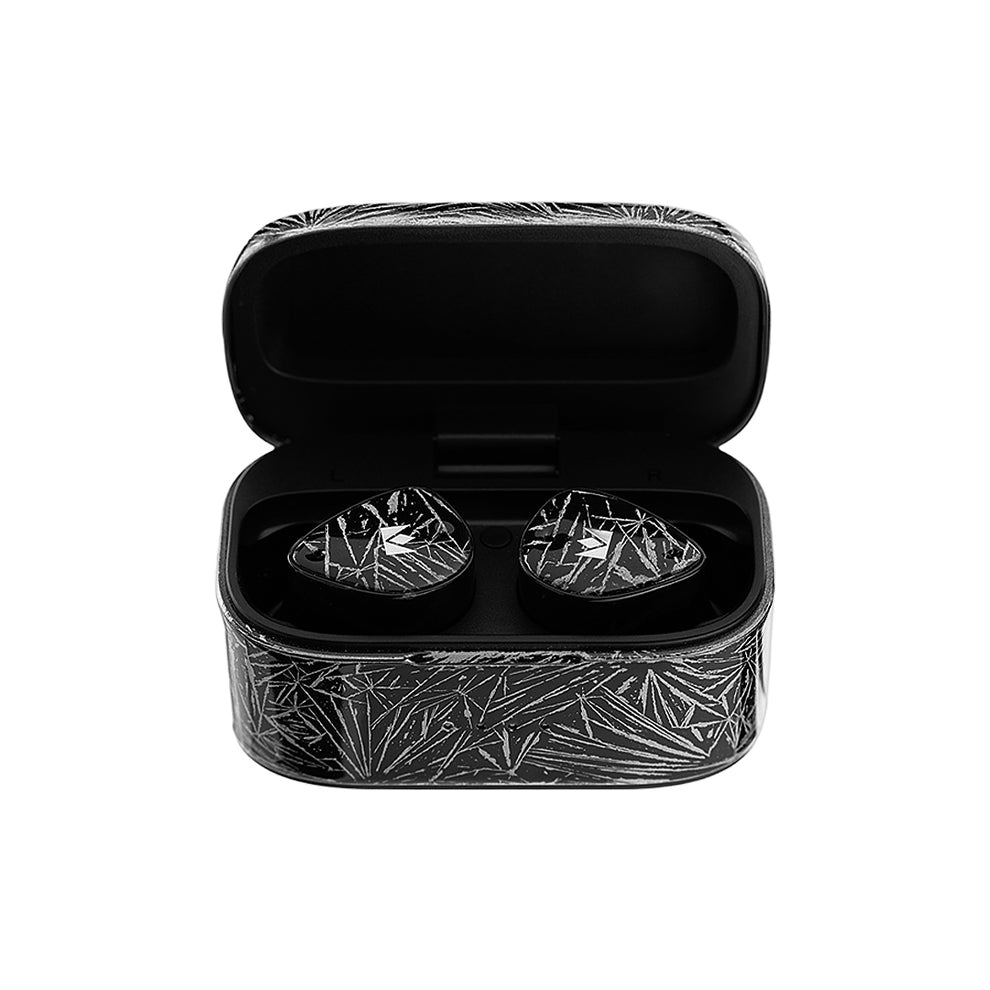
The launch information also lists a black-and-silver finish, glass-fiber faceplates, ABS housings and an aluminum-alloy charging case. Each earbud weighs 8 grams, while the case weighs 64.7 grams. The case supports USB-C and wireless charging.
Why three driver types matter
To understand Astrid’s design, it helps to know what the three driver technologies do. Each converts an electrical audio signal into movement that creates sound, but they use different mechanical approaches.
Dynamic drivers
A dynamic driver uses a voice coil attached to a diaphragm. When current passes through the coil, it moves within a magnetic field and drives the diaphragm back and forth. This movement creates changes in air pressure that we hear as sound.
Dynamic drivers are common because they can cover a wide frequency range and can be made in many sizes. Their performance depends on the diaphragm material, motor design, suspension, enclosure and tuning. A larger driver does not automatically produce better bass, and a particular diaphragm material does not guarantee a preferred sound.
Noble specifies an 8.3mm dynamic driver in each Astrid earbud. The product page does not state the exact job assigned to that driver in the three-way system. It would be tempting to assume that the dynamic driver handles bass, but that would be speculation without a published crossover or manufacturer explanation.
Planar magnetic drivers
Planar magnetic drivers use a thin diaphragm with conductive traces. Magnetic forces act across the diaphragm rather than driving it only from a central voice coil. The approach can help the diaphragm move in a more controlled way across its surface.
Audeze’s technical explanation of planar magnetic technology describes how distributed driving force can reduce some of the mechanical behavior associated with conventional cone drivers. That page explains Audeze’s own designs, so it should be treated as a technical overview from a manufacturer—not as a measurement of Noble’s planar driver.
Astrid uses a 6mm planar driver. That is notable in a compact true wireless earbud, where space, battery power, heat and acoustic volume are tightly constrained. But the driver’s presence alone does not tell us how much it contributes to the final sound. We need measurements and listening tests to find out whether it improves detail, transient response or tonal balance in this particular design.
Balanced-armature drivers
Balanced-armature drivers use a small armature that moves within a magnetic assembly and transfers that motion to a diaphragm. Their compact size makes them useful in in-ear monitors, where designers may combine several small drivers in one shell.
Knowles’ balanced-armature overview explains why these receivers are used in both in-ear monitors and true wireless products: they can provide separate acoustic elements in a small package. That is a description of the technology category, not proof that Astrid will outperform another earbud.
Noble does not name the balanced-armature driver’s supplier or provide its model number. It also does not publish a crossover diagram. Without those details, readers should avoid claims that the balanced armature is specifically responsible for treble or that the planar driver handles the midrange. Those assignments may be common in some multi-driver designs, but they are not confirmed for Astrid.
Why integration matters more than driver count
A multi-driver system introduces a design challenge: the output from each driver must combine smoothly. If the transition between drivers is poorly managed, the response can develop peaks or dips. Timing and phase differences can also affect how the combined output behaves.
A designer can use acoustic filters, electrical crossover networks, digital processing or a combination of methods to manage the transition. Noble has not published enough detail to establish how Astrid handles those tasks.
The same caution applies to frequency response. A stated range of 20Hz to 20kHz tells us the manufacturer’s claimed operating range. It does not tell us whether the earbud is flat, bass-heavy, bright, smooth or uneven. It also does not show how the response changes with different ear tips or different ear shapes.
For a $539 product, independent frequency-response measurements, distortion testing and channel matching would be especially useful. They would help show whether the three-driver arrangement delivers a practical benefit rather than simply a more impressive specification sheet.
Audiodo Personal Sound explained
Astrid’s second major feature is Audiodo Personal Sound. The software uses a short test in a companion app to create a listening profile based on a user’s hearing sensitivity. The profile can then be used to adjust playback, and Noble says the settings can be saved on the earbuds for use with compatible source devices.
The concept addresses a real issue: people do not all hear the same way. Sensitivity can vary between listeners and between frequencies. A personalized profile can adjust the audio signal to account for some of those differences.
Audiodo describes Personal Sound as an audio-personalization algorithm that uses a three-minute app-based hearing test. The company says it analyzes sensitivity across key frequencies and advertises 95% accuracy. That accuracy figure is a company claim. I did not find an independent validation study for Astrid’s implementation in the sources reviewed for this article.
It is also important to understand what this feature is—and what it is not. Personal Sound is being presented here as a consumer audio-personalization tool. It should not be treated as a diagnosis of hearing loss, a medical hearing examination or a replacement for an audiologist. The test may help shape playback, but it does not establish that a listener has a hearing condition or that the earbuds can treat one.
The feature could still be useful. A listener who finds that certain parts of music are harder to hear may prefer a profile that changes the balance. Another listener may simply like the result because it better matches their taste. Those are different outcomes: one is an adjustment based on measured sensitivity, while the other is a preference.
The distinction matters because a personalized profile is not automatically an objectively accurate or universally better sound. Some users may prefer the default tuning. Others may prefer their own equalizer settings. A useful review should compare the default profile, the Audiodo profile and manual EQ using the same tracks and listening levels.
Privacy is another point to check. Noble says the profile can be stored on the earbuds, but the product information reviewed here does not fully explain how the original test data is handled by the app, whether any data is sent to a cloud service, or how long that data is retained. Buyers should read the companion app’s privacy policy before completing a hearing-related profile test.
Bluetooth 6.0, LDAC and aptX Adaptive
Astrid supports Bluetooth 6.0 and lists four audio codecs: SBC, aptX, aptX Adaptive and LDAC. That is a broad set of options for a true wireless product, but codec support only helps when the connected phone, tablet or audio player supports the same codec.
Noble explicitly notes that the codec in use depends on the connected device and its software. That is the right way to think about codec compatibility. The earbud cannot force a phone to transmit a codec that the phone does not support.
LDAC
LDAC is Sony’s Bluetooth audio coding technology. Sony says it can transmit approximately three times more data than standard SBC under suitable conditions and can carry high-resolution audio content over Bluetooth. The important phrase is under suitable conditions. The source device must support LDAC, the setting must be enabled, and the wireless link must be stable.
A codec logo does not guarantee that every song will arrive at the highest available setting. Streaming quality, the source file, phone settings and radio conditions all affect the result. A higher-bitrate codec also does not guarantee that the listener will hear a difference in every environment.
aptX Adaptive
Qualcomm designed aptX Adaptive to adjust its bit rate and latency based on the environment and the type of content. Qualcomm describes the technology as a way to maintain robust streaming in challenging radio-frequency conditions while supporting music, video and gaming use.
That flexibility is useful, but it still depends on the source device. A phone that does not support aptX Adaptive cannot use it just because the earbuds list it. The same applies to the codec’s low-latency behavior: the complete connection chain needs to support the feature.
Neither LDAC nor aptX Adaptive should be treated as a guarantee of lossless playback. Astrid’s specification sheet lists codec compatibility; it does not establish that every Bluetooth connection will deliver a bit-perfect or lossless signal.
What Bluetooth 6.0 does—and does not—tell us
Bluetooth 6.0 is a version of the Bluetooth Core Specification. The Bluetooth SIG’s Core 6.0 feature overview discusses features such as Channel Sounding, decision-based advertising filtering, monitoring advertisers and improvements to the Isochronous Adaptation Layer.
Those changes are not a direct sound-quality rating. Bluetooth version numbers do not tell buyers how an earbud is tuned, how effective its ANC is or how good its microphones sound.
It is also important not to assume that Bluetooth 6.0 automatically means a product supports every newer Bluetooth audio feature. Noble’s Astrid specification lists Bluetooth 6.0, the codecs, multipoint and Qualcomm TrueWireless Mirroring. It does not list LE Audio or Auracast. Buyers who specifically want broadcast audio or LE Audio features should look for those capabilities in the product specification rather than infer them from the Bluetooth version.
ANC, transparency and call quality
Astrid includes active noise cancellation and a Hear Through mode. ANC uses microphones and signal processing to reduce some incoming environmental noise. Hear Through does the opposite: it uses the microphones to let more outside sound reach the listener.
These features make Astrid more practical for everyday use than a traditional wired in-ear monitor. They may help on public transport, in an office or while moving between listening and conversation. But the presence of ANC does not tell us how much noise the product cancels.
A proper ANC review should measure performance across different frequencies and environments. Low-frequency engine rumble, mid-frequency conversation and higher-pitched sounds can behave differently. Ear-tip fit and passive isolation also affect the result.
For context, Bose lists its QuietComfort Ultra Earbuds (2nd Gen) at $299 and describes its ANC system as a combination of passive isolation and active processing. Sony lists the WF-1000XM6 at a $329.99 MSRP, with a current direct-store price of $299.99 at the time of this check. Those products have established review histories, while Astrid still needs independent testing.
Noble also lists Qualcomm cVc call processing. What Hi-Fi? reports microphone noise and wind reduction as part of the feature set. Neither statement tells us how well Astrid performs on a busy street, in a crosswind or during a meeting with background voices. Microphone quality should be assessed with recordings, not inferred from the presence of a processing label.
The same rule applies to transparency. A Hear Through mode can make it easier to hear a conversation without removing the earbuds, but it is not a guarantee of natural sound or safe awareness in every situation. Users should still pay attention to their surroundings, especially near traffic or other hazards.
Battery life, charging and durability
Noble lists USB-C and wireless charging for the Astrid case. What Hi-Fi? reports a rated playback time of up to 11 hours from the earbuds and up to 40 hours with the case when using charge-saving settings.
Those are manufacturer-style maximum figures reported in launch coverage, not independent battery measurements. The report does not provide enough detail to confirm the exact playback time with ANC enabled, the selected codec, volume level or other test conditions.
Battery life can change with ANC, transparency, codec, connection strength, call use and listening volume. A review should test the earbuds at a fixed volume with ANC both on and off, and should state whether the total figure includes charging-case top-ups.
The earbuds are also reported to have an IPX4 water-resistance rating. That rating is designed for splashing water, not immersion. It should not be read as permission to swim or shower with the earbuds. The charging case may have a different protection level, so users should keep it away from moisture unless Noble states otherwise.
Astrid’s 8-gram weight per earbud is another point worth considering. Weight alone does not determine comfort. The shape of the shell, nozzle angle, ear-tip material and the pressure created by the seal all matter. Noble includes silicone tips, but the product information reviewed here does not provide enough independent fit data to say whether Astrid will suit small ears or long listening sessions.
How the $539 price compares
At $539, Astrid is positioned well above mainstream premium true wireless earbuds. The price is not automatically unreasonable for an enthusiast-focused product, but it raises the standard of evidence buyers should expect.
| Earbuds | US price checked November 13, 2026 | What the comparison tells us |
|---|---|---|
| Noble Audio Astrid | $539 | Three driver technologies, Audiodo personalization and a broad codec list; direct store currently sold out |
| Bose QuietComfort Ultra Earbuds (2nd Gen) | $299 | A lower-priced premium ANC alternative with Bose CustomTune and established ANC features |
| Sony WF-1000XM6 | $329.99 MSRP; $299.99 current direct price | A lower-priced flagship option with ANC and Sony’s own sound and app features |
Astrid costs $240 more than Bose’s $299 model, or about 80% more. It is $209 above Sony’s $329.99 MSRP, or about 63% more. These are price comparisons only. They do not mean the products have equal sound quality, ANC performance or comfort.
The Bose and Sony products are built around a different value proposition. Both place strong emphasis on noise cancellation and everyday convenience. Noble is putting more of the story on its hybrid driver architecture and personalization. Those differences may appeal to different buyers, but the higher price still needs to be justified by performance.
A useful review should test Astrid against the same music, devices, volume levels and environments used for competing earbuds. It should also separate sound quality from ANC, microphone performance, app reliability and comfort. A product can sound excellent but be less effective on calls, or have strong ANC but be uncomfortable for a particular ear shape.
There is another practical issue: availability. Noble’s direct product page currently shows Astrid as sold out direct and says authorized dealers may have stock. That means a buyer should check dealer status, return terms and warranty coverage before paying. A $539 purchase is not a good place to accept uncertainty about stock or after-sales support.
Who should consider Astrid—and who should wait
Astrid may interest listeners who enjoy experimenting with audio, use compatible Android or portable audio devices, and want a true wireless earbud with more than one driver technology. The Audiodo profile may also appeal to people who want to tailor playback to their hearing sensitivity rather than rely only on a standard EQ.
It is less compelling for buyers who mainly want the strongest proven ANC, the best microphone for work calls or the lowest price for a premium wireless earbud. Bose and Sony already have products with established independent reviews and lower prices.
iPhone users should pay attention to codec compatibility before buying. Noble lists LDAC and aptX Adaptive, but the actual codec depends on the connected device and its software. The presence of those codecs on the earbud does not mean every phone can use them.
People who want to use the earbuds for workouts should also check fit and water-resistance requirements. IPX4 is a splash-resistance rating, not a swimming rating. The 8-gram earbud weight and shell shape may work for some ears and not others.
For most US buyers, the sensible choice is to wait for independent testing and confirmed stock from an authorized dealer. The product has an interesting design, but the current evidence does not establish that it is a better purchase than less expensive alternatives.
What independent testing needs to answer
A useful Astrid review should go beyond repeating the feature list. The following tests would help determine whether the design delivers a meaningful advantage.
1. Frequency response and distortion
Measure the frequency response using a consistent fixture and repeat the test with different ear tips. Check left-right matching and distortion at multiple volume levels. If the three-driver design is well integrated, the response should be controlled rather than showing obvious peaks or dips around driver transitions.
2. Driver integration
A review should look for evidence of smooth crossover behavior. Noble has not published crossover frequencies or a detailed driver allocation. Measurements can help reveal whether the combined output is coherent, although they cannot replace listening tests.
3. ANC performance
Test low-, mid- and high-frequency noise separately. Compare ANC on and off in a controlled environment, then repeat in realistic settings such as public transport, an office and a street. A single headline ANC figure would not be enough.
4. Microphone and wind performance
Record calls in a quiet room, a busy street and moderate wind. Compare the raw microphone output with any available noise-reduction modes. This matters because the product is positioned as a daily wireless earbud, not just a music player.
5. Real-world battery life
Test at a fixed volume with ANC on and off, and state the codec and source device. The case should be tested separately to confirm the number of full recharges it can provide. Until then, the 11-hour and 40-hour ratings remain reported maximum figures.
6. Audiodo personalization
Compare the default tuning with the Audiodo profile and manual EQ. A useful test should explain the procedure, show how repeatable the profile is and avoid treating the software’s advertised accuracy as independent validation.
7. Fit and app reliability
Test the earbuds across different ear shapes and tip sizes. Check whether the touch controls work consistently, whether multipoint switching is smooth and whether the app maintains the personalized profile after pairing with more than one device.
8. Long-term support and availability
Check firmware updates, app support, warranty terms and authorized-dealer availability. These are part of the value of a $539 wireless product, especially when the manufacturer’s direct store currently shows it as sold out.
The bottom line
Noble Audio Astrid is an ambitious true wireless earbud. Its combination of an 8.3mm dynamic driver, a 6mm planar driver and a balanced-armature driver brings a multi-driver IEM approach into a compact wireless format. LDAC, aptX Adaptive, ANC, multipoint, wireless charging and Audiodo Personal Sound make the feature list even more interesting.
But the feature list is not the verdict. Three driver types do not guarantee better sound, Bluetooth 6.0 does not guarantee every modern audio feature, and a short personalization test does not prove a medical hearing result. The battery and ANC claims also need independent testing.
At $539, Astrid is about 80% more expensive than Bose’s QuietComfort Ultra Earbuds (2nd Gen) at the listed $299 price and about 63% above Sony’s $329.99 WF-1000XM6 MSRP. That is a significant premium. Noble’s direct store also currently marks the product as sold out, although authorized dealers may have stock.
The product deserves attention from audio enthusiasts, but the buying recommendation should remain cautious. Wait for independent frequency-response, ANC, microphone, battery and comfort testing before treating Astrid as a better choice than established premium earbuds. The technology is interesting; the value still has to be demonstrated.
Frequently Asked Questions
How much do Noble Audio Astrid earbuds cost?
Noble lists Astrid at $539 in the United States. Its direct store currently shows the product as sold out, but the company says authorized dealers may have availability.
What drivers are inside each Astrid earbud?
Each earbud contains an 8.3mm dynamic driver, a 6mm planar magnetic driver and a balanced-armature driver. Noble does not publish the crossover frequencies or the exact frequency range handled by each driver.
Do Noble Audio Astrid earbuds support LDAC?
Yes. Noble lists LDAC, aptX Adaptive, aptX and SBC. The codec that is actually used depends on the connected phone or audio player and its software.
Does Astrid support active noise cancellation?
Yes. Noble lists Active Noise Cancellation and a Hear Through mode. Independent testing is still needed to establish how effective the ANC is across different types of noise.
How long does Astrid’s battery last?
Launch coverage reports up to 11 hours from the earbuds and up to 40 hours with the charging case under charge-saving settings. These are reported maximum figures, not independent battery test results.
What is Audiodo Personal Sound?
Audiodo Personal Sound is an audio-personalization feature that uses a short app-based test to create a listening profile. It is intended to adjust playback, not to diagnose hearing loss or replace a medical hearing assessment.
Are Astrid earbuds waterproof?
Launch coverage reports an IPX4 rating, which is intended for splashing water. It does not mean the earbuds are suitable for swimming or submersion, and users should not assume the charging case has the same rating.
