


ANC stands for Active Noise Cancellation, a technology in headphones and earbuds that uses microphones and digital processing to detect ambient noise and generate an opposing “anti-noise” sound wave to effectively cancel it out.
This dramatically reduces unwanted background sounds, particularly consistent low-frequency hums like airplane engines or air conditioners, creating a quieter listening experience.
Key Takeaways:
- ANC (Active Noise Cancellation) works by electronically counteracting external sounds using a specially generated anti-noise signal.
- It’s distinct from passive noise isolation, which relies on physical barriers like ear cushions to block sound.
- ANC is most effective against consistent, low-frequency noises but struggles with sudden, high-pitched, or human speech sounds.
- Modern ANC features adaptive capabilities, adjusting cancellation levels to your environment in real-time.
- Transparency mode allows you to hear your surroundings without removing your headphones.
- While ANC can help you listen at lower volumes, it is NOT a substitute for certified hearing protection in hazardous environments.
- Using ANC generally consumes more battery power compared to listening without it.
- Some users may experience a temporary “pressure” sensation or wind noise with ANC activated, depending on the headphone model and environment.
What Is ANC?
ANC, or Active Noise Cancellation, is an advanced audio technology integrated into headphones and earbuds designed to significantly reduce unwanted ambient sounds from your environment. Instead of just physically blocking noise, ANC actively cancels it out using electronic processing.
This means those loud airplane engines or the constant hum of an office air conditioner can become a mere whisper, transforming your listening experience.
The Simple Definition of Active Noise Cancellation
Active Noise Cancellation (ANC) is a feature that uses microphones to pick up ambient sound, an electronic circuit to invert that sound wave, and then plays the inverted wave through the headphone speakers.
This inverted “anti-noise” wave effectively cancels out the original external noise through the principle of destructive interference, creating a noticeable reduction in perceived sound. It’s a marvel of modern audio engineering, turning noisy environments into personal oases of calm.
ANC vs. Noise Cancellation vs. Noise Isolation
It’s easy to get these terms tangled, but for TechOzea, we keep it crystal clear:
- Noise Isolation (Passive Noise Cancellation): This refers to the physical design of headphones or earbuds. Thick earcups, snug-fitting ear tips, and materials that block sound waves simply create a physical barrier. Think of it like putting on earmuffs, no electronics required. This is effective against a broad range of frequencies, especially higher-pitched sounds.
- Noise Cancellation: This is the broader term encompassing any method of reducing unwanted sound. It can refer to both passive isolation and active cancellation.
- Active Noise Cancellation (ANC): This is the specific electronic process we’re discussing. It actively generates a sound wave to cancel out external noise, requiring power and sophisticated digital signal processing. While passive isolation is always present to some degree in ANC headphones, it’s the active component that does the heavy lifting against low-frequency noise.
How Do Noise-Canceling Headphones Work?
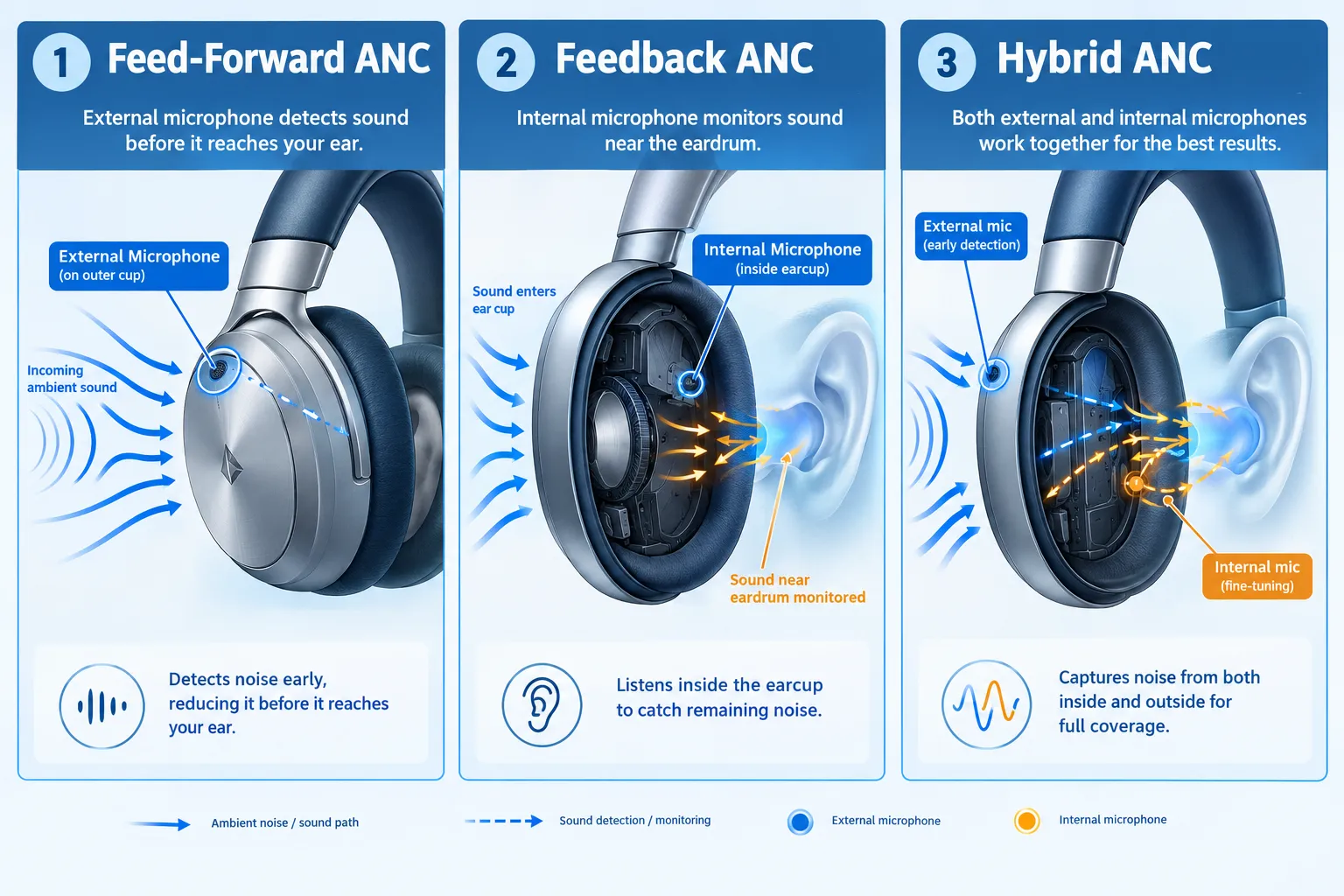 At its core, What Is ANC? How Noise-Canceling Headphones Work involves a clever trick of physics known as destructive interference. It’s not magic; it’s a precisely engineered four-step dance between microphones, a processor, and speakers. Understanding this process demystifies how your quiet commute becomes possible.
Step 1: Microphones Listen to Outside Noise
The journey to silence begins with tiny, strategically placed microphones on your headphones or earbuds. These microphones continuously pick up the ambient sounds around you, the rumble of a bus, the chatter in an office, or the whir of an airplane engine. They act as the ears of your ANC system, feeding real-time sound data to the internal electronics.
Step 2: The ANC Processor Analyzes the Sound
Once the external sound is captured by the microphones, it’s sent to a dedicated ANC processor or chipset within your headphones. This powerful digital signal processor (DSP) analyzes the incoming sound wave, identifying its frequency, amplitude, and phase. This analysis happens almost instantaneously, ensuring minimal delay in response.
Step 3: The Headphones Create an Opposing Sound Signal
This is where the “cancellation” truly happens. Based on its analysis, the ANC processor generates an “anti-noise” sound wave. This anti-noise wave is precisely inverted in phase compared to the incoming external noise.
Imagine a sound wave as a ripple in water; the anti-noise wave is an identical ripple, but perfectly out of sync, designed to meet the original wave and flatten it out.
Step 4: The Speaker Plays Music and Anti-Noise Together
Finally, your headphone speakers play this newly created anti-noise signal directly into your ear canal, simultaneously with any audio you’re listening to (or even in silence).
When the external noise wave meets the anti-noise wave generated by your headphones, they effectively cancel each other out through destructive interference. The result is a significant reduction in the perceived volume of the ambient sound, allowing you to enjoy your music or simply the quiet.
Why Does ANC Work Better Against Some Sounds?
ANC isn’t a universal mute button; its effectiveness varies significantly depending on the type of sound it’s trying to block. Understanding these limitations is key to appreciating what ANC can and can’t do.
Why Airplane and Engine Noise Are Easier to Reduce
ANC excels at canceling out consistent, low-frequency sounds because these sound waves are predictable. The rumble of an airplane engine, the hum of an HVAC system, or the drone of a train are largely steady and repetitive.
This consistency allows the ANC processor more time to accurately analyze the sound and generate a precise, opposing anti-noise wave. Low-frequency waves also have longer wavelengths, making them easier for the anti-noise to “catch” and cancel effectively. This is why ANC headphones are particularly effective for airplane travel.
Why Voices, Alarms, and Sudden Sounds Can Still Get Through
Conversely, ANC struggles with high-frequency, sudden, or inconsistent sounds like human voices, alarms, barking dogs, or the clatter of keyboards. These sounds are often complex, rapidly changing, and have shorter wavelengths.
The ANC system has less time to process these fleeting sounds and generate an accurate anti-noise signal before they’ve already reached your ear. While some premium ANC headphones use advanced algorithms to tackle these, a certain amount of this noise will always penetrate.
Active Noise Cancellation vs. Passive Noise Isolation
When evaluating What Is ANC? How Noise-Canceling Headphones Work, it’s crucial to distinguish between active noise cancellation and passive noise isolation, as both play a role in reducing unwanted sound. One relies on electronics, the other on physical design.
| Feature | Active Noise Cancellation (ANC) | Passive Noise Isolation |
|---|---|---|
| How it Works | Uses microphones & electronics to create opposing sound waves. | Relies on physical barriers (earcups, ear tips, materials). |
| Power Required | Yes, requires battery power. | No, works without power. |
| Best Sound Types | Consistent, low-frequency hums (engines, fans). | High-frequency sounds (voices, sharp noises), broadband noise. |
| Common Products | Premium over-ear headphones, high-end true wireless earbuds. | In-ear monitors, well-sealed over-ear headphones, earplugs. |
| Limitations | Less effective on sudden, high-frequency, or speech sounds; consumes battery. | Cannot effectively block low-frequency rumble; depends on fit. |
What Are the Different Types of ANC?
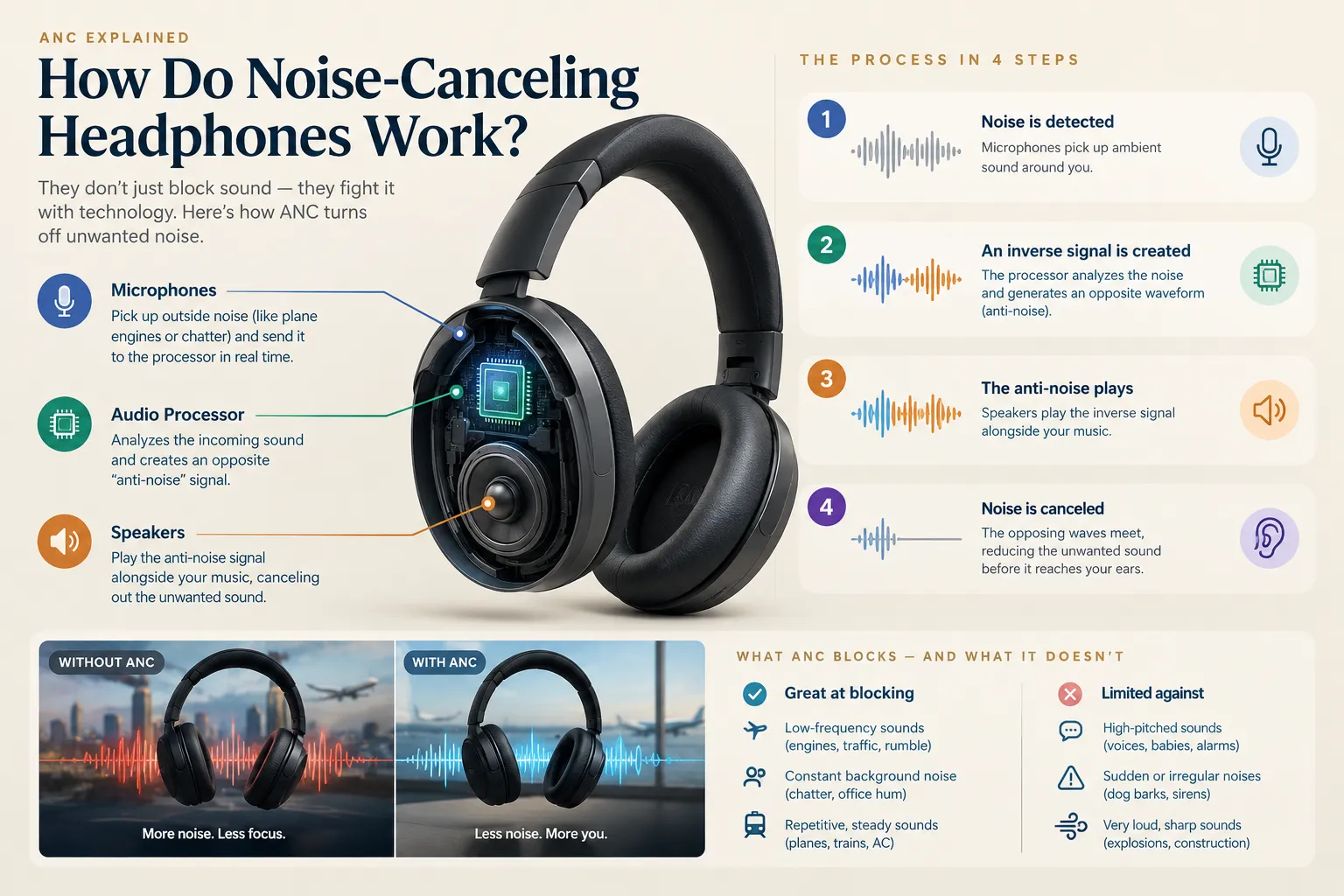 Not all ANC is created equal. The effectiveness and characteristics of active noise cancellation largely depend on the specific microphone configuration used by the headphones. TechOzea TESTED and Compared! these architectures so you know the difference.
Feed-Forward ANC
In a feed-forward ANC system, microphones are placed on the outside of the headphone earcups. These microphones detect external noise before it even reaches your ear.
- Advantage: Because the microphone hears the sound early, the system has more time to process the signal and generate the anti-noise. This can be effective in predictable environments.
- Limitation: External microphones are susceptible to wind noise and can sometimes struggle with sounds that change quickly. They also can’t correct for noise that might leak in due to a poor ear seal.
Feedback ANC
Feedback ANC systems place microphones inside the earcup, near your ear. These microphones listen to the sound that actually reaches your ear, including both the ambient noise that made it past the passive isolation and your music.
- Advantage: By monitoring the sound closer to the eardrum, feedback ANC can make more precise adjustments and is excellent at correcting for imperfections in the ear seal or changes in how the headphone sits on your head. It also tends to provide better noise reduction over a broader frequency range.
- Limitation: Because the microphone is listening after the sound has entered the earcup, there’s less time for the system to react and generate the anti-noise, which can sometimes lead to slight phase shifts affecting audio quality.
Hybrid ANC
Hybrid ANC combines both feed-forward (external) and feedback (internal) microphones. This is the most advanced and typically most effective type of ANC, found in premium noise-canceling headphones and earbuds.
- Advantage: By using both internal and external microphones, hybrid ANC leverages the strengths of both systems. The external mic catches noise early, while the internal mic fine-tunes the cancellation and corrects for any errors. This results in broader-spectrum noise reduction, less susceptibility to wind noise, and often better overall sound quality.
- Limitation: It’s more complex and expensive to implement, leading to higher costs for the consumer. It also requires more processing power, potentially impacting battery life.
What Is Adaptive ANC?
Adaptive ANC represents the cutting edge of noise-canceling technology in 2026. Unlike fixed ANC, which applies a constant level of noise reduction, adaptive ANC dynamically adjusts its performance based on your surroundings.
Modern headphones and earbuds with adaptive ANC use sophisticated algorithms to continuously monitor the ambient soundscape.
If you move from a quiet office to a noisy street, the system automatically recalibrates its noise-canceling strength and frequency response to optimize performance for the new environment.
This ensures you get the BEST possible balance of noise reduction and comfort without manual intervention.
Adaptive ANC vs. Adjustable ANC
While often used interchangeably, there’s a subtle but important difference:
- Adaptive ANC: This refers to automatic adjustments made by the headphone itself in response to changing environmental noise. You set it and forget it.
- Adjustable ANC: This typically refers to headphones that allow you to manually select different levels of noise cancellation (e.g., “low,” “medium,” “high,” or a slider). Many adaptive systems also offer adjustable options, giving you manual control if desired.
What Is Transparency Mode?
Transparency mode, also known as Ambient mode or Awareness mode, is a crucial feature in many modern noise-canceling headphones that allows you to hear your surroundings without removing your headphones.
Instead of blocking external sound, it uses the same external microphones as ANC to amplify select outside noises and feed them into your audio mix.
This means you can listen to your music or podcast while still being aware of your environment, hearing traffic, announcements, or conversations. It’s an indispensable safety and convenience feature.
When Should You Use Transparency Mode?
Transparency mode is incredibly useful in a variety of real-world scenarios:
- Walking or Jogging: Stay safe by hearing approaching traffic or other pedestrians.
- Commuting: Listen for train station announcements or airport gate changes without constantly taking off your headphones.
- Conversations: Quickly chat with a colleague or cashier without interrupting your audio flow.
- Home Use: Hear your doorbell, phone ring, or children’s voices while still enjoying your content.
Does ANC Work Without Music Playing?
Yes, ANC absolutely works without music playing. The active noise cancellation process is entirely independent of any audio you might be listening to. The microphones, processor, and speakers are dedicated to generating and playing the anti-noise signal whether your music is on or off.
Wearing ANC headphones in silence can provide a remarkable sense of calm in a noisy environment.
While your music can further mask any residual noise that ANC doesn’t entirely eliminate, the core function of noise reduction operates continuously as long as ANC is activated.
Many users find this useful for focusing in a busy office or simply finding peace during a noisy commute, even without listening to anything.
Does ANC Block All Noise?
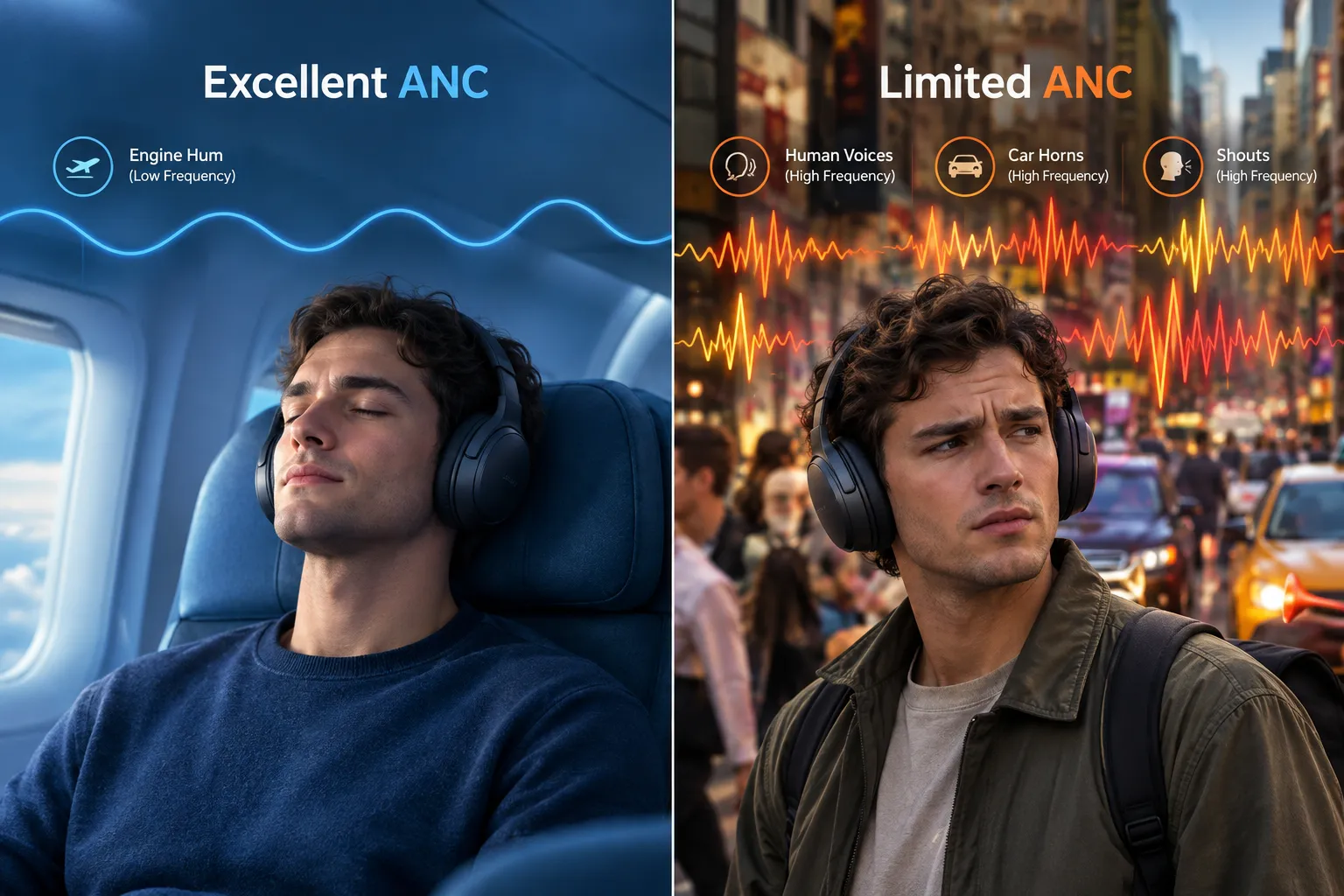 No, ANC does not block all noise. This is a common misconception. While powerful, ANC technology has inherent limitations, particularly with certain types of sounds. Understanding these limitations helps set realistic expectations for your noise-canceling headphones.
Here’s a general guide to typical ANC performance:
| Sound | Typical ANC Performance |
|---|---|
| Airplane engine | Excellent |
| Bus and train rumble | Excellent |
| Air conditioner | Very good |
| Steady traffic | Good |
| Office chatter | Moderate |
| Human speech | Limited to moderate |
| Car horn | Limited |
| Sudden loud sounds | Limited |
It’s important to remember that these are general tendencies. The actual performance can vary significantly between different headphone models, their design, fit, and the quality of their ANC implementation. Our lab-tested reviews at TechOzea always break down how specific models handle these different noise types.
Does ANC Protect Your Hearing?
This is an important question. While ANC can contribute to safer listening habits, it is NOT a direct substitute for certified hearing protection.
ANC reduces ambient noise, which can allow users to listen to music or other audio at lower volumes.
The World Health Organization’s safe listening guidance notes that well-fitted, noise-canceling headphones can reduce the need to increase volume in noisy environments.
The WHO recommends keeping listening volumes down and limiting exposure duration. For example, an average listening level of 80 dB can be considered safe for up to 40 hours per week, while 90 dB should be limited to approximately four hours per week.
The U.S. Centers for Disease Control and Prevention also explains that repeated exposure to loud sounds can damage hearing and recommends proper hearing protection in hazardous environments.
The National Institute on Deafness and Other Communication Disorders states that long or repeated exposure to sounds at or above 85 dBA can cause noise-induced hearing loss.
The TechOzea Stance: While ANC can be a valuable tool for reducing the need to blast your volume in noisy settings, it’s essential to understand that ANC headphones are not designed or certified as hearing protection devices (like earplugs or earmuffs) for hazardous environments (e.g., construction sites, extremely loud concerts). For true hearing protection, rely on products specifically rated for noise reduction.
Does ANC Use More Battery?
Yes, using Active Noise Cancellation invariably consumes more battery power than listening with ANC turned off. The electronic components required for ANC are actively working, drawing power to continuously monitor, process, and generate anti-noise signals.
Here’s why ANC demands more battery:
- Microphone Operation: The multiple microphones constantly capture ambient sound.
- Digital Signal Processing (DSP): The ANC chipset performs complex real-time calculations to analyze noise and create the anti-noise waveform.
- Electronic Amplification: The anti-noise signal needs to be amplified and played through the speakers.
- Adaptive Processing: If your headphones feature adaptive ANC, the system is continuously recalibrating, requiring even more computational power.
Battery-Saving Tips: If battery life is a priority for a long flight or workday, consider turning off ANC when you’re in a quiet environment, or opt for a pair of headphones with exceptional battery life, especially when ANC is enabled.
When we TESTED headphones, we always measure battery life with ANC on and off. You might be surprised how much difference it makes. Looking for a long-lasting option? Check out What Headphones Have The Longest Battery Life.
Can ANC Affect Sound Quality?
The debate over whether ANC impacts sound quality is one of the most persistent among audio enthusiasts. The short answer is: yes, it can, but the extent varies greatly depending on the quality of the ANC implementation.
Here’s how ANC can influence your listening experience:
- Digital Signal Processing (DSP): The very act of processing ambient noise and generating anti-noise can introduce subtle changes to the headphone’s acoustic response. High-quality ANC systems employ sophisticated DSP to minimize these effects, aiming for a neutral sound profile. Budget noise-canceling headphones might show more noticeable alterations.
- Changes in Bass Perception: ANC is most effective at canceling low-frequency sounds. This can sometimes make the bass in your music feel less impactful or different, as the external low-end rumble is no longer present to acoustically combine with your audio.
- “Ear Pressure” Sensation: Some users report a slight “pressure” or “suck-out” sensation with ANC active. This isn’t actual physical pressure but an auditory phenomenon caused by the absence of familiar low-frequency sounds, making your ears feel sealed. It’s similar to the feeling you get when ascending or descending in an airplane.
- Implementation Quality: Premium headphones from brands like Sony, Bose, or Sennheiser invest heavily in R&D to deliver ANC that minimizes impact on sound quality. They often use advanced algorithms and acoustic designs to ensure your music still sounds rich and clear, even with full noise cancellation engaged.
Ultimately, for many everyday users, the benefits of reduced noise far outweigh any minor, often imperceptible, changes to sound quality. For audiophiles, it’s a critical point to consider when choosing between a dedicated listening headphone and an ANC-equipped model.
Common Problems With Noise-Canceling Headphones
Even the best noise-canceling headphones aren’t perfect. Users occasionally encounter specific issues. Knowing these common problems can help you troubleshoot or choose a better model.
Why Do I Still Hear Voices?
As we’ve discussed, ANC excels at consistent, low-frequency hums but struggles with high-frequency, sudden, and especially human speech.
Voices are complex, with varied tones and rapid changes in pitch and volume that are difficult for current ANC technology to fully counteract. You will almost always hear some level of voices, especially close conversations, even with top-tier ANC.
Why Does ANC Sound Worse in the Wind?
External microphones used in feed-forward and hybrid ANC systems are highly susceptible to wind noise. When wind blows across these microphones, it creates turbulence that the system interprets as ambient noise, causing it to generate anti-noise in response.
This can result in an annoying whooshing or rumbling sound in your ears. Many newer headphones feature wind-noise reduction algorithms, but it remains a challenge for external mics.
Why Do My Ears Feel Strange With ANC On?
That “pressure” or “suck-out” feeling is a common sensation, often described as similar to being in a pressurized cabin or having clogged ears. It’s an auditory illusion, not actual physical pressure building up in your ears.
Your brain is simply reacting to the sudden absence of low-frequency ambient sound it’s used to hearing. For most people, this sensation dissipates over time, but some remain more sensitive to it than others.
If it’s persistent and uncomfortable, try different ANC modes if available, or consider headphones known for less pressure.
Why Does My ANC Performance Change Over Time?
Several factors can affect ANC performance over time or in different situations:
- Fit and Seal: The most common culprit. A poor ear seal (due to hair, glasses, or incorrect ear tip size for earbuds) allows noise to leak in, reducing ANC effectiveness.
- Microphone Blockage: Dirt, lint, or debris blocking the tiny ANC microphones can impair their ability to pick up ambient noise accurately.
- Software Updates: Firmware updates can sometimes improve or, in rare cases, alter ANC performance.
- Environmental Changes: Moving from a noisy environment to a quieter one might make residual ANC artifacts more noticeable.
Are ANC Headphones Worth It?
Ultimately, the value of ANC headphones depends entirely on your lifestyle, listening habits, and the environments you frequent.
At TechOzea, our lab-tested reviews consistently highlight the transformative impact of good ANC, and for many, it’s a non-negotiable feature.
Which should you buy? Here are some recommendations by use case:
- Frequent Travelers: Absolutely. Whether it’s the roar of a jet engine or the chatter of fellow passengers, quality ANC makes long journeys significantly more bearable. Check out our Best Noise Cancelling Headphones For Airplane Travel.
- Daily Commuters: A game-changer for bus, train, or subway rides, allowing you to enjoy your audio or simply find peace amidst the urban din.
- Office Workers: Essential for creating a personal quiet zone in open-plan offices, reducing distractions from colleagues, phones, and keyboards.
- Students: Ideal for focus in libraries, dorms, or coffee shops when trying to concentrate on studies.
- Home Users: Great for blocking out noisy neighbors, household appliances, or street noise for relaxation or focused work.
- Audiophiles: While some purists worry about sound quality impact, premium ANC models have largely mitigated these concerns, offering excellent sound alongside effective cancellation.
- Gamers: Can enhance immersion by blocking out real-world distractions, though dedicated gaming headsets often prioritize other features like low latency and spatial audio.
For many users, the ability to reclaim quiet in a noisy world is priceless. If you regularly find yourself battling distracting sounds, a good pair of ANC headphones or earbuds is one of the best investments you can make in your audio experience and personal well-being.
Looking for budget options? We TESTED and Compared! the Best Noise Cancelling Headphones Under 100.
Frequently Asked Questions About ANC
What does ANC stand for?
ANC stands for Active Noise Cancellation.
Is ANC bad for your ears?
No, ANC is not inherently bad for your ears. In fact, by reducing ambient noise, it can help you listen to music at lower, safer volumes, which is beneficial for hearing health.
Does ANC work without music?
Yes, ANC works effectively without music playing. It actively reduces ambient noise whether or not you’re listening to audio.
Does ANC block voices?
ANC can moderately reduce the volume of voices, especially distant chatter, but it is generally less effective at blocking human speech, particularly close conversations, due to their complex and inconsistent frequencies.
Does ANC use more battery?
Yes, ANC requires power for its microphones, processor, and speakers, so using it will typically consume more battery life compared to listening with ANC turned off.
Can ANC headphones protect your hearing?
ANC headphones can help you avoid raising your listening volume in noisy environments, which can contribute to hearing protection. However, they are not certified as hearing protection devices and should not be used as a substitute for earplugs or earmuffs in extremely loud or hazardous settings.
Which is better: passive isolation or ANC?
Neither is definitively “better”; they work differently and excel against different types of noise. Passive isolation (physical blocking) is good for high-frequency sounds, while ANC (electronic cancellation) is best for consistent, low-frequency hums. Premium headphones often combine both.
Do ANC earbuds work as well as ANC headphones?
Modern ANC earbuds have made significant strides and can offer impressive noise cancellation, often rivaling or even surpassing some older over-ear headphones. However, over-ear headphones generally still have a slight edge due to their larger acoustic seal and more space for advanced components. See our picks for the Best Noise Cancelling Earbuds.
Conclusion
Understanding What Is ANC? How Noise-Canceling Headphones Work reveals a sophisticated technology that profoundly changes how we experience sound in our daily lives.
From the rumble of an airplane to the chatter of an open office, ANC leverages microphones and digital processing to create an opposing anti-noise signal, delivering a quieter, more focused listening experience.
While it doesn’t create complete silence and has limitations, particularly with unpredictable sounds like human voices, the advancements in adaptive ANC and hybrid microphone architectures mean today’s noise-canceling headphones are more effective and versatile than ever.
Ultimately, for anyone seeking refuge from a noisy world or simply aiming for a more immersive audio experience, active noise cancellation remains one of the most valuable features in modern personal audio.
