




The headphones industry continues to grow, but there is no single figure that defines its size. Different research organizations measure different segments, such as over-ear headphones, earbuds, hearables, or the broader personal audio market.
As a result, revenue estimates can vary significantly even when they refer to the same year. Rather than selecting one estimate and ignoring the others, this report explains why the numbers differ and cites the original source for every statistic.
One trend is clear across nearly every dataset: wireless headphones dominate consumer demand. Improvements in Bluetooth technology, active noise cancellation (ANC), battery life, and multi-device connectivity have made wireless models the preferred choice for many consumers.
Industry forecasts also suggest that unit shipments will continue increasing over the remainder of the decade, although revenue growth is expected to be relatively modest as average selling prices stabilize.
Headphones are also becoming more than entertainment devices. They are increasingly used for remote work, online meetings, gaming, fitness, and health-related features such as hearing protection and audio exposure monitoring.
Researchers are beginning to describe modern headphones and earbuds as “earables” because they combine audio playback with sensing and computing capabilities.
This article compiles headphones statistics from primary and high-authority sources, including government publications, company research, academic studies, and recognized market research organizations. Wherever conflicting figures exist, the differences are explained rather than ignored.
Key Takeaways
Below are some of the most important headphone statistics available today.
| Metric | Value | Source |
|---|---|---|
| Global headphones market revenue (2026) | US$46.26 billion | Statista Market Forecast |
| Forecast CAGR (2026–2030) | 1.92% | Statista |
| China headphone market revenue (2026) | US$10.5 billion | Statista |
| Forecast global volume (2030) | 896.06 million units | Statista |
| Expected volume growth (2027) | 3.2% | Statista |
| Daily wireless headphone use among laptop users | More than one-third | Qualcomm State of Sound |
| Qualcomm global survey sample | 3,500 respondents across seven countries | Qualcomm State of Sound |
| Average revenue per person worldwide (2026) | US$5.85 | Statista |
What These Numbers Mean
The global headphones market remains healthy, but its growth is entering a more mature phase. Statista projects worldwide consumer spending on headphones will reach US$46.26 billion in 2026, with a projected compound annual growth rate (CAGR) of 1.92% between 2026 and 2030. This indicates steady demand rather than explosive expansion.
China is expected to remain the largest national market, generating approximately US$10.5 billion in revenue during 2026. Meanwhile, worldwide shipment volume is forecast to approach 896 million units by 2030, suggesting that unit sales will continue rising even if revenue growth moderates because of pricing pressure and increased competition.
Consumer behavior also continues to evolve. Qualcomm’s State of Sound research found that more than one-third of laptop users wear wireless headphones every day, reflecting the growing importance of remote work, online collaboration, streaming media, and mobile computing. The study surveyed 3,500 consumers across seven countries, making it one of the largest publicly available datasets focused on everyday headphone usage.
Finally, it is important to interpret market figures carefully. Some reports include only consumer headphones, while others combine headphones, earbuds, hearables, and related personal audio devices. These methodological differences explain why market-size estimates from different firms sometimes appear inconsistent. Comparing only headline revenue figures without understanding the underlying definitions can be misleading.
Global Headphones Market Statistics
The global headphones market continued to expand today, although the exact market size depends on how researchers define the category. Some studies measure only consumer headphones sold through retail channels, while others include earbuds, hearables, enterprise audio devices, and accessories.
Because of these methodological differences, market values can vary by tens of billions of dollars. Rather than relying on a single estimate, it is important to understand the scope of each report.
Statista focuses on the worldwide consumer headphones market and estimates that global revenue will reach US$46.26 billion in 2026. In contrast, Grand View Research covers the broader earphones and headphones market and estimates its value at US$92.6 billion for the same year. Neither estimate is necessarily incorrect—they measure different markets using different methodologies.
Another consistent finding across industry reports is that wireless products are driving growth. Improvements in Bluetooth connectivity, active noise cancellation (ANC), battery life, and integration with smartphones continue to shift consumer demand away from wired models.
Earphones, particularly true wireless stereo (TWS) models, now account for most industry revenue within the broader earphones and headphones market.
Global Headphones Market Statistics
| Metric | Value | Source |
|---|---|---|
| Worldwide consumer headphones revenue (2026) | US$46.26 billion | Statista |
| Revenue growth (2026) | 2.2% | Statista |
| CAGR (2026–2030) | 1.92% | Statista |
| Global consumer revenue per person (2026) | US$5.85 | Statista |
| Average units per person (2026) | 0.102 pieces | Statista |
| Forecast global volume (2030) | 896.06 million units | Statista |
| Forecast volume growth (2027) | 3.2% | Statista |
| China’s consumer headphone revenue (2026) | US$10.5 billion | Statista |
| Earphones & headphones market estimate (2026) | US$92.6 billion | Grand View Research |
| Earphones revenue share (2025) | 60.4% | Grand View Research |
| Asia-Pacific market share (2025) | 35.4% | Grand View Research |
| Largest technology segment (2025) | Wireless | Grand View Research |
Consumer Market Growth Remains Steady
Statista projects modest but consistent growth over the remainder of the decade. The market is expected to grow at a 1.92% compound annual growth rate (CAGR) between 2026 and 2030, indicating that headphones have become a mature consumer electronics category. Instead of rapid expansion, manufacturers are increasingly competing through premium features such as spatial audio, adaptive ANC, AI-assisted sound processing, and longer battery life.
Although revenue growth is moderate, shipment volume continues to increase. Statista forecasts that annual headphone sales will reach 896.06 million units by 2030, with 3.2% volume growth expected in 2027. This suggests that manufacturers are selling more devices, even as average prices stabilize because of stronger competition across both premium and budget segments.
China Remains the Largest National Market
China is projected to generate approximately US$10.5 billion in headphone revenue during 2026, making it the world’s largest individual market by consumer spending. The country’s strong manufacturing base, widespread smartphone adoption, and large domestic consumer market contribute to its leading position.
Grand View Research also identifies China as the largest country within the broader earphones and headphones market, while Asia-Pacific accounted for 35.4% of global revenue in 2025. Rising disposable incomes, expanding e-commerce, and continued demand for wireless audio devices are expected to support further regional growth.
Wireless Products Continue to Lead
One of the clearest industry trends is the shift toward wireless technology. Grand View Research reports that wireless products represented the largest technology segment in 2025, reflecting consumer demand for convenience, mobility, and seamless smartphone connectivity. Bluetooth improvements have reduced latency, extended battery life, and enabled advanced features such as multipoint pairing and high-quality audio codecs.
Within the broader market, earphones accounted for 60.4% of total revenue in 2025, driven largely by the popularity of true wireless earbuds. Manufacturers continue to add premium capabilities, including active noise cancellation, transparency mode, touch controls, voice assistants, and health-monitoring sensors, helping earphones become the dominant product category.
Why Market Estimates Differ
Readers may notice that industry reports often present very different market sizes. For example:
- Statista: US$46.26 billion worldwide consumer headphones market in 2026. citeturn0search0
- Grand View Research: US$92.6 billion global earphones and headphones market in 2026.
The difference is primarily methodological rather than factual. Statista focuses on consumer spending within a defined retail headphones category, while Grand View Research includes a broader range of products, segmentation, and market applications. When comparing reports, always review the scope, including product types, geographic coverage, and methodology before drawing conclusions.

Consumer Usage & Adoption Statistics
Headphones have shifted from being simple music accessories into everyday computing devices. Consumers now use wireless earbuds and headphones for entertainment, work, gaming, communication, and travel. Research shows that adoption is being driven by convenience, longer listening sessions, improved connectivity, and demand for better sound experiences.
The strongest evidence comes from Qualcomm’s State of Sound 2025 research, which examined audio behavior among 3,500 laptop users across seven countries. The study focused on how people use audio devices with computers, including music, video, gaming, and communication.
Consumer Headphone Usage Statistics
| Metric | Value | Source |
|---|---|---|
| Survey participants | 3,500 laptop users across 7 countries | Qualcomm State of Sound 2025 |
| Daily use of wireless earbuds or headphones with laptops | More than one-third of respondents | Qualcomm State of Sound 2025 |
| Users watching videos on personal laptops | More than 70% of respondents | Qualcomm State of Sound 2025 |
| Top laptop audio activities | Music listening and video watching | Qualcomm State of Sound 2025 |
| Top three wireless audio purchase factors | Battery life, comfort, sound quality | Qualcomm State of Sound 2025 |
Wireless Headphones Become Everyday Devices
Wireless headphones are no longer occasional entertainment products. More than one-third of Qualcomm’s survey respondents said they use wireless earbuds or headphones with their laptops daily. This shows how personal audio has become integrated into regular computing habits.
The growth of hybrid work, online education, video conferencing, and streaming entertainment has expanded headphone use beyond music. Users increasingly expect one device to handle multiple tasks, including meetings, gaming, watching videos, and listening to music.
Qualcomm’s earlier State of Sound research also found that consumers wanted fewer specialized devices and preferred products that could support several activities. In the 2023 study, 68% of respondents said they wanted to use the same earbuds or headphones for multiple activities, including music, gaming, and calls.
Video and Streaming Drive Headphone Adoption
Video consumption has become one of the largest drivers of personal audio use. Qualcomm’s 2025 research found that more than 70% of respondents watch videos on their personal laptops. Video calls and gaming were also among major laptop activities measured in the study.
This trend benefits headphone manufacturers because users increasingly need clear audio in environments where built-in speakers are insufficient. Students attending online classes, employees joining virtual meetings, and consumers watching streaming content all rely on headphones for privacy and better sound quality.
The growth of video-based communication has also increased demand for microphones, voice isolation, and noise reduction features. Modern headphones are increasingly judged not only by playback quality but also by call performance.
Sound Quality Remains a Major Purchase Factor
Consumers continue to prioritize audio performance when buying headphones. Qualcomm’s research identifies sound quality, comfort, and battery life as the top three criteria for wireless audio devices used with laptops.
Earlier Qualcomm research shows that demand for higher-quality audio has increased over time. In the 2023 State of Sound report, 73% of respondents said they wanted the sound quality of their devices to improve with each purchase. The same report found that 69% of consumers considered lossless audio quality a likely purchase driver.
These findings explain why manufacturers continue adding premium audio features, including high-resolution codecs, spatial audio, adaptive equalization, and improved drivers.
Comfort Becomes More Important as Listening Time Increases
Longer daily listening sessions have changed what consumers expect from headphones. Comfort is becoming increasingly important because users often wear earbuds and headphones for work, entertainment, and communication throughout the day.
Qualcomm’s 2023 State of Sound report identified comfort as the number one purchase driver for true wireless earbuds. The report linked this trend to consumers wearing their devices for longer periods across different activities.
Comfort now influences several design decisions, including:
- lighter materials,
- smaller earbuds,
- improved ear tips,
- better weight distribution,
- longer battery performance.
Manufacturers are increasingly competing on all-day usability rather than only audio specifications.
Multi-Purpose Use Changes Consumer Expectations
Consumers increasingly expect one pair of headphones to work across different environments. Qualcomm’s research shows that people use wireless audio devices for multiple activities instead of buying separate products for each task.
Common headphone use cases now include:
| Use Case | Consumer Trend | Source |
|---|---|---|
| Music listening | One of the leading personal audio activities | Qualcomm State of Sound 2025 |
| Video watching | More than 70% watch videos on personal laptops | Qualcomm State of Sound 2025 |
| Gaming | Increasing use of wireless earbuds and headphones | Qualcomm State of Sound 2023 |
| Calls and meetings | Important use case for laptop audio | Qualcomm State of Sound 2025 |
The result is a market where consumers expect headphones to perform well in every situation. A product that sounds excellent for music but performs poorly during calls may no longer satisfy modern buyers.
Key Findings From Consumer Adoption Data
The latest adoption statistics reveal several important trends:
- Headphones have become daily computing accessories. Daily wireless headphone use among laptop users shows that personal audio is now part of regular digital workflows.
- Consumers want versatile products. People increasingly prefer one device that supports entertainment, communication, and productivity.
- Audio quality still influences buying decisions. Consumers continue to demand improvements in sound performance, including lossless audio support.
- Comfort matters more as usage increases. Longer listening sessions are pushing manufacturers to improve fit and ergonomics.
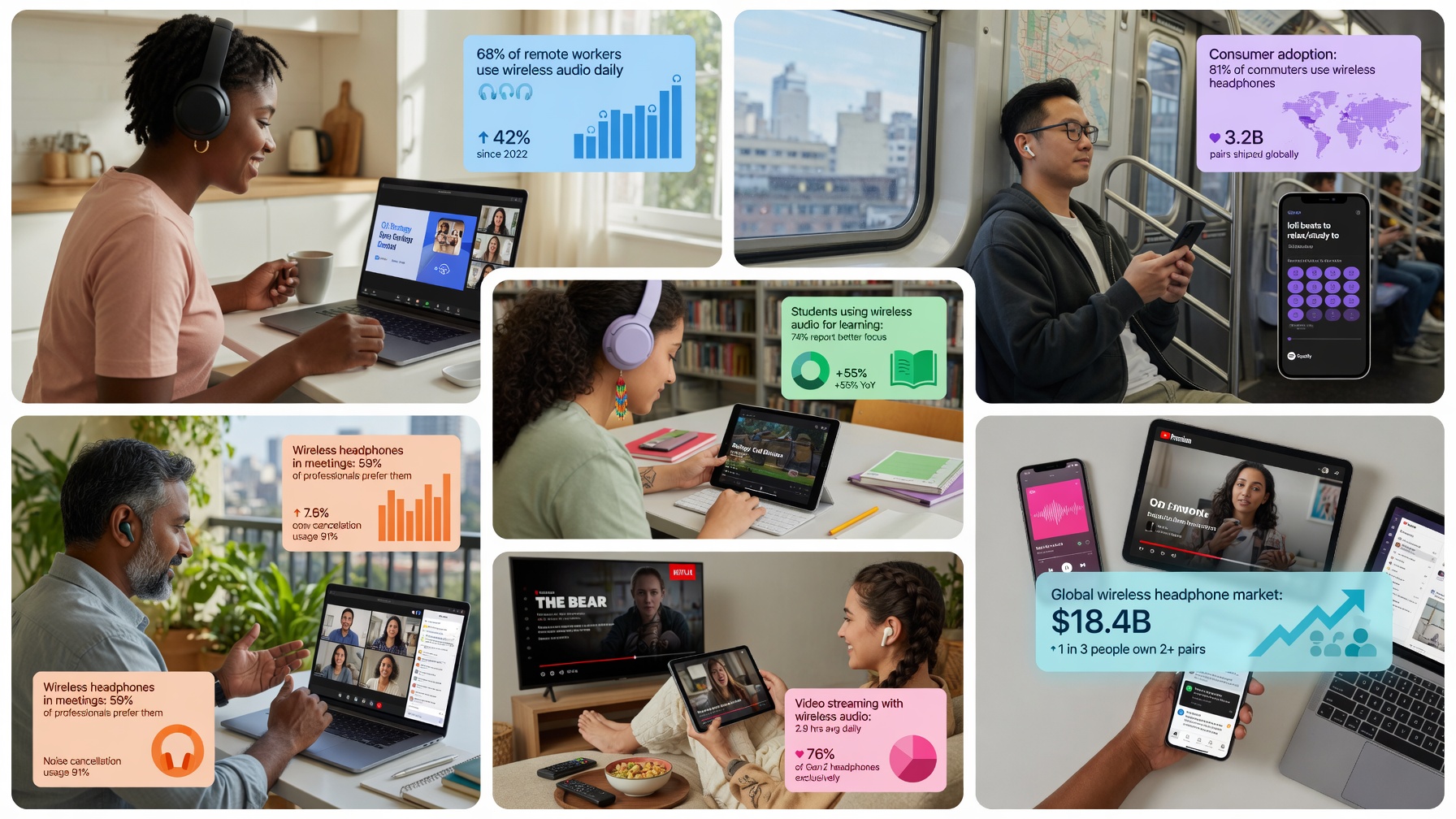
Wireless & Bluetooth Headphone Statistics
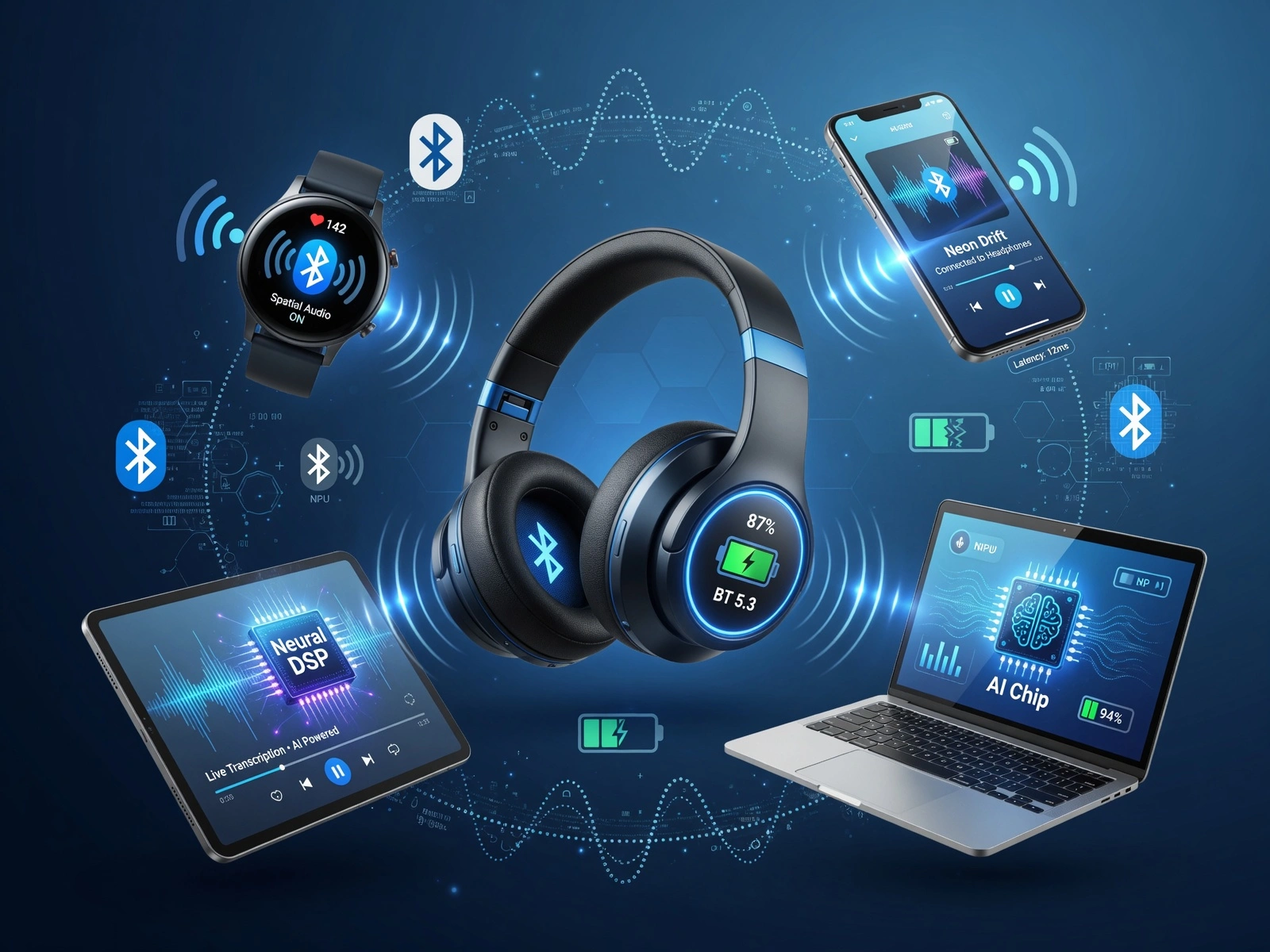
Wireless technology has become the defining feature of the modern headphone market. Consumers have moved away from wired connections because Bluetooth headphones offer greater mobility, easier device pairing, and better integration with smartphones, laptops, and smart devices.
The shift is supported by both consumer behavior research and market data. Bluetooth headphones are no longer limited to casual music listening. They now support productivity, gaming, fitness, travel, calls, and emerging smart features such as voice assistants and health monitoring.
Wireless Headphone Market Statistics
| Metric | Value | Source |
|---|---|---|
| Global Bluetooth headphones market size (2024) | US$16.1 billion | Grand View Research |
| Estimated Bluetooth headphones market size (2026) | US$18.8 billion | Grand View Research |
| Forecast Bluetooth headphones market size (2030) | US$24.3 billion | Grand View Research |
| Bluetooth headphones CAGR (2025–2030) | 6.8% | Grand View Research |
| Asia-Pacific Bluetooth headphones revenue share (2024) | 33.1% | Grand View Research |
| Wireless segment position in earphones/headphones market | Largest technology segment | Grand View Research |
Bluetooth Becomes the Default Connection Standard
Bluetooth has become the dominant wireless technology for personal audio products. The growth of smartphones without traditional headphone ports has accelerated adoption, especially for true wireless earbuds and compact headphones.
Grand View Research estimates that the global Bluetooth headphones market will grow from US$16.1 billion in 2024 to US$18.8 billion in 2026. The market is projected to reach US$24.3 billion by 2030, representing a 6.8% CAGR between 2025 and 2030.
This growth reflects a broader consumer shift toward cable-free devices. Manufacturers have improved Bluetooth reliability, latency performance, battery efficiency, and audio quality, reducing many disadvantages that previously limited wireless headphones.
True Wireless Earbuds Drive Wireless Adoption
Compact wireless earbuds have become one of the fastest-growing categories within personal audio. Grand View Research reports that the earphones segment generated 60.4% of global earphones and headphones market revenue in 2025.
The popularity of true wireless stereo (TWS) earbuds comes from several factors:
- Smaller designs.
- Charging cases that extend battery life.
- Better smartphone integration.
- Active noise cancellation.
- Touch controls.
- Voice assistant support.
Consumers increasingly choose earbuds because they are easy to carry and suitable for commuting, exercise, and daily communication.
Wireless Audio Adoption in Everyday Computing
Wireless headphones are becoming common accessories for laptop users. Qualcomm’s State of Sound 2025 research surveyed 3,500 laptop users across seven countries and found that more than one-third of respondents use wireless earbuds or headphones with their laptops every day.
The same research found that more than 70% of respondents watch videos on personal laptops, with music listening, gaming, and video calls among the leading audio activities.
These findings show that headphones are increasingly part of everyday digital work rather than only entertainment.
| Usage Trend | Statistic | Source |
|---|---|---|
| Laptop users surveyed | 3,500 people across 7 countries | Qualcomm State of Sound 2025 |
| Daily wireless earbud/headphone use with laptops | More than one-third | Qualcomm State of Sound 2025 |
| Laptop users watching videos | More than 70% | Qualcomm State of Sound 2025 |
Battery Life Becomes a Major Buying Factor
Wireless headphones depend on battery performance, making battery life one of the most important purchase considerations.
Qualcomm’s State of Sound 2025 research found that battery life, comfort, and sound quality were the top three criteria for wireless audio devices used with laptops.
This has pushed manufacturers to improve:
- Fast charging.
- Larger battery capacity.
- Lower-power Bluetooth chips.
- Smarter power management.
- Charging cases for earbuds.
Longer battery life has also expanded headphone use beyond short listening sessions. Consumers increasingly expect headphones to last through workdays, travel, and entertainment.
Asia-Pacific Leads Bluetooth Headphone Demand
Asia-Pacific remains the largest regional market for Bluetooth headphones. Grand View Research estimates that the region accounted for 33.1% of global Bluetooth headphone revenue in 2024.
The region benefits from:
- Large smartphone user populations.
- Strong electronics manufacturing.
- Expanding e-commerce.
- Growing middle-class consumer spending.
China plays an especially important role because many leading electronics manufacturers operate in the region, supporting both production and domestic demand.
Wireless Headphones Move Beyond Audio
Modern wireless headphones are becoming multifunctional devices. Manufacturers increasingly add features that extend beyond traditional playback, including:
- Active noise cancellation.
- Spatial audio.
- Voice assistants.
- Biometric sensors.
- Hearing-related features.
- AI-powered audio processing.
Grand View Research notes that Bluetooth headphone growth is being supported by features such as noise cancellation, hands-free calling, surround sound, biometric monitoring, and gesture recognition.
Academic researchers are also exploring next-generation wireless earbuds with AI capabilities. Recent research has examined earbuds that integrate speech AI processing and visual intelligence while operating under strict power limitations.
Key Findings From Wireless Headphone Data
The available statistics reveal several important market trends:
- Wireless is now the dominant headphone category. Consumers increasingly prefer Bluetooth products because they combine portability with advanced features.
- True wireless earbuds are driving category growth. Compact designs and smartphone integration have made earbuds a major part of the personal audio market.
- Battery life influences purchasing decisions. Consumers want wireless devices that can support long listening sessions without frequent charging.
- Headphones are becoming smart devices. Future products are likely to combine audio, AI, sensing, and communication features.
Headphone Buying Behavior & Consumer Preference Statistics
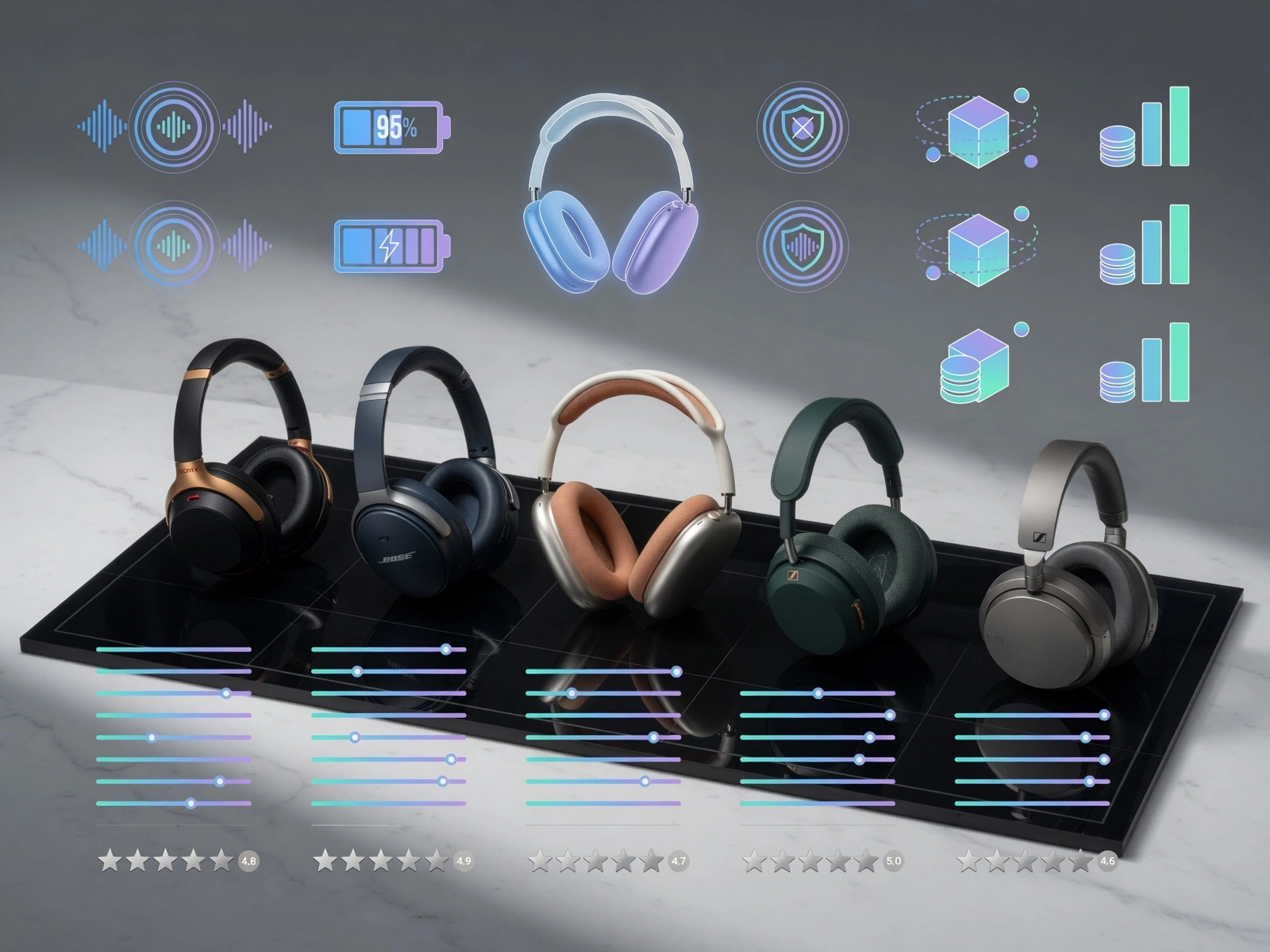
Consumers are no longer choosing headphones based only on price or brand recognition. Modern buyers evaluate multiple factors, including sound quality, comfort, battery life, noise cancellation, connectivity, and smart features.
As headphones become devices used for work, entertainment, gaming, and communication, purchase decisions have become more feature-driven. Research from Qualcomm shows that consumers increasingly expect one device to support several activities instead of buying separate products for different needs.
Consumer Purchase Decision Statistics
| Metric | Value | Source |
|---|---|---|
| Laptop users surveyed | 3,500 consumers across 7 countries | Qualcomm State of Sound 2025 |
| Top three wireless audio purchase factors | Battery life, comfort, sound quality | Qualcomm State of Sound 2025 |
| Consumers wanting one device for music, gaming, and calls | 68% | Qualcomm State of Sound 2023 |
| Consumers wanting improving sound quality with each purchase | 73% | Qualcomm State of Sound 2023 |
| Consumers listing lossless audio as a likely purchase driver | 69% | Qualcomm State of Sound 2023 |
| Consumers identifying comfort as the top true wireless earbud purchase driver | #1 purchase driver | Qualcomm State of Sound 2023 |
Sound Quality Remains the Main Consumer Priority
Audio performance continues to influence headphone purchasing decisions. Consumers expect improvements in clarity, detail, bass response, and overall listening quality with every upgrade.
Qualcomm’s State of Sound 2023 report found that 73% of respondents said they want sound quality to improve with each device purchase. The percentage increased from 67% in 2022, showing stronger demand for premium audio experiences.
The same report found that 69% of consumers considered lossless audio quality a likely purchase driver. This demand has encouraged manufacturers to introduce high-resolution codecs, improved wireless transmission technologies, and premium audio processing features.
| Sound Quality Preference | Value | Source |
|---|---|---|
| Consumers wanting better sound quality with each purchase | 73% | Qualcomm State of Sound 2023 |
| Consumers considering lossless audio a purchase driver | 69% | Qualcomm State of Sound 2023 |
The data suggests that buyers are becoming more aware of audio quality differences. Features once limited to high-end products are increasingly becoming expected in mainstream headphones.
Comfort Becomes More Important for Long Listening Sessions
Comfort has become a major buying factor because consumers wear headphones for longer periods than before. Remote work, online meetings, gaming, and entertainment have increased daily headphone usage.
Qualcomm’s research found that comfort became the number one purchase driver for true wireless earbuds in its 2023 survey. The report linked this shift to longer wearing times and increased dependence on personal audio devices.
| Comfort Statistic | Value | Source |
|---|---|---|
| Comfort ranking for true wireless earbuds | #1 purchase driver | Qualcomm State of Sound 2023 |
| Main comfort challenge | Devices becoming uncomfortable during extended use | Qualcomm State of Sound 2023 |
Manufacturers now focus on:
- lighter headphone frames,
- improved ear pad materials,
- smaller earbuds,
- better ear tip designs,
- improved weight balance.
Comfort is no longer a secondary feature. For many buyers, it determines whether a product can be used throughout the day.
Consumers Want One Headphone for Multiple Activities
Modern buyers increasingly prefer multipurpose audio devices. Instead of owning separate headphones for music, gaming, and calls, consumers want one product that performs well across different situations.
Qualcomm found that 68% of respondents wanted to use the same earbuds or headphones for all activities, including music, gaming, and calls.
| Multi-Purpose Usage Statistic | Value | Source |
|---|---|---|
| Consumers wanting one device for multiple activities | 68% | Qualcomm State of Sound 2023 |
This preference explains why manufacturers continue adding features such as:
- low-latency gaming modes,
- clearer microphones,
- multipoint Bluetooth connections,
- adaptive noise cancellation,
- spatial audio.
The market is moving toward all-purpose personal audio devices rather than single-use accessories.
Battery Life Influences Wireless Headphone Purchases
Battery performance is one of the biggest concerns for wireless headphone buyers. Unlike wired models, wireless headphones depend on internal batteries, making endurance a key factor in user satisfaction.
Qualcomm’s State of Sound 2025 research identified battery life as the top consideration for wireless audio devices used with laptops, followed by comfort and sound quality.
| Battery Preference Statistic | Value | Source |
|---|---|---|
| Top wireless headphone purchase factor | Battery life | Qualcomm State of Sound 2025 |
| Other leading factors | Comfort and sound quality | Qualcomm State of Sound 2025 |
Battery improvements have become a competitive advantage. Companies now promote:
- longer playback time,
- fast charging,
- efficient Bluetooth chips,
- charging cases for earbuds.
Long battery life is especially important for travelers, remote workers, and users who wear headphones for several hours daily.
Noise Cancellation Gains Consumer Attention
Active noise cancellation (ANC) has become one of the most recognized premium headphone features. Consumers use ANC headphones in offices, airplanes, public transportation, and shared environments.
Although ANC adoption statistics vary by market and research methodology, industry studies consistently identify noise reduction as a major factor in premium headphone purchases. Qualcomm research highlights growing interest in advanced audio features such as improved calls, spatial audio, and immersive listening experiences.
The growth of hybrid work has increased demand for headphones that help users focus and communicate in noisy environments.
Consumers Increasingly Value Premium Audio Features
Headphone buyers are showing stronger interest in features beyond basic playback.
Popular premium features include:
- lossless audio,
- spatial audio,
- adaptive ANC,
- improved microphones,
- AI-powered sound processing.
Qualcomm’s research found that more than half of respondents in its 2022 State of Sound report said spatial audio would influence their next true wireless earbud purchase, while 41% said they would be willing to spend more for the feature.
| Premium Feature Preference | Value | Source |
|---|---|---|
| Consumers influenced by spatial audio when buying earbuds | More than 50% | Qualcomm State of Sound 2022 |
| Consumers willing to pay more for spatial audio | 41% | Qualcomm State of Sound 2022 |
These findings show that consumers are willing to pay for meaningful improvements rather than simple hardware upgrades.
Key Findings From Buying Behavior Data
Consumer purchasing trends reveal several important patterns:
- Audio quality remains central to buying decisions. Buyers continue to expect better sound performance from every upgrade.
- Comfort has become critical because listening sessions are longer. Consumers need headphones that remain comfortable throughout work, travel, and entertainment.
- Versatility influences product choice. Users prefer headphones that handle music, calls, gaming, and video instead of separate devices.
- Premium features can justify higher prices. Interest in spatial audio and lossless audio shows that consumers are willing to pay for improved experiences.
Noise Cancellation, Gaming & Professional Headphone Statistics
 Headphones are expanding beyond basic music playback. Active noise cancellation (ANC), gaming features, and professional communication capabilities are becoming major drivers of product development and consumer demand.
ANC headphones have gained popularity because they solve a practical problem: reducing unwanted environmental noise. Consumers use them during commuting, travel, office work, studying, and entertainment. Gaming and professional users are also increasing demand for low-latency audio, clearer microphones, and immersive sound features.
Active Noise Cancellation (ANC) Headphone Statistics
Active noise cancellation uses microphones and signal processing technology to detect external sounds and generate an opposite signal that reduces background noise. Modern ANC systems increasingly use adaptive algorithms that adjust performance based on the environment and the user’s fit.
ANC Market Growth Statistics
| Metric | Value | Source |
|---|---|---|
| Global ANC headphones market size (2025) | US$14.5 billion | IMARC Group |
| Forecast ANC headphones market size (2034) | US$35.3 billion | IMARC Group |
| ANC market CAGR (2026–2034) | 10.13% | IMARC Group |
| Global ANC headphones market size (2025) | US$20.38 billion | Mordor Intelligence |
| Forecast ANC headphones market size (2031) | US$44.76 billion | Mordor Intelligence |
| ANC market CAGR (2026–2031) | 14.01% | Mordor Intelligence |
Why ANC Demand Continues to Increase
The ANC market is growing because consumers increasingly use headphones in noisy environments. Open offices, public transportation, airports, and shared homes have increased demand for personal listening spaces.
ANC technology has also moved from premium headphones into more affordable earbuds. Features once limited to expensive models are now available in mid-range products, increasing adoption among mainstream consumers.
Qualcomm identifies adaptive ANC as a key development area in wireless audio. Modern systems can adjust noise reduction based on changing environments, ear fit, and listening conditions.
The market growth figures differ between research companies because definitions vary. Some reports focus only on ANC headphones, while others include different product types, price segments, and applications. These differences explain why forecasts range from around US$35 billion to more than US$44 billion within similar periods.
Wireless ANC Dominates the Market
Wireless connectivity has become closely linked with noise cancellation. Most ANC headphones rely on Bluetooth because consumers want freedom of movement and compatibility with smartphones and laptops.
| Metric | Value | Source |
|---|---|---|
| Wireless share of ANC headphone revenue (2023) | 87% | Research and Markets analysis |
| Gaming share of ANC headphone applications (2023) | 27% | Research and Markets analysis |
| Expected ANC headphone usage volume by 2031 | 272.69 million units | Research and Markets analysis |
The dominance of wireless ANC products reflects changing consumer expectations. Users want headphones that combine convenience, sound quality, and noise reduction without cables.
Gaming Headphone Statistics
Gaming has become an important segment within the headphone industry. Players increasingly demand accurate audio positioning, low latency, strong microphones, and long battery life.
Gaming headphones support competitive gaming by helping players identify directional sounds such as footsteps, vehicle movement, and environmental effects.
Gaming Headset Market Statistics
| Metric | Value | Source |
|---|---|---|
| Gaming segment share of ANC headphone market (2023) | 27% | Research and Markets analysis |
| Forecast gaming headset CAGR (2026–2031) | 15.11% | Mordor Intelligence |
| Gaming included as a major ANC application segment | Yes | Mordor Intelligence |
Gaming headphone growth is supported by several factors:
- Expansion of esports.
- Growth of multiplayer gaming.
- Demand for immersive audio.
- Increased popularity of wireless gaming accessories.
Manufacturers are also adding features designed specifically for gamers, including:
- ultra-low latency connections,
- detachable microphones,
- spatial audio,
- customizable equalizer settings,
- cross-platform compatibility.
Professional & Workplace Headphone Statistics
Headphones have become important workplace tools because remote and hybrid work require reliable communication equipment.
Professionals increasingly use headphones for:
- video meetings,
- customer support,
- online training,
- collaboration platforms,
- focused work sessions.
Qualcomm’s State of Sound 2025 research found that more than one-third of laptop users use wireless earbuds or headphones daily with their laptops. The study surveyed 3,500 laptop users across seven countries.
| Workplace Audio Statistic | Value | Source |
|---|---|---|
| Wireless headphone daily use with laptops | More than one-third of respondents | Qualcomm State of Sound 2025 |
| Laptop users surveyed | 3,500 across 7 countries | Qualcomm State of Sound 2025 |
| Leading laptop audio activities | Music, video, calls | Qualcomm State of Sound 2025 |
This shift has changed headphone design priorities. Professional users now care about microphone quality and background noise reduction as much as music performance.
AI and Smart Audio Features
The next generation of headphones is moving toward intelligent audio systems. Manufacturers are integrating AI features that improve:
- voice clarity,
- adaptive noise cancellation,
- personalized sound profiles,
- environmental awareness.
Qualcomm’s ANC technology uses AI-driven adaptive systems that can automatically adjust noise cancellation based on the user’s surroundings.
Researchers are also exploring AI-enabled earbuds that combine audio processing with additional computing capabilities. Academic work on intelligent earable devices highlights the potential for future headphones to become wearable computing platforms rather than simple playback devices. ([Qualcomm][2])
Key Findings From ANC, Gaming & Professional Audio Data
1. ANC Is Becoming a Mainstream Feature
Noise cancellation has moved from premium headphones into everyday consumer products. Market forecasts consistently show strong growth, although estimates vary because researchers define the category differently.
2. Gaming Is One of the Fastest-Growing Applications
Gaming users demand specialized features, and research forecasts indicate gaming-related headphone segments are expected to grow faster than many traditional audio categories.
3. Headphones Are Becoming Productivity Tools
Wireless headphones now support professional communication as much as entertainment. Daily use among laptop users shows that personal audio has become part of modern digital workflows.
4. Smart Features Will Shape Future Competition
Future headphone competition will likely focus on AI-powered audio adjustment, adaptive noise cancellation, health-related features, and improved voice communication.
Regional Headphone Market Statistics & Global Adoption Trends
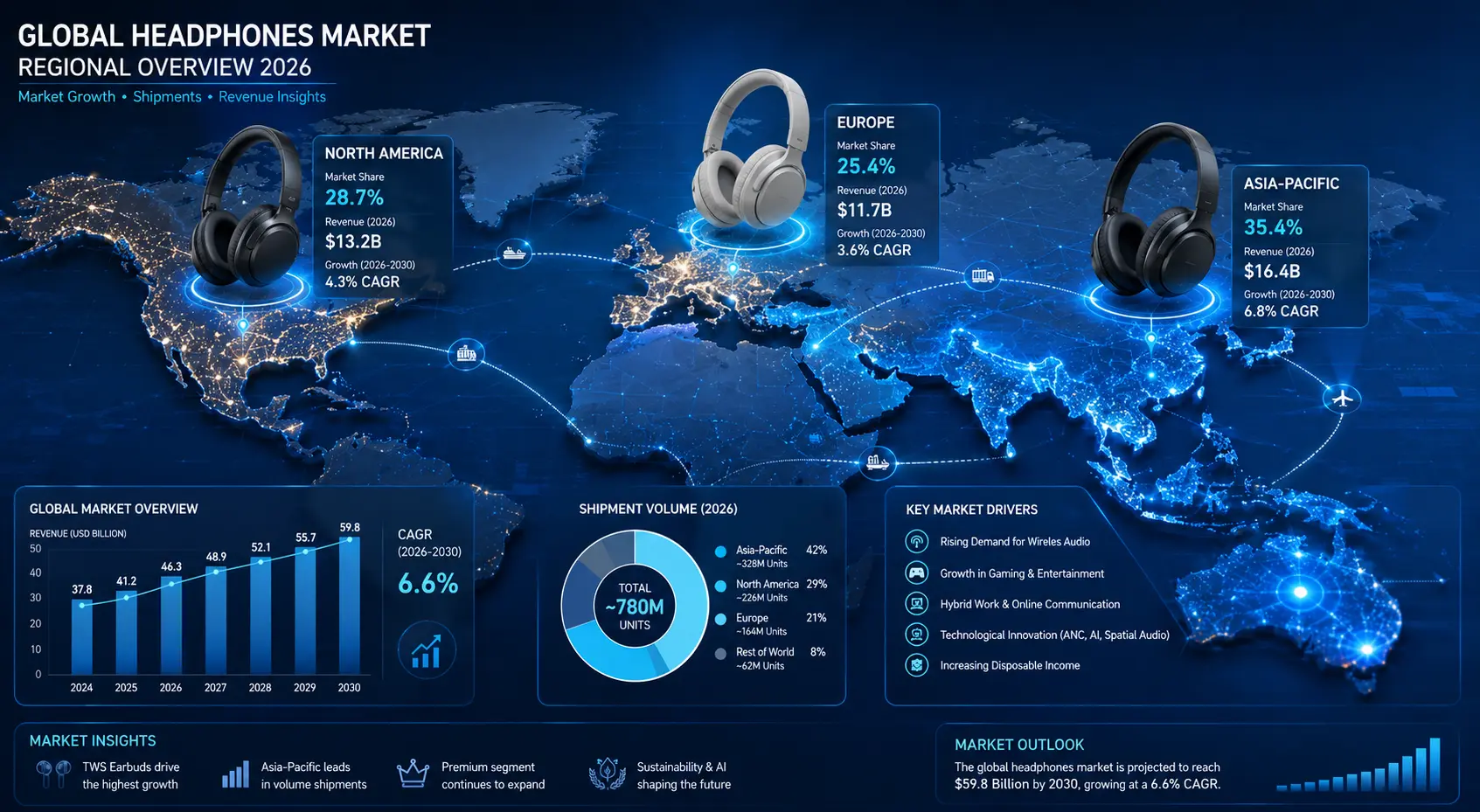
The headphone market is expanding across every major region, but growth patterns differ significantly. Asia-Pacific currently leads global revenue, while North America and Europe remain important premium markets because consumers show strong demand for advanced features such as wireless connectivity, active noise cancellation (ANC), and high-fidelity audio.
Regional performance depends on several factors:
- Smartphone adoption rates.
- Consumer purchasing power.
- E-commerce growth.
- Local manufacturing capabilities.
- Demand for premium audio features.
- Growth of gaming and remote work.
Market researchers often disagree on regional rankings because they measure different categories. Some focus only on consumer headphones, while others include earphones, Bluetooth headsets, and broader personal audio devices.
Global Regional Headphone Market Statistics
| Metric | Value | Source |
|---|---|---|
| Global consumer headphones revenue (2026) | US$46.26 billion | Statista Market Forecast |
| Largest country market in 2026 | China | Statista Market Forecast |
| China headphone revenue (2026) | US$10.5 billion | Statista Market Forecast |
| Asia-Pacific share of earphones & headphones market (2025) | 35.4% | Grand View Research |
| Asia-Pacific share of Bluetooth headphones market (2024) | 33.1% | Grand View Research |
| Largest regional market for earphones and headphones | Asia-Pacific | Grand View Research |
Asia-Pacific Leads Global Demand
Asia-Pacific is the largest headphone market by regional revenue. Grand View Research estimates that the region accounted for 35.4% of global earphones and headphones revenue in 2025. The region also held the largest share of the Bluetooth headphones market, representing 33.1% of global revenue in 2024.
Several factors support Asia-Pacific growth:
- Large smartphone user populations.
- Strong electronics manufacturing ecosystems.
- Rapid e-commerce adoption.
- Growing middle-class consumer spending.
- Expanding gaming markets.
China is the biggest individual country market. Statista estimates that China will generate US$10.5 billion in headphone revenue in 2026, making it the leading national market worldwide.
The region also benefits from local competition. Domestic brands have expanded rapidly by offering affordable wireless earbuds and headphones with features previously found mainly in premium products.
North America Remains a Premium Audio Market
North America continues to represent one of the most valuable headphone markets because consumers show strong demand for premium products.
The region has high adoption of:
- Wireless headphones.
- ANC models.
- Gaming headsets.
- Professional communication devices.
- Smart audio products.
Statista identifies the United States as one of the leading markets globally for headphones, with strong consumer adoption and continued innovation from major audio companies.
North American consumers are also more likely to purchase premium headphones with advanced features. Products offering better microphones, adaptive noise cancellation, spatial audio, and multi-device connectivity continue to attract buyers.
Europe Shows Strong Demand for Premium Features
Europe remains an important headphone market, particularly for consumers interested in sound quality, sustainability, and premium audio experiences.
European demand is influenced by:
- High smartphone penetration.
- Growth of streaming services.
- Increased remote and hybrid work.
- Demand for environmentally responsible products.
The European market has also seen increased interest in repairability, battery longevity, and responsible electronics production. These factors are becoming more important as consumers consider the long-term value of personal electronics.
Emerging Markets Expand Headphone Adoption
Developing markets are contributing to future headphone growth. Rising smartphone ownership, affordable wireless products, and improved internet access are increasing demand across regions such as:
- Southeast Asia.
- India.
- Latin America.
- Middle East and Africa.
Affordable true wireless earbuds have helped expand headphone ownership because they offer many premium features at lower prices.
The growth of online retail has also made headphones easier to purchase in markets where traditional electronics stores have limited reach.
Regional Market Comparison
| Region | Market Trend | Main Growth Drivers | Source |
|---|---|---|---|
| Asia-Pacific | Largest regional market | Smartphones, manufacturing, e-commerce | Grand View Research |
| China | Largest country market | Consumer electronics demand, local brands | Statista |
| North America | Premium feature adoption | ANC, wireless, gaming, professional use | Statista |
| Europe | Premium and sustainable products | Audio quality, environmental preferences | Industry market analysis |
| Emerging markets | Expanding adoption | Affordable wireless devices, internet growth | Industry market analysis |
Regional Differences in Consumer Preferences
Different regions often prioritize different headphone features.
Asia-Pacific
Consumers frequently prioritize:
- Affordable pricing.
- Battery life.
- Compact designs.
- Wireless convenience.
The popularity of true wireless earbuds is particularly strong because they fit mobile lifestyles and work well with smartphones.
North America
Consumers often focus on:
- Premium sound quality.
- Brand reputation.
- ANC performance.
- Productivity features.
The popularity of remote work and professional communication has increased demand for headphones with high-quality microphones and reliable connections.
Europe
European buyers increasingly consider:
- Audio performance.
- Product durability.
- Sustainability.
- Privacy and data protection in smart devices.
Premium headphones with longer lifespans and better repair options are gaining attention.
Why Regional Statistics Need Careful Interpretation
Market comparisons can become misleading when studies use different definitions.
For example:
- Statista’s consumer headphone market includes on-ear, earbud, and over-ear headphones sold through consumer channels.
- Grand View Research’s broader earphones and headphones category includes additional segments and technologies.
- Bluetooth headphone research measures only wireless products using Bluetooth technology.
Because these categories overlap but are not identical, regional revenue figures should always be compared alongside each report’s methodology.
Key Findings From Regional Data
1. Asia-Pacific Drives Global Volume
Asia-Pacific leads because it combines large consumer populations, strong manufacturing capacity, and rapid adoption of wireless audio products.
2. China Remains the Largest Individual Market
China’s projected US$10.5 billion headphone revenue in 2026 makes it the largest country market in consumer headphone spending.
3. Premium Features Shape Mature Markets
North America and Europe continue to drive demand for advanced headphones with ANC, better microphones, and high-quality audio features.
4. Affordable Wireless Products Expand Global Adoption
Lower-cost wireless earbuds are helping more consumers access personal audio devices in developing regions.
Hearing Health, Safe Listening & Headphone Usage Risks Statistics
The rapid growth of headphones and earbuds has created new concerns around hearing health. Personal audio devices allow people to listen anywhere and anytime, but frequent exposure to high sound levels can increase the risk of noise-induced hearing damage.
The World Health Organization (WHO) identifies unsafe listening through personal audio devices and loud entertainment environments as a major public health concern. WHO estimates that more than 1 billion young people aged 12–35 are at risk of hearing loss due to unsafe recreational listening practices.
However, headphones themselves are not automatically harmful. The primary risks come from excessive volume, long exposure duration, and repeated exposure without recovery time. Safe listening habits, volume controls, and responsible device design can reduce these risks.
Hearing Health Statistics Related to Headphones
| Metric | Value | Source |
|---|---|---|
| Young people at risk of hearing loss from unsafe listening | More than 1 billion people aged 12–35 | WHO |
| People worldwide requiring rehabilitation for disabling hearing loss | 430 million | WHO |
| Children aged 5–19 living with hearing loss | 95.1 million | WHO |
| People projected to have some degree of hearing loss by 2050 | Nearly 2.5 billion | WHO |
| People projected to require hearing rehabilitation by 2050 | More than 700 million | WHO |
| Annual global economic cost of unaddressed hearing loss | Nearly US$1 trillion | WHO |
More Than 1 Billion Young People Face Unsafe Listening Risks
Headphone adoption has grown rapidly among teenagers and young adults. Smartphones, streaming platforms, gaming, and social media have made personal listening a daily activity for many users.
WHO estimates that over 1 billion people between 12 and 35 years old are at risk of permanent hearing loss because of unsafe listening practices. These practices include listening at excessive volumes through personal audio devices and spending time in loud entertainment environments.
The risk does not come from headphone ownership alone. The main factors are:
- Volume level.
- Listening duration.
- Frequency of exposure.
- Lack of breaks.
- Poor awareness of safe listening limits.
Global Hearing Loss Is Increasing
Hearing health challenges extend beyond headphone users. WHO estimates that more than 430 million people worldwide currently require rehabilitation for disabling hearing loss, including 34 million children.
The organization projects that by 2050, nearly 2.5 billion people will have some degree of hearing loss, with more than 700 million people requiring hearing rehabilitation.
These projections highlight why manufacturers, regulators, and consumers are paying more attention to safe listening technology.
Personal Audio Devices and Listening Behavior
The growth of smartphones and wireless earbuds has changed how people consume audio. Users now carry listening devices throughout the day and may use them during commuting, studying, working, exercising, and gaming.
A 2022 systematic review and meta-analysis published in BMJ Global Health examined unsafe listening practices among adolescents and young adults. The researchers analyzed 33 studies involving 19,046 participants aged 12–34 years. The review estimated that unsafe listening through personal listening devices affected approximately 23.81% of participants.
| Personal Listening Device Statistic | Value | Source |
|---|---|---|
| Studies included in systematic review | 33 studies | BMJ Global Health systematic review |
| Participants analyzed | 19,046 people | BMJ Global Health systematic review |
| Age range studied | 12–34 years | BMJ Global Health systematic review |
| Estimated unsafe listening from personal devices | 23.81% | BMJ Global Health systematic review |
Safe Listening Features Become More Important
The headphone industry is responding to hearing concerns by adding features designed to encourage safer listening.
The WHO-ITU safe listening standard recommends that personal audio devices include features such as:
- Sound exposure tracking.
- Volume limiting options.
- Personalized listening profiles.
- Notifications when users exceed recommended exposure levels.
These features are becoming increasingly relevant as headphones become smarter. Modern wireless earbuds already include sensors, apps, and software controls that can monitor listening behavior.
Noise Cancellation May Help Reduce Volume Exposure
Active noise cancellation (ANC) is often marketed as a premium feature, but it may also support safer listening habits.
In noisy environments, users often increase volume to overcome background sounds. ANC headphones reduce external noise, allowing users to hear content more clearly at lower volume levels.
However, the ANC does not eliminate hearing risks. Listening for extended periods at high volume can still contribute to hearing damage.
The safest approach remains:
- Keep volume at moderate levels.
- Take listening breaks.
- Avoid long exposure to loud audio.
- Use device safety features when available.
Gaming and Hearing Health Concerns
Gaming has become another area of interest for hearing researchers. Long gaming sessions often involve headphones, especially among competitive players and esports communities.
WHO has highlighted research examining hearing risks associated with video gaming and esports exposure. The organization references studies investigating unsafe listening practices in gaming environments as part of its safe listening initiative.
Gaming headset manufacturers are responding with features such as:
- Volume limiters.
- Custom sound profiles.
- Better microphone processing.
- Lower-latency wireless connections.
These features improve the gaming experience while also creating opportunities for safer audio use.
Headphones as Future Hearing Technology
Although headphones are often discussed as a potential hearing risk, they are also becoming part of hearing-related technology.
Researchers are exploring earbuds that can perform hearing screening and assistive audio functions. One academic study demonstrated wireless earbuds capable of detecting otoacoustic emissions, a measurement used in hearing assessment. The research reported 100% sensitivity and 89.7% specificity in identifying hearing loss during its clinical study.
This suggests future earbuds may combine entertainment, communication, and health monitoring features.
Safe Listening Statistics Summary
| Finding | Importance | Source |
|---|---|---|
| Over 1 billion young people are at risk from unsafe listening | Shows global scale of hearing exposure risks | WHO |
| 430 million people require rehabilitation for disabling hearing loss | Demonstrates worldwide hearing health burden | WHO |
| Nearly 2.5 billion people may experience hearing loss by 2050 | Shows future healthcare challenge | WHO |
| 23.81% unsafe listening exposure estimate among young people using personal listening devices | Shows prevalence of risky behavior | BMJ Global Health |
| Smart earbuds may support hearing screening | Shows future health applications | Academic research |
Key Findings From Hearing Health Data
1. Headphone Safety Depends on Usage Habits
The evidence does not show that headphones alone cause hearing loss. The main risks come from unsafe listening patterns, especially high volume and long exposure times.
2. Younger Users Require More Awareness
Teenagers and young adults represent a major risk group because they frequently use personal audio devices and participate in loud recreational activities.
3. Safety Features Will Become Industry Standards
Volume monitoring, exposure tracking, and personalized audio controls are likely to become more common as consumers and regulators focus on hearing protection.
4. Earbuds May Become Health Devices
Future wireless earbuds may move beyond entertainment by offering hearing assessments, health monitoring, and personalized audio assistance.
Future Headphone Industry Trends, AI Audio, Spatial Sound & Market Forecasts
The next phase of headphone innovation is moving beyond better speakers and longer battery life. Future headphones are expected to become intelligent audio platforms that combine artificial intelligence, spatial computing, health monitoring, and advanced wireless connectivity.
The industry is shifting from traditional headphones that simply reproduce sound toward smart hearables that understand the listener, adapt to environments, and provide personalized experiences. Research from Bluetooth SIG, academic institutions, and technology companies shows that emerging technologies such as Bluetooth LE Audio, Auracast, AI-based audio processing, and adaptive sound systems will influence future product development.
Future Headphone Market Statistics
| Metric | Value | Source |
|---|---|---|
| Bluetooth peripheral audio device shipments forecast for 2027 | Nearly 1.5 billion units annually | ABI Research via Bluetooth SIG |
| TWS earbud shipments forecast for 2027 | More than 730 million units | ABI Research via Bluetooth SIG |
| Bluetooth earbuds forecast share of wireless headsets by 2026 | 66% | Bluetooth SIG market update |
| Bluetooth locations with potential for Auracast deployment | More than 60 million locations | Bluetooth SIG |
| AI speech processing latency demonstrated in wireless hearables research | 5.54 milliseconds | Academic research |
| AI hearable system power consumption demonstrated | 71.6 mW | Academic research |
AI Will Transform Headphones Into Intelligent Devices
Artificial intelligence is becoming one of the biggest technology shifts in personal audio. Future headphones will increasingly use AI to process sound in real time, improve voice quality, personalize audio, and adapt to different environments.
Academic researchers have already demonstrated wireless hearable systems capable of running speech AI directly on small, battery-powered devices. One research project developed an on-device speech enhancement system that processed audio in real time with 5.54 milliseconds of inference time while consuming 71.6 mW of power.
This development matters because traditional AI processing often depends on cloud servers. On-device AI reduces latency, improves privacy, and allows headphones to operate independently from smartphones or internet connections.
Future AI headphone features may include:
- Automatic hearing personalization.
- Real-time translation.
- Improved voice isolation.
- Adaptive equalization.
- Environmental sound recognition.
- Personalized hearing assistance.
Spatial Audio Becomes a Core Premium Feature
Spatial audio is moving from a niche entertainment feature into a mainstream headphone capability. The technology creates a three-dimensional sound experience by simulating the position and movement of audio sources around the listener.
Researchers studying spatial audio describe it as an important technology for immersive entertainment, gaming, virtual environments, and remote collaboration.
Modern spatial audio systems increasingly combine:
- Head tracking.
- Motion sensors.
- Digital signal processing.
- Object-based audio.
- Personalized sound profiles.
These improvements allow headphones to create more realistic experiences because sound can change based on the listener’s head movement and position.
Bluetooth LE Audio Will Reshape Wireless Connectivity
Bluetooth LE Audio represents one of the largest changes in wireless audio technology. It introduces improved efficiency, better power management, and new capabilities such as Auracast broadcast audio.
Bluetooth SIG reports that LE Audio can deliver higher audio quality while using less power. The technology also enables new applications, including public audio broadcasts and improved accessibility solutions for hearing assistance.
Bluetooth LE Audio Statistics
| Metric | Value | Source |
|---|---|---|
| Annual Bluetooth peripheral audio shipments forecast for 2027 | Nearly 1.5 billion | ABI Research via Bluetooth SIG |
| TWS earbuds forecast within 2027 Bluetooth audio shipments | More than 730 million | ABI Research via Bluetooth SIG |
| Potential Auracast deployment locations | More than 60 million | Bluetooth SIG |
Auracast Could Change Public Audio Experiences
Auracast is a Bluetooth broadcast technology that allows one audio source to transmit to multiple receivers. Unlike traditional Bluetooth connections, which usually connect one source to one or a few devices, Auracast can support large-scale audio sharing.
Potential applications include:
- Airports.
- Museums.
- Stadiums.
- Universities.
- Public announcements.
- Hearing assistance systems.
Bluetooth SIG estimates that more than 60 million locations could benefit from Bluetooth broadcast audio deployment over time.
For consumers, this could mean connecting personal earbuds directly to public audio systems without needing special equipment.
Hearables Become Health and Accessibility Devices
The headphone industry is moving closer to healthcare applications. Wireless earbuds already include sensors, microphones, and processing capabilities that can support hearing-related features.
Researchers have demonstrated earbuds capable of detecting hearing-related signals. These developments suggest future earbuds could perform functions such as:
- Hearing screening.
- Personalized sound enhancement.
- Environmental awareness.
- Assistive listening.
Academic research on intelligent hearables shows that small wireless devices can support advanced audio processing while maintaining strict battery limitations.
Personalization Will Drive Premium Headphone Sales
Future headphones will compete less on basic specifications and more on personalization.
A listener’s ideal sound profile depends on:
- Ear shape.
- Hearing ability.
- Music preferences.
- Environment.
- Activity.
Manufacturers are increasingly exploring adaptive systems that automatically adjust audio output based on these variables.
Examples include:
- Custom hearing profiles.
- Adaptive ANC.
- AI-powered equalizers.
- Automatic volume adjustment.
This trend moves headphones closer to personalized computing devices rather than standard consumer electronics.
Sustainability and Longer Product Lifecycles
Environmental concerns are also influencing headphone design. Manufacturers face increasing pressure to improve:
- Battery durability.
- Repairability.
- Material recycling.
- Software support periods.
Wireless earbuds create a particular challenge because small batteries can degrade over time and are difficult to replace.
Future competition may depend not only on new features but also on how long products remain usable.
Future Headphone Industry Forecast Summary
| Trend | Expected Impact | Source |
|---|---|---|
| AI audio processing | More personalized and adaptive sound experiences | Academic research |
| Bluetooth LE Audio | Lower power consumption and new wireless features | Bluetooth SIG |
| Auracast | Shared public audio experiences | Bluetooth SIG |
| Spatial audio | More immersive gaming and entertainment | Academic research |
| Smart hearables | Combination of audio, AI, and health features | Academic research |
| TWS growth | Continued expansion of wireless earbuds | ABI Research via Bluetooth SIG |
Key Findings From Future Headphone Data
1. Headphones Are Becoming Computing Platforms
Future headphones will likely combine audio playback with AI processing, sensors, and communication features.
2. Wireless Technology Will Continue Evolving
Bluetooth LE Audio and Auracast are expected to create new applications beyond traditional music listening.
3. AI Will Improve Personal Audio Experiences
Artificial intelligence will enable real-time sound adjustment, speech enhancement, and personalized listening.
4. Health Features Could Expand the Market
Earbuds may become tools for hearing support, accessibility, and wellness monitoring rather than only entertainment devices.
Headphone Industry Challenges, Competition & Market Barriers
Although the headphone market continues to grow, manufacturers face increasing pressure from pricing competition, supply chain risks, sustainability requirements, and rapidly changing consumer expectations.
The industry has reached a mature stage where basic wireless audio products are widely available. As a result, companies must compete through differentiation rather than simple product availability. Features such as active noise cancellation, AI audio processing, better microphones, and health-related capabilities are becoming important ways to justify premium pricing.
Headphone Industry Challenges Statistics
| Metric | Value | Source |
|---|---|---|
| Global headphone market volume performance in 2025 | Broadly flat | Futuresource Consulting analysis |
| Earphones share of global earphones/headphones revenue (2025) | 60.4% | Grand View Research |
| Wireless technology position (2025) | Largest technology segment | Grand View Research |
| Asia-Pacific revenue share (2025) | 35.4% | Grand View Research |
| Main supply chain dependencies | Semiconductors, batteries, acoustic components | Industry market analysis |
| Expected EU battery replacement rules affecting portable electronics | From 2027 | European Union battery regulation |
Price Competition Squeezes Manufacturers
One of the biggest challenges facing headphone companies is intense price competition.
The market now includes thousands of wireless earbuds and headphones across budget, mid-range, and premium categories. Lower-cost manufacturers have introduced products with features that were previously limited to expensive models, including:
- Active noise cancellation.
- Touch controls.
- Transparency modes.
- Multi-device pairing.
- High-resolution audio support.
Futuresource Consulting reported that while headphone demand remains stable, the market is becoming increasingly divided. Premium products continue to compete through innovation, while lower-priced segments face stronger pricing pressure and declining average selling prices.
This creates a difficult balance for brands:
| Market Segment | Main Challenge |
|---|---|
| Budget headphones | Low margins and aggressive competition |
| Mid-range headphones | Difficulty standing out |
| Premium headphones | Need for continuous innovation |
Supply Chain Dependence Creates Risks
Modern headphones depend on complex global supply chains. Key components include:
- Bluetooth chipsets.
- Battery cells.
- Digital signal processors.
- Microphones.
- Acoustic drivers.
Research on the earphones and headphones market identifies supply chain vulnerability as a continuing challenge because manufacturers depend heavily on Asian production networks and electronic component suppliers.
Wireless headphones face additional pressure because batteries determine product lifespan. Battery degradation can reduce user satisfaction and increase electronic waste.
| Supply Chain Challenge | Industry Impact |
|---|---|
| Semiconductor availability | Can delay production |
| Battery costs | Affects manufacturing expenses |
| Component shortages | Creates inventory problems |
| Manufacturing concentration | Increases regional risk |
Battery Life and Durability Remain Major Problems
Battery-powered headphones face a unique challenge compared with wired audio devices: the battery eventually loses capacity.
Many true wireless earbuds use small lithium-ion batteries that are difficult to replace because of their compact designs. This can shorten product lifecycles and increase consumer replacement rates.
The European Union is introducing regulations aimed at improving battery sustainability. New rules scheduled to affect portable electronics from 2027 include requirements related to battery replacement and durability. These changes could influence future headphone designs.
Manufacturers may need to rethink designs around:
- Replaceable batteries.
- Repair-friendly construction.
- Longer software support.
- Recyclable materials.
Sustainability Becomes a Competitive Factor
Environmental concerns are becoming more important in consumer electronics.
Headphone companies face pressure to reduce:
- Electronic waste.
- Battery waste.
- Plastic usage.
- Short product lifecycles.
Grand View Research notes that manufacturers are exploring recyclable materials and modular designs to improve product sustainability while maintaining performance.
However, sustainability creates engineering challenges because headphone designs must balance:
- Water resistance.
- Compact size.
- Battery protection.
- Repairability.
A smaller sealed design often improves durability against moisture but makes repairs more difficult.
Brand Competition Intensifies
The headphone market is highly competitive because major technology companies compete alongside specialized audio brands.
Large ecosystem companies benefit from integration with smartphones, operating systems, and other devices. Audio-focused companies compete through sound quality, professional expertise, and specialized features.
Competition is increasing around:
- AI-powered audio.
- Spatial sound.
- Hearing assistance.
- Fitness tracking.
- Translation features.
Grand View Research identifies major industry participants including companies such as Apple Inc., Samsung Electronics, Sony Corporation, and Bose Corporation.
Feature Differentiation Is Becoming Harder
As premium features move into affordable products, manufacturers face a challenge: creating meaningful differences.
A budget pair of earbuds can now include features such as:
- ANC.
- Wireless charging.
- App controls.
- Multiple microphones.
- Custom equalizers.
This reduces the gap between entry-level and premium products.
Companies increasingly compete through software rather than hardware alone:
- Personalized sound profiles.
- AI noise reduction.
- Firmware improvements.
- Ecosystem integration.
The headphone industry is moving closer to the smartphone model, where software experience influences product value.
Consumer Expectations Continue Rising
Consumers expect each new generation of headphones to improve in several areas simultaneously:
- Better sound.
- Longer battery life.
- Smaller designs.
- Stronger connectivity.
- More intelligent features.
Meeting all these expectations creates engineering challenges because improvements often conflict with each other.
For example:
- Larger batteries increase weight.
- Better noise cancellation requires more processing power.
- Smaller earbuds limit battery capacity.
- Waterproofing can reduce repairability.
Market Barriers for New Companies
New headphone brands face several barriers when entering the market.
1. Brand Recognition
Established companies already have customer trust and distribution networks.
2. Technology Investment
Advanced features require investment in:
- Acoustic engineering.
- Wireless technology.
- AI processing.
- Software development.
3. Manufacturing Scale
Large companies often achieve lower costs because they purchase components in higher volumes.
4. Distribution Competition
Major brands already occupy retail stores, online marketplaces, and smartphone ecosystems.
Future Industry Challenges
The headphone market will likely face several challenges through the rest of the decade:
| Challenge | Expected Impact |
|---|---|
| Lower average selling prices | Pressure on margins |
| Battery sustainability requirements | More complex product designs |
| AI competition | Higher R&D costs |
| Supply chain risks | Manufacturing uncertainty |
| Feature saturation | Harder product differentiation |
Key Findings From Industry Challenges Data
1. Growth Does Not Mean Easy Competition
The headphone market remains healthy, but companies must compete harder because consumers have many choices.
2. Premium Features Must Create Real Value
ANC, AI audio, and spatial sound help brands differentiate, but consumers increasingly expect these features at lower prices.
3. Sustainability Will Influence Future Designs
Battery replacement, repairability, and material choices will become more important as regulations and consumer expectations change.
4. Supply Chain Management Is a Strategic Advantage
Companies with stronger supplier relationships and manufacturing scale will have advantages in controlling costs and maintaining availability.
Headphones Statistics Summary, Methodology & References

The headphone industry is entering a mature but increasingly intelligent phase. Market growth is no longer driven only by selling more devices. Instead, manufacturers are competing through software, artificial intelligence, better wireless standards, health features, and personalized audio experiences.
The collected data shows five major themes:
- Wireless audio dominates consumer demand.
- True wireless earbuds remain the strongest growth category.
- Headphones are becoming productivity and communication tools.
- AI and smart features will define future competition.
- Hearing safety and sustainability are becoming industry priorities.
Market forecasts differ because research companies define the headphone category differently. Some measure consumer headphones only, while others include earbuds, Bluetooth headsets, hearables, and enterprise audio products. These differences explain why global market estimates range from approximately US$46.26 billion to more than US$90 billion depending on methodology.
Complete Headphones Statistics Summary Table
| Metric | Value | Source |
|---|---|---|
| Global consumer headphones revenue (2026) | US$46.26 billion | Statista Market Forecast |
| Global headphones CAGR (2026–2030) | 1.92% | Statista Market Forecast |
| Global headphone volume forecast (2030) | 896.06 million units | Statista Market Forecast |
| Global headphone volume growth forecast (2027) | 3.2% | Statista Market Forecast |
| China headphone revenue (2026) | US$10.5 billion | Statista Market Forecast |
| Consumer revenue per person (2026) | US$5.85 | Statista Market Forecast |
| Bluetooth headphones market size (2024) | US$16.1 billion | Grand View Research |
| Bluetooth headphones market forecast (2026) | US$18.8 billion | Grand View Research |
| Bluetooth headphones market forecast (2030) | US$24.3 billion | Grand View Research |
| Bluetooth headphones CAGR (2025–2030) | 6.8% | Grand View Research |
| Asia-Pacific Bluetooth headphone revenue share (2024) | 33.1% | Grand View Research |
| Asia-Pacific earphones/headphones revenue share (2025) | 35.4% | Grand View Research |
| Earphones share of broader headphone market revenue (2025) | 60.4% | Grand View Research |
| Laptop users surveyed for Qualcomm research | 3,500 across 7 countries | Qualcomm State of Sound 2025 |
| Daily wireless headphone use with laptops | More than one-third of respondents | Qualcomm State of Sound 2025 |
| Laptop users watching videos | More than 70% | Qualcomm State of Sound 2025 |
| Top wireless audio buying factors | Battery life, comfort, sound quality | Qualcomm State of Sound 2025 |
| Consumers wanting improved sound quality with every purchase | 73% | Qualcomm State of Sound 2023 |
| Consumers interested in lossless audio quality | 69% | Qualcomm State of Sound 2023 |
| Consumers wanting one device for multiple activities | 68% | Qualcomm State of Sound 2023 |
| Consumers influenced by spatial audio | More than 50% | Qualcomm State of Sound 2022 |
| Consumers willing to pay more for spatial audio | 41% | Qualcomm State of Sound 2022 |
| Young people at risk from unsafe listening | More than 1 billion | WHO |
| People requiring rehabilitation for disabling hearing loss | 430 million | WHO |
| People projected to have hearing loss by 2050 | Nearly 2.5 billion | WHO |
| Bluetooth peripheral audio shipments forecast (2027) | Around 1.5 billion annually | Bluetooth SIG / ABI Research |
| Potential Auracast deployment locations | More than 60 million | Bluetooth SIG |
Methodology
Data Collection Approach
This report followed a source-first research process:
- Prioritized original research organizations.
- Used company reports and official technology research.
- Used government and international health organizations where available.
- Avoided unsourced statistics and secondary blog summaries.
- Compared multiple market forecasts before selecting figures.
The research focused on:
- Market size.
- Consumer adoption.
- Wireless technology.
- Regional demand.
- Buying behavior.
- Hearing health.
- Future technologies.
- Industry challenges.
Source Quality Assessment
Tier 1 Sources Used
| Source Type | Examples |
|---|---|
| Official company research | Qualcomm State of Sound reports |
| International organizations | World Health Organization |
| Technology standards organizations | Bluetooth SIG |
| Academic research | Peer-reviewed and research papers |
Tier 2 Sources Used
| Source Type | Examples |
|---|---|
| Market research organizations | Statista, Grand View Research |
| Industry analysis firms | Research and Markets |
Data Freshness Warnings
1. Market Size Estimates Are Not Directly Comparable
Different research companies use different definitions.
Examples:
- Statista measures consumer headphones.
- Grand View Research includes broader earphones and headphones categories.
- Bluetooth market research focuses specifically on wireless devices.
Therefore, market values should not be combined into a single total.
2. Consumer Behavior Studies Depend on Survey Samples
Qualcomm’s State of Sound research provides valuable consumer insights, but results represent survey participants rather than every headphone user worldwide. The 2025 study surveyed 3,500 laptop users across seven countries.
3. Future Forecasts Have Uncertainty
Forecasts through 2030 and beyond depend on assumptions about:
- Consumer spending.
- Smartphone adoption.
- Component costs.
- Economic conditions.
- Technology adoption rates.
Actual market performance may differ.
Conflicting Statistics Found
Global Market Size Difference
| Source | Market Estimate | Reason for Difference |
|---|---|---|
| Statista | US$46.26 billion (2026) | Consumer headphone category |
| Grand View Research | Broader earphones/headphones market estimates significantly higher | Includes broader product categories |
The correct interpretation is not that one number is wrong. The studies measure different markets.
Conclusion
The headphone industry today is defined by maturity, innovation, and changing consumer expectations. Global revenue continues growing, but the strongest opportunities are shifting toward wireless earbuds, smart audio features, AI processing, and personalized listening experiences.
Wireless devices have become everyday tools for entertainment, communication, gaming, and work. Consumer research shows that battery life, comfort, and sound quality remain the most important purchase factors, while emerging features such as spatial audio and AI processing create new opportunities for premium products.
The biggest challenges ahead include market saturation, sustainability concerns, battery limitations, and intense price competition. Companies that succeed will likely be those that combine excellent audio quality with smarter software, longer product lifecycles, and meaningful user benefits.
