




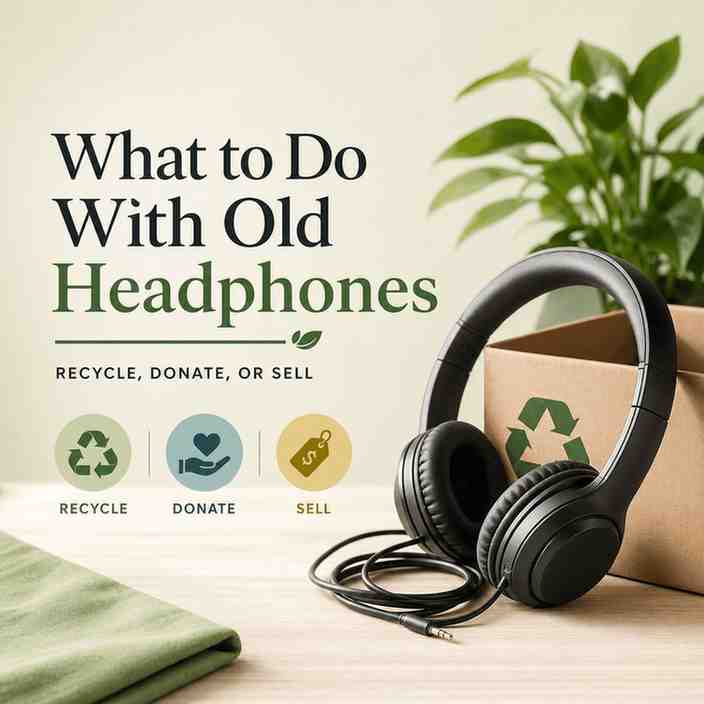
If you have a drawer full of tangled cords and half-working earbuds, you are not alone. At some point, everyone asks the same question: What can I do with my old headphones?
The answer depends on two things:
- Do they still work?
- Do they contain a battery (wireless headphones, true wireless earbuds, noise-canceling models)?
Some options are better for your wallet, some are better for the environment, and some are just the easiest way to clear space today. This guide walks through all of it, including how headphones are recycled, plus a few health questions people often ask like Can headphones cause lightheadedness? and Can headphones cause TMJ pain?
Quick check: are your old headphones still worth saving?
Before you recycle, donate, or sell, take two minutes to test them.
Basic test checklist:
- Try them with another device (phone, laptop, tablet).
- Test both sides (left/right).
- Check the mic if it has one.
- For wireless models: test charging, pairing stability, and battery life.
- Inspect the cable for frays near the plug (a common failure point).
- Clean the ear tips or pads so you can evaluate the real condition.
If they work reliably, you have more options than you think.
Here are the best ways to handle your old headphones, depending on their condition:
1. Recycling and Disposal
Broken headphones should usually be recycled, not trashed. Even “simple” wired pairs contain mixed materials that do not belong in a landfill.
Never put them in the trash
Never put them in the trash: Headphones contain metals, plastics, and sometimes lithium-ion batteries that pollute the environment and pose a fire hazard in landfills.
This is especially important for:
- True wireless earbuds (almost always lithium-ion)
- Over-ear wireless headphones
- Noise-canceling headphones (battery + electronics)
If the battery is swollen, hot, leaking, or smells like chemicals, stop using it and take it to a proper battery drop-off location.
Retail drop-offs (easy option)
Retail Drop-Offs: Many electronics retailers (like Best Buy) offer convenient drop-off bins for old headphones, cables, and small electronics.
Tips:
- Bring them in a bag so small parts do not fall out.
- Tell staff if it contains a battery (wireless models almost always do).
Mail-in programs
Mail-In Programs: Brands like Shokz and many original manufacturers have take-back or mail-in programs to process your devices responsibly.
If your headphones are a known brand, check:
- The manufacturer support site (search “recycling” or “take-back program”)
- Any warranty page that mentions disposal guidance
- Local country-specific e-waste partners
Mail-in is ideal if you do not have a nearby drop-off point.
Local e-waste facilities
If your old headphones are broken, recycling them at local e-waste facilities is often the best move. They may contain hazardous materials and are difficult to separate safely at home.
Search terms that usually work:
- “e-waste drop off near me”
- “household hazardous waste electronics”
- “electronics recycling event [your city]”
How are headphones recycled?
People often picture recycling as “melt it down and reuse it,” but electronics recycling is more like careful disassembly, sorting, and recovery.
How headphones are recycled (typical process):
- Collection and sorting
- Items are separated by type: small electronics, cables, battery-containing devices, etc.
- Battery removal (when applicable)
- Wireless headphones and earbuds typically go through a battery handling process first because lithium-ion cells are a fire risk. It’s crucial to follow the proper procedures for recycling electronics and batteries to prevent fires.
- Manual disassembly
- Facilities may remove easy-to-separate parts such as ear pads, headbands, and housings.
- Material processing
- Shredding and separation systems sort plastics, ferrous metals, non-ferrous metals, and circuit board material.
- Recovery
- Metals like copper and aluminum can be recovered. Circuit boards may be processed to recover small amounts of precious metals, depending on the recycler.
The key takeaway is that headphones are recyclable, but they need the right stream, not the curbside bin.
Donating and giving away (if they still work)
If your headphones still work, donating keeps them in use and reduces demand for new products.
Charity: Consider giving working headphones to local charity shops, Goodwill, or specialized donation centers.
That said, some charities cannot accept used in-ear earbuds for hygiene reasons, so it helps to donate smartly.
Best places to donate working headphones
- Local charity shops / thrift stores (call first, especially for earbuds)
- Schools and libraries (useful for computer labs, language learning)
- Community centers / youth programs
- Shelters and transitional housing programs (often need practical electronics)
- Friends, family, neighbors (fastest option)
Make them donation-ready
A quick clean makes donation more likely to be accepted.
- Wipe down plastic/metal surfaces with a light alcohol wipe.
- Replace or wash removable silicone tips (if possible).
- For over-ear models, wipe ear pads and headband and let them dry fully.
- Include the charging cable or dongle if it requires one.
If they are “working but finicky” (cutting out unless the cable is at a certain angle), that is usually better for recycling than donating.
3. Selling old headphones (the best option if they are decent)
If you have name-brand headphones that still perform well, selling can be worth your time.
What sells well
- Popular consumer models (Sony, Bose, Apple, Sennheiser, JBL, Beats)
- Studio headphones (Audio-Technica, Beyerdynamic, AKG)
- Gaming headsets (SteelSeries, HyperX, Logitech)
- Open-back audiophile models (often hold value)
Where to sell
- Facebook Marketplace / local classifieds (quick, no shipping)
- eBay (best reach, more effort)
- Swappa (good for certain electronics categories)
- Reddit communities (requires care and following rules)
- Consignment electronics shops (less money, less hassle)
How to price fairly
Search sold listings (not active listings). Condition matters a lot:
- New ear pads and clean condition raise value.
- Missing charging case for earbuds drops value dramatically.
- Damaged hinges or peeling pads often make buyers walk away.
Be honest about batteries
For wireless models, include a line like:
- “Battery lasts about X hours at normal volume.”
- “Includes case, cable, and original box” (if true)
Honesty prevents returns and bad reviews.
4. Trade-in or upgrade programs (low effort, not always highest payout)
Some brands and retailers offer store credit for old gear. This is usually not the best money, but it is easy.
Trade-in makes sense if:
- You were already planning to buy a replacement.
- Your old headphones are not worth selling.
- You want a simple, trackable recycling path.
5. Upcycle and reuse: creative options before you recycle
If they are not worth selling and donation is not appropriate, you can still reuse parts or repurpose them. This is especially good for wired headphones with a damaged plug or worn pads.
Here are a few practical ideas:
Make them your backup headset
Even if you have a new daily pair, an old set can live in:
- Your work bag
- Your car
- A travel pouch
- A spare desk drawer
Backups save you in those “forgot my headphones” moments.
Turn them into DIY noise-reduction earmuffs
Old over-ear headphones can become basic earmuffs for:
- Lawn mowing (as a comfort layer under proper ear protection)
- Woodworking (again, under proper ear protection if needed)
- Studying in a busy house
Important note: they are not certified hearing protection, so do not rely on them for hazardous noise levels. But they can be a comfort layer and reduce distraction.
DIY mini speaker or parts salvage
If you like tinkering, headphone drivers can be used in small DIY audio projects. Even if you are not building a speaker, you can salvage:
- The cable (for other projects)
- The 3.5mm plug (sometimes reusable)
- Small screws and plastic parts
Replace parts instead of replacing the whole thing
Some “broken” headphones just need:
- New ear pads
- A new cable (if detachable)
- A headband cushion
- A new ear tip set (for earbuds)
If the headphones are mid-to-high end, a $15 to $30 part can extend life by years.

What if your old headphones are broken?
If they are broken, the best default is recycling, especially through a local e-waste facility.
But “broken” can mean different things:
- Cable damage: sometimes fixable with a replacement cable or a simple repair.
- Only one side works: could be wiring, could be a driver failure.
- Charging issues: might be a bad cable, dirty charging contacts, or a dead battery.
- Physical cracks: if the structure is compromised, recycle.
If you do not want to troubleshoot, recycling is the cleanest and safest option.
Health questions people ask: dizziness, TMJ, and comfort
Old headphones are not just a clutter problem. Sometimes they are uncomfortable, and discomfort is one reason people stop using them in the first place. Two common questions come up a lot.
Can headphones cause lightheadedness?
Yes, they can, in some situations. The most common reasons are not “dangerous,” but they are real:
- Too much clamping pressure restricting comfort and circulation around the ears and jaw area
- Noise-canceling pressure sensation (some people feel mild disequilibrium)
- Volume too loud causing ear fatigue, headaches, or a “woozy” feeling
- Ear canal irritation from in-ear tips that do not fit well
What to do:
- Lower volume and take listening breaks.
- Try a different fit (larger/smaller tips, over-ear instead of in-ear).
- Turn off ANC to see if symptoms stop.
- If lightheadedness is frequent or severe, consider speaking with a clinician.
Can headphones cause TMJ pain?
Yes. If you have TMJ issues or you are prone to jaw tension, certain headphone designs can aggravate it.
Common triggers:
- Tight headbands that press the jaw joint area
- On-ear designs that push directly on the jaw and temple region
- Long listening sessions while clenching your jaw (often while working or gaming)
What helps:
- Choose lighter headphones with lower clamp force.
- Prefer over-ear cups that do not press on the jaw hinge.
- Take breaks and relax your jaw (especially during intense gaming or work).
- If pain persists, consider professional advice.
If your old headphones cause discomfort, that is a good reason to replace them. Then you can donate, sell, or recycle the old pair responsibly.
A simple decision guide (so you can act today)
If you just want the quickest answer to What can I do with my old headphones?, use this:
- Working + clean + safe → donate or sell.
- Working but not worth selling → give to a friend, keep as backup, or donate where accepted.
- Broken or unreliable → recycle at e-waste drop-off.
- Wireless or battery inside → treat as e-waste, do not trash.
- Swollen or damaged battery → take to a proper battery/e-waste handler ASAP.
FAQ
Should I throw away old headphones?
No. If they are broken, recycle them through e-waste. If they work, donate or sell.
Are headphones considered e-waste?
Yes. Wired and wireless headphones both count as e-waste, and wireless models also involve battery handling.
Do thrift stores accept used headphones?
Many do, especially over-ear headphones. Some may refuse used earbuds for hygiene reasons, so call ahead.
Let’s wrap up
Old headphones sit in that weird space between “too small to matter” and “too annoying to deal with.” But they do matter, especially when batteries and mixed materials are involved.
So, if you are staring at a pair right now, pick one path and finish the job:
- If they are broken, recycle them at local e-waste facilities.
- If they still work, donate them to local charities, schools, or friends.
- If they are worth something, sell them and put that money toward an upgrade.
- If you like DIY projects, upcycle them into a backup headset, basic earmuffs, or a small parts project.
That is the real answer to What can I do with my old headphones? Do the option that matches their condition, and do not put them in the trash.
FAQs (Frequently Asked Questions)
What should I do before deciding what to do with my old headphones?
Before recycling, donating, or selling your old headphones, take two minutes to test them. Try them with another device, check both left and right sides, test the microphone if available, and for wireless models, assess charging, pairing stability, and battery life. Also inspect cables for frays and clean ear tips or pads to evaluate their real condition.
Can I throw my old headphones in the trash?
No, you should never put old headphones in the trash. They contain metals, plastics, and sometimes lithium-ion batteries that can pollute the environment and pose fire hazards in landfills. Proper recycling methods should be followed to dispose of them safely.
Where can I recycle my broken or old headphones?
Broken or old headphones can be recycled at retail drop-off bins offered by electronics retailers like Best Buy, via mail-in programs from manufacturers such as Shokz, or at local e-waste facilities. Always inform staff if your headphones contain a battery and bring them in a bag to keep small parts together.
How are headphones recycled at e-waste facilities?
Headphone recycling involves collection and sorting by type, battery removal for wireless models due to fire risks, manual disassembly of parts like ear pads and housings, shredding and separation of materials such as plastics and metals, and recovery of valuable metals like copper and aluminum. This careful process ensures safe material reuse without landfill pollution.
Can I donate my old headphones if they still work?
Yes! Donating working headphones helps keep them in use and reduces demand for new products. Consider giving them to local charity shops, Goodwill, or specialized donation centers. However, some charities may not accept used in-ear earbuds due to hygiene reasons, so it’s best to check before donating.
Are there health concerns associated with headphone use like lightheadedness or TMJ pain?
Some people ask if headphones can cause lightheadedness or TMJ (temporomandibular joint) pain. While these issues are less common, improper fit or prolonged use at high volumes might contribute to discomfort or ear-related symptoms. It’s advisable to use headphones responsibly and consult a healthcare professional if you experience persistent symptoms.
