


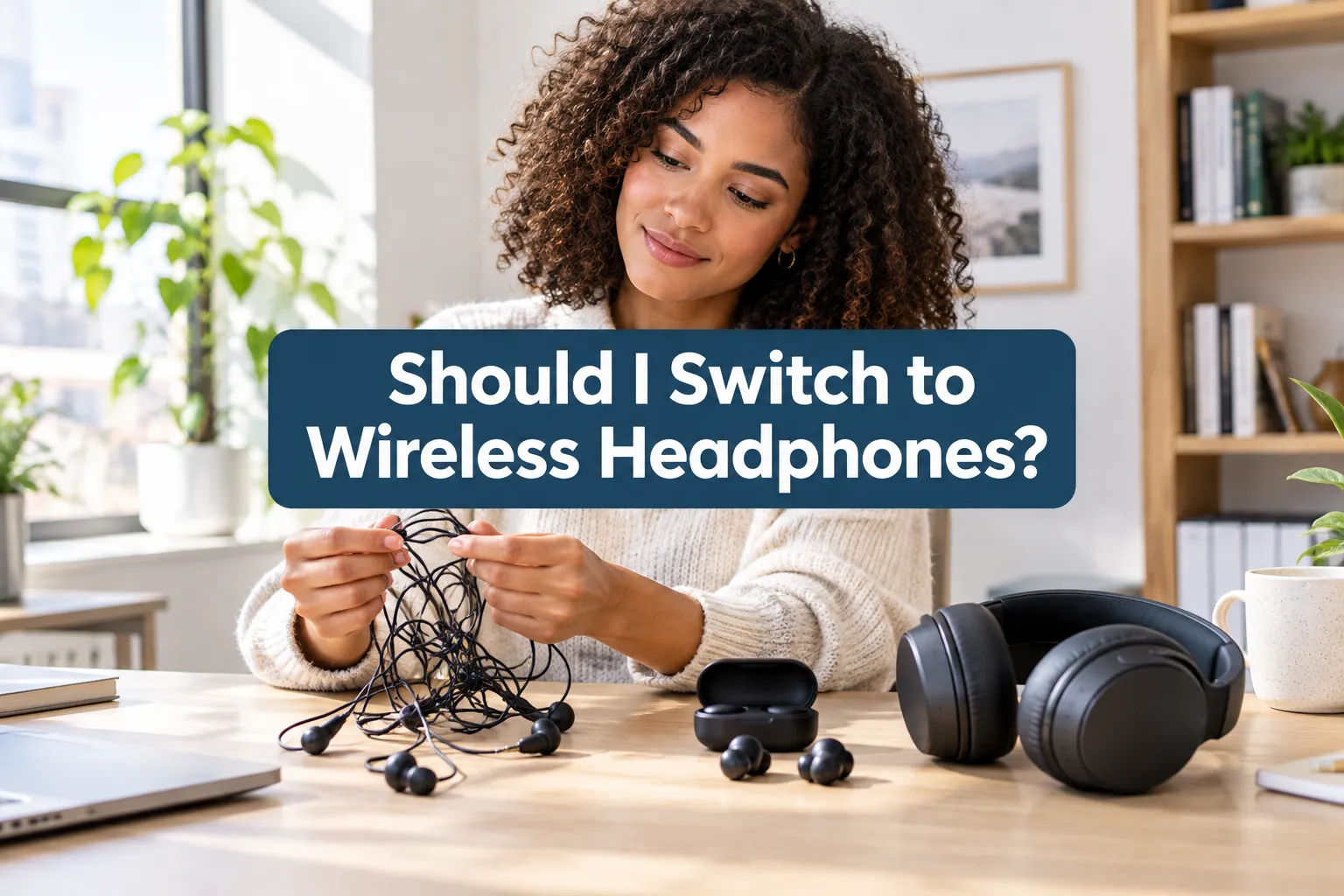
Deciding whether you should switch to wireless headphones largely depends on your lifestyle, priorities, and budget. For most people, the convenience and advanced features of modern wireless headphones outweigh the traditional benefits of wired models, offering freedom of movement and useful smart integrations. The Bluetooth technology overview explains the wireless standard that enables compatibl devices to communicate without physical cables.
However, considerations such as audio fidelity for critical listening, battery management, and potential latency for specific applications still make wired options relevant for some users. Independent testing by RTINGS’ wired vs. wireless headphone comparison also highlights why your listening habits and connection requirements should guide your decision.
Key Takeaways
- Wireless headphones offer unparalleled freedom of movement, a major draw for active users and commuters.
- Advanced features like active noise cancellation (ANC), transparency modes, and smart assistants are now common in wireless models.
- Battery life remains a key consideration, with significant improvements in recent years, but charging is a daily reality.
- Audio quality for wireless has improved dramatically, but wired still holds an edge for audiophiles seeking uncompressed sound.
- Latency can be a factor for competitive gaming or professional audio production, where wired options are often preferred.
- The market offers a wide range of wireless options, from budget-friendly earbuds to high-end over-ear headphones.
- Cost can be higher for wireless headphones with equivalent features compared to their wired counterparts.
- Durability of integrated batteries and potential for connection issues are real-world considerations.
Why Should I Switch to Wireless Headphones: The Freedom Factor

You should switch to wireless headphones if you value unencumbered movement and a clutter-free experience above all else. The primary benefit of cutting the cord is undeniable freedom, allowing you to move, work out, or commute without tangled cables or accidental tugs that pull your headphones off.
This convenience has become a dealbreaker for many users, especially with the decline of headphone jacks on many smartphones.
Based on our testing, this freedom translates into several practical advantages:
- Mobility: Whether you’re at the gym, walking around the house, or navigating a busy city, not having a cable tethering you to your device is incredibly liberating. We tested several models for running and found the wireless experience significantly superior for intense activity. If you’re looking for Best Headphones For Running, wireless is often the way to go.
- Convenience: Pairing with multiple devices and switching between them has become much smoother. Many modern wireless headphones offer seamless switching, a feature wired headphones simply cannot replicate. Learning How To Connect Wireless Headphones is usually straightforward.
- Integration: Wireless headphones often come with integrated controls for music playback, calls, and voice assistants, along with smart features like active noise cancellation (ANC) and ambient sound modes. These functionalities enhance the overall user experience significantly. To understand more about these features, check out What Is ANC? How Noise-Canceling Headphones Work (And What They Can’t Block).
A potential dealbreaker for some might be the initial setup, but connecting wireless headphones is usually quite simple. For example, How To Pair Bluetooth Headphones In 60 Seconds (Any Device) outlines just how quick it can be. If you’re shopping on a budget, you can also find excellent wireless earbuds under $50, which proves how far the technology has come.
What Are the Main Drawbacks of Wireless Headphones?
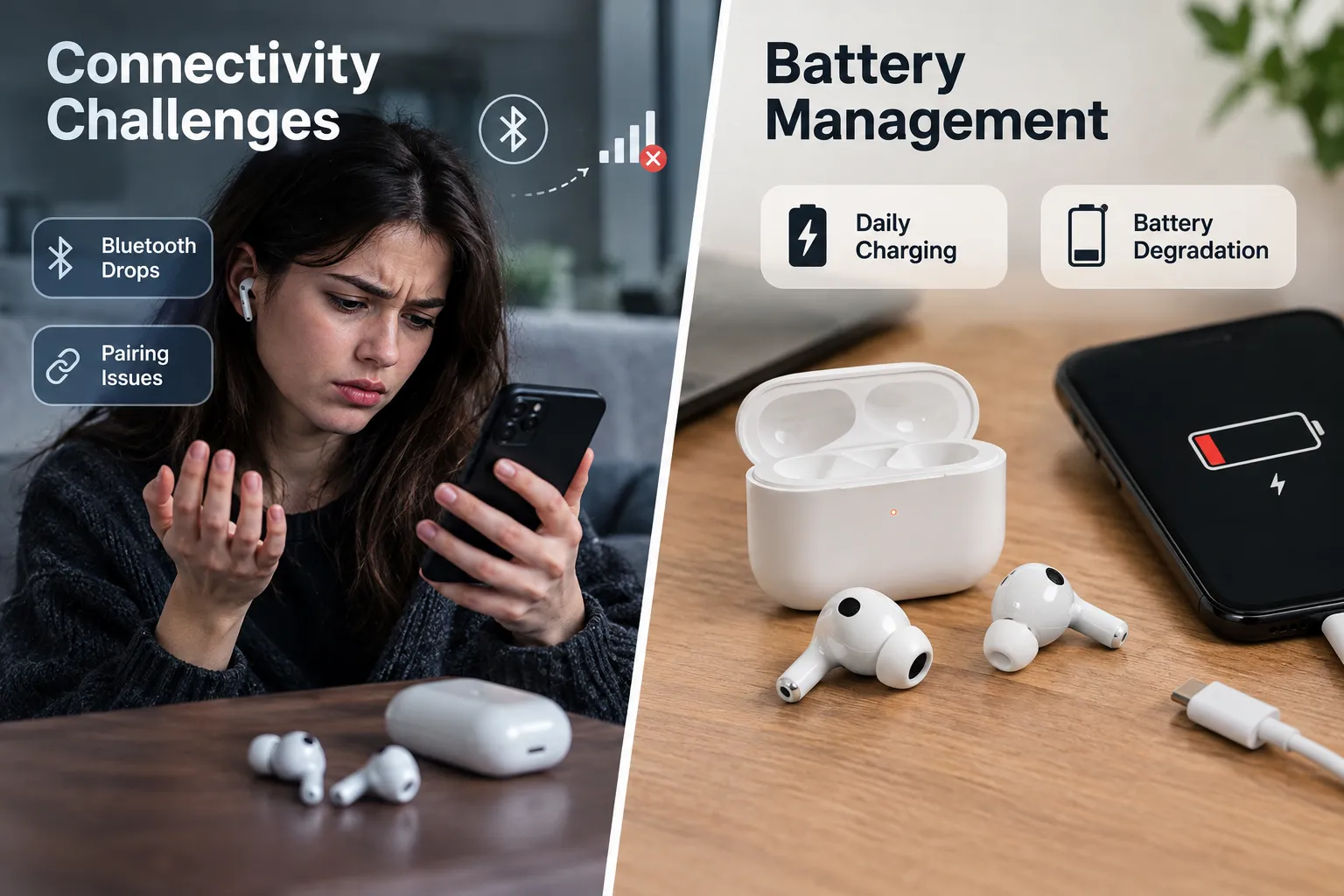
The main drawbacks of wireless headphones typically revolve around battery life, potential audio latency, and sometimes a higher price point for comparable sound quality to wired models.
While wireless technology has advanced considerably, these aspects still require consideration before making a switch.
Here are the key considerations:
- Battery Life and Charging: Wireless headphones require charging, which means another device to keep topped up. While many models now offer excellent battery life, some even exceeding 30 hours on a single charge, you still need to remember to charge them. Running out of battery mid-commute can be frustrating. We often highlight Top Wireless Headphones With Long Battery Life to help manage this.
- Audio Latency: For most casual listening, video watching, or phone calls, latency is negligible. However, for critical applications like competitive gaming or professional audio monitoring, the slight delay in audio transmission over Bluetooth can be a significant issue. Wired headphones offer zero latency, which is why they remain dominant in these niches.
- Cost: While budget-friendly wireless options exist, acquiring wireless headphones with high-fidelity audio, robust noise cancellation, and premium build quality often means a higher initial investment compared to wired counterparts that offer similar audio performance.
- Connection Reliability: Although Bluetooth technology has matured, occasional connection drops or pairing issues can still occur, especially in crowded wireless environments. This is less common with newer standards but can still be a source of frustration.
- Durability and Repairability: Wireless headphones, especially true wireless earbuds, often have integrated batteries that degrade over time. This can shorten the overall lifespan of the device. The compact design of many wireless devices also makes them less repairable than some wired models. This is particularly relevant when considering How Long Do Wireless Earbuds Last? Real Lifespan.
If you prioritize consistent, lag-free audio and never want to worry about charging, staying with wired headphones is a valid choice. Still, for most everyday listeners, the benefits of wireless outweigh these drawbacks. For a deeper dive, our article on Wired Vs Wireless Headphones provides a comprehensive comparison.
Should I Switch to Wireless Headphones for Specific Use Cases?
Whether you should switch to wireless headphones becomes clearer when considering your primary use cases. Different activities highlight the strengths or weaknesses of wireless tech.
- Commuting and Travel: Wireless headphones with active noise cancellation (ANC) are strong contenders here. They block out engine hums and crowd chatter, making your journey more pleasant. Models like the Bose QuietComfort Ultra Headphones are great examples. For more options, see our guide on 10 Best Noise Cancelling Headphones For Airplane Travel (Tested On Flights).
- Working Out: For exercise, wireless is almost universally recommended. No wires to snag on equipment or get caught on your body, and many are sweat-resistant. Look for models explicitly designed for sports, like those featured in our Best Headphones For Working Out article.
- Office or Remote Work: Wireless headphones offer the flexibility to move around your workspace during calls or while listening to music. Features like multi-point connectivity allow seamless switching between your laptop and phone. Our comparison of Headphones Vs Earbuds For Work: Pros And Cons Explained might help your decision.
- Critical Listening or Studio Work: If absolute audio fidelity and zero latency are paramount, such as for professional music production or audiophile-grade listening, wired headphones still tend to be the preferred choice. While wireless audio quality has improved, it still involves compression and potential latency. However, some specialized low-latency wireless studio headphones are emerging, like the LEWITT LW6.
- Gaming: For casual gaming, wireless headphones are perfectly fine. However, for competitive gaming where every millisecond counts, wired connections often provide an edge due to lower latency. We recently tested the Best Wireless Earbuds For Gaming In 2026, The Winner Wasn’t The One Most Gamers Expected.
Consider what you do most often with your headphones. If it involves movement, travel, or general convenience, wireless is likely the better fit. If it’s about uncompromising sound or zero lag, wired might still be the answer.
Is the Audio Quality Good Enough to Switch to Wireless Headphones?
For most people, yes. Modern wireless headphones can deliver excellent sound quality, making them a practical choice for everyday listening. However, it is important to distinguish between high-quality Bluetooth audio and genuinely lossless transmission.
Bluetooth audio codecs such as AAC, LDAC, and aptX Adaptive use different encoding approaches and have different performance characteristics. Their availability and actual performance depend on both the source device and the headphones. Sony explains its proprietary LDAC audio coding technology, which is designed to transmit more audio data than conventional Bluetooth codecs under supported conditions.
Based on listening comparisons across different genres and price points, several factors help explain why wireless headphones can sound so good:
- Improved Codecs: Newer Bluetooth codecs allow for greater bandwidth, meaning more audio data can be transmitted, resulting in richer, more detailed sound. This is a significant improvement over older, more compressed codecs.
- Digital Signal Processing (DSP): Many wireless headphones utilize sophisticated DSP to enhance sound profiles, correct for speaker limitations, and optimize clarity. This can result in a very pleasing “out of the box” sound experience.
- Personalized Audio: Some premium wireless models even offer personalized sound profiles, adapting the audio to your unique hearing, which can further elevate the listening experience beyond what basic wired headphones provide.
The bigger issue for true audiophiles isn’t just the wireless transmission, but the quality of the Digital-to-Analog Converter (DAC) and amplifier built into the headphones. While high-end wired setups can use external, dedicated DAC/amp units, wireless headphones rely on their internal components.
However, for 95% of users, the convenience of wireless far outweighs the marginal, often imperceptible, difference in raw audio fidelity that wired connections might offer. If you’re wondering Do High Quality Headphones Really Make A Difference, the answer is yes, but the gap between wired and wireless is shrinking.
Wireless vs. Wired Headphones: Key Differences
| Feature | Wireless Headphones (2026) | Wired Headphones (2026) |
|---|---|---|
| Connectivity | Bluetooth, proprietary wireless; no physical cable to source | 3.5mm jack, USB-C, Lightning; requires physical port |
| Freedom | High; untethered movement, no snags | Low; cable restricts movement, potential for tangles |
| Battery Life | Requires charging (6-60+ hours depending on model); can run out of power | No battery needed; always ready to use if device has power |
| Audio Latency | Minor latency possible (20-200ms); generally negligible for casual use, noticeable for gaming/pro audio | Zero latency; ideal for critical listening, gaming, studio work |
| Sound Quality | Excellent for most users; advanced codecs deliver near-lossless audio; relies on internal DAC/amp | Potentially superior for audiophiles; no compression; relies on source device’s DAC/amp |
| Features | ANC, transparency mode, smart assistants, touch controls, multi-point pairing | Generally fewer smart features; passive noise isolation common; inline remotes for basic control |
| Price | Can be higher for equivalent sound/features due to integrated tech | Often more affordable for comparable audio quality |
| Durability | Batteries degrade over time; more complex electronics can fail | Less complex, fewer points of failure; cables can fray over time |
Should I Switch to Wireless Headphones: Making Your Decision
Making the decision on whether you should switch to wireless headphones comes down to a personal evaluation of your needs against the pros and cons. We recommend considering a few key points.
- Assess Your Lifestyle:
- Are you active? If you frequently exercise, commute, or move around while listening, wireless is the clear winner.
- How often do you travel? ANC-equipped wireless headphones are invaluable for blocking out ambient noise on planes or trains. Do Noise Cancelling Headphones Actually Help On A Plane confirms their utility.
- Do you use multiple devices? Seamless switching between a phone, tablet, and laptop is a major convenience of modern wireless headphones.
- Consider Your Priorities:
- Is ultimate sound fidelity your top concern? If you’re an audiophile, a high-quality wired setup might still offer a marginal edge, though the gap is closing.
- Do you hate charging? If managing another device’s battery is a hassle, wired headphones provide peace of mind.
- Is budget a primary factor? You can often get better sound quality for less money with wired headphones, particularly at lower price points.
- Future-Proofing: Many new devices, especially smartphones, are ditching the headphone jack. Switching to wireless prepares you for this trend. However, also consider that Are Wired Headphones Safer Than Wireless addresses any health concerns, ensuring you make an informed choice.
Health and hearing safety should also influence your decision, but wireless connectivity itself does not automatically make headphones safer. The World Health Organization’s Make Listening Safe initiative emphasizes managing listening volume and exposure duration to reduce the risk of hearing damage.
For most people, wireless headphones offer a compelling combination of convenience, useful features, and excellent everyday audio quality. If mobility and smart features matter most, switching is likely to be worthwhile.
However, if you need a predictable low-latency connection, prefer not to manage batteries, or have specific studio-monitoring requirements, wired headphones remain a strong option.
FAQS: Should I Switch to Wireless Headphones
Are wireless headphones better for my ears than wired?
There is no definitive evidence suggesting wireless headphones are inherently better or worse for your ears than wired ones. The main factor for hearing safety is listening volume and duration, regardless of connectivity type. Can Headphones Cause Hearing Damage? Safe Volume Levels explains this in detail.
Do wireless headphones really sound as good as wired?
For most listeners, modern wireless headphones sound very good, often indistinguishable from wired, especially with advanced Bluetooth codecs. Audiophiles may detect differences, but for everyday use, the quality gap is minimal.
How long do wireless headphones usually last?
The lifespan of wireless headphones varies widely, typically 2-5 years. Battery degradation is a common factor influencing their longevity.
Can wireless headphones connect to anything?
Most wireless headphones use Bluetooth, allowing them to connect to a wide range of devices including smartphones, tablets, laptops, and some smart TVs. Compatibility depends on the specific device’s Bluetooth capabilities.
Is it worth buying expensive wireless headphones?
It is worth buying expensive wireless headphones if you prioritize premium sound quality, advanced features like superior ANC, robust build quality, and personalized audio experiences. For casual listening, more affordable options can suffice.
What is the biggest disadvantage of wireless headphones?
The biggest disadvantage for many is the need for regular charging and the risk of battery depletion, which isn’t an issue with wired headphones.
Conclusion
Deciding whether you should switch to wireless headphones comes down to balancing convenience against specific needs. For the majority of users, the enhanced freedom, smart features, and steadily improving audio quality of wireless models make them an excellent choice for daily listening, commuting, and active lifestyles.
The days of constant cable management are fading, and wireless offers a genuinely liberating experience.
However, if you’re an audiophile prioritizing uncompressed audio fidelity, a professional requiring zero-latency monitoring, or simply someone who dislikes managing battery life, wired headphones retain their appeal.
We recommend assessing your primary use cases and budget. Start by trying a well-reviewed mid-range wireless option; you might find the benefits quickly outweigh the minor trade-offs.
