



Key Takeaways
- Neurable One is more than an AI headphone: it combines conventional ANC audio hardware with 12 EEG sensors designed to turn brain-activity signals into consumer-facing focus and fatigue metrics.
- The EEG feature has important limitations: dry wearable EEG is technically challenging, and existing research shows that electrode contact, movement, hair and impedance can affect signal quality.
- The $499 price buys an experimental new category, not a medical instrument: Neurable explicitly describes One as a consumer wellness product, and independent reporting says new efficacy research specific to this model remains limited.
The headphone market has spent years adding smarter microphones, better noise cancellation, spatial audio, voice assistants and increasingly sophisticated artificial intelligence.
Neurable One takes that trend in a completely different direction.
Instead of only listening to the world around you, the $499 over-ear headphone attempts to collect information from the person wearing it.
The company has integrated 12 EEG sensors into the ear cushions, six on each side, allowing the headphones to collect electrical signals associated with brain activity while the user listens to music, works, studies or relaxes.
The accompanying software then turns that data into consumer-friendly indicators such as Focus, Cognitive Load, Sleepiness, Stress, Brain Battery and Alpha Peak Frequency.
That sounds futuristic.
But the important question for buyers is more practical:
What does the headphone actually measure, how reliable are those measurements, and is the EEG system worth paying for?
That distinction matters because Neurable One is entering a category where the underlying technology is considerably less mature than the audio technology surrounding it.
The headphone can be evaluated as an ordinary wireless ANC product.
The brain-sensing system requires a much more cautious interpretation.
Table of Contents
- What is Neurable One?
- Why These Are Different From Ordinary AI Headphones
- How the 12 EEG Sensors Work
- What Neurable One Actually Measures
- The “Brain Battery” Problem
- Can EEG Really Measure Focus?
- Why Dry EEG Is Technically Difficult
- What the Headphones Offer as an Audio Product
- Battery Life Drops When EEG Is Active
- The Privacy Question Is Bigger Than Bluetooth
- Neurable One Is Not a Medical Device
- What This Means for the Headphone Industry
- Who Should Consider Neurable One?
- Who Should Wait?
- What to Watch Next
- Conclusion
- FAQs
What Is Neurable One?
Neurable One is an over-ear wireless headphone from neurotechnology company Neurable.
Unlike many previous Neurable products, the company is now controlling the complete hardware and software experience itself. Neurable says its roots go back to 2015, when the company emerged from the University of Michigan’s Direct Brain Interface Lab.
The result is unusual because the product is simultaneously:
- a conventional wireless headphone;
- an ANC headphone;
- a microphone-equipped communication device;
- a Bluetooth wearable;
- and an EEG sensing platform.
The official preorder price is $499.
That places it directly in premium-headphone territory.
At that price, consumers are no longer comparing it only with inexpensive productivity gadgets. They can also compare it with established ANC headphones from Sony, Bose, Technics and Sennheiser.
TechOzea’s existing Sony WH-1000XM6 review is therefore useful context because it shows what a mature premium ANC headphone looks like when its primary job is audio rather than brain sensing.
Neurable is attempting something different.
The company is betting that the extra sensing layer will eventually become valuable enough to justify the premium.
Why These Are Different From Ordinary AI Headphones
Most “AI headphones” use microphones and digital signal processing to understand sound.
They may:
- isolate your voice;
- remove background noise;
- detect environmental sounds;
- translate speech;
- improve call quality;
- or adapt audio to your surroundings.
Neurable One adds another input: electrical activity detected from the scalp.
That creates a fundamentally different feedback loop.
A conventional ANC headphone might ask:
What noise is reaching the microphones?
Neurable’s system is attempting to add:
What patterns are being detected from the wearer while that audio experience is happening?
The distinction is important.
The EEG sensors are not there to improve bass response or make ANC stronger. They exist to collect biological signals that software can process.
Neurable describes the product as a consumer wellness system rather than a medical device.
That means consumers should treat the resulting metrics as personal indicators rather than clinical measurements.
How the 12 EEG Sensors Work
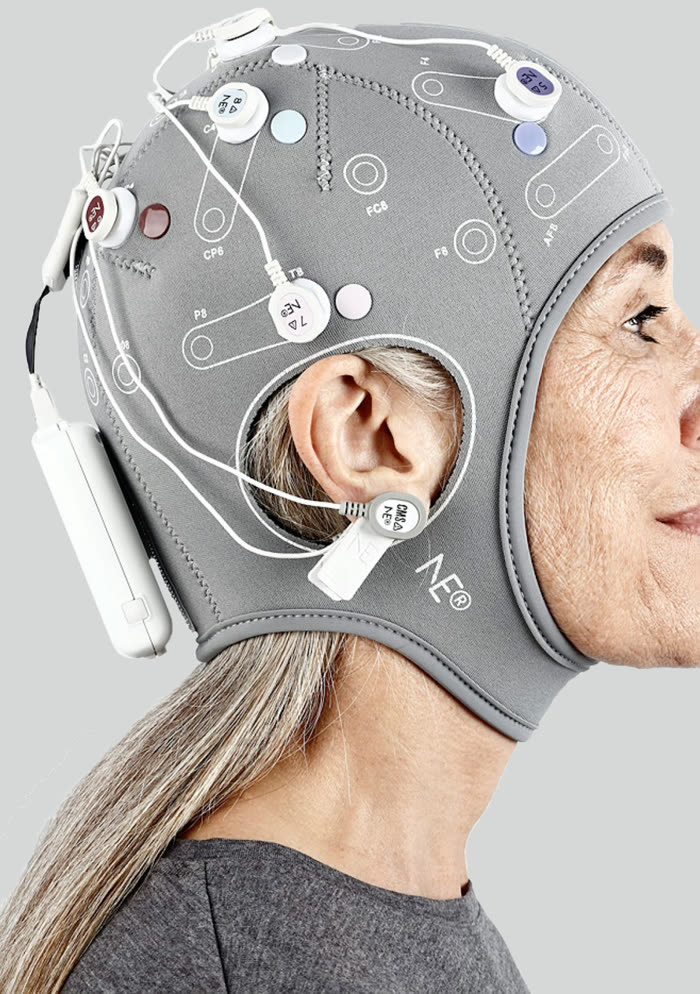
EEG stands for electroencephalography.
At a basic level, EEG records electrical activity associated with brain activity through electrodes placed against the scalp.
Traditional EEG systems often require carefully positioned electrodes, conductive material and controlled measurement conditions.
Neurable is trying to remove much of that inconvenience.
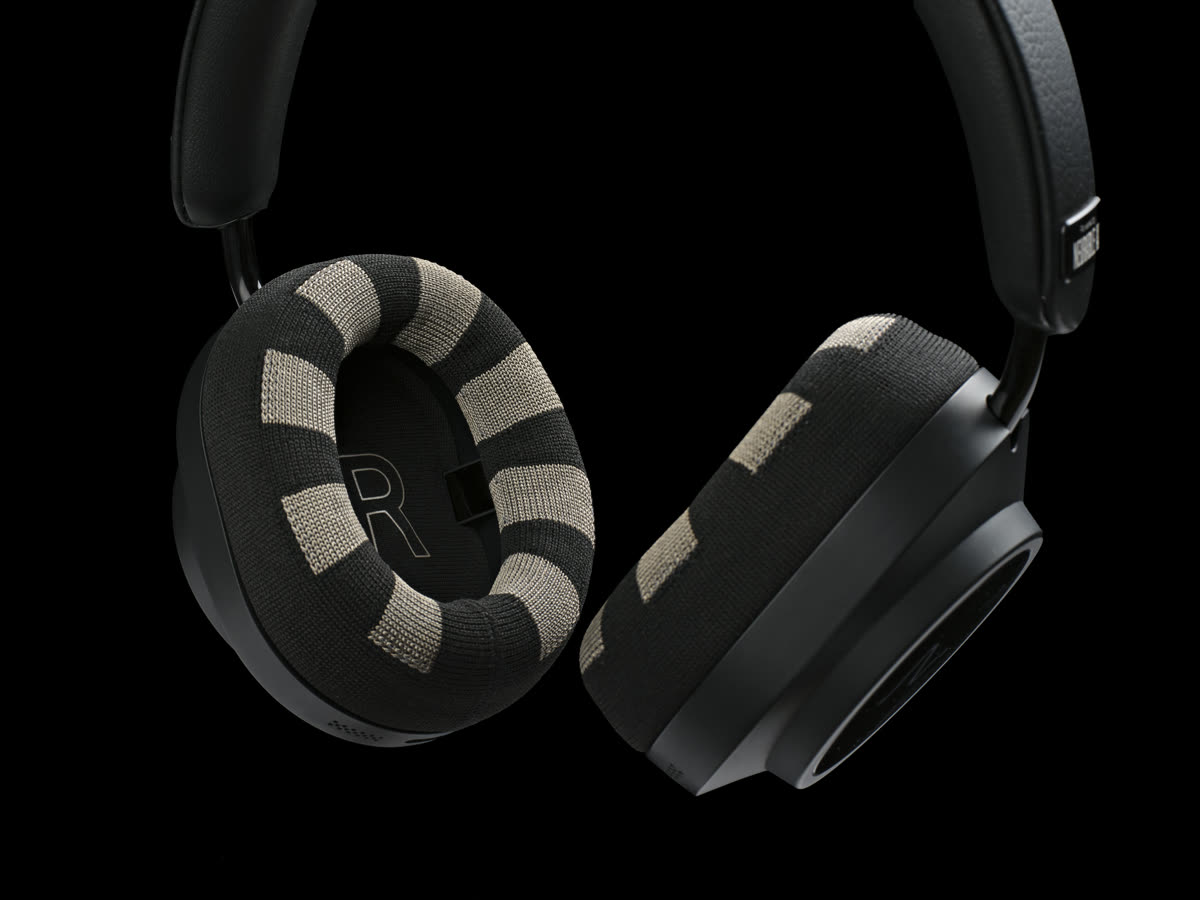
Its 12 sensors are integrated into the headphone cushions. The company describes them as dry sensors incorporated into the cushion material rather than conventional gel-based clinical electrodes.
This is one of the most technically interesting parts of the product.
The ear cushions already need to perform several jobs.
They have to:
- create a comfortable seal;
- position the driver correctly;
- reduce outside noise;
- maintain consistent pressure;
- remain comfortable for extended use;
- and now provide electrical contact for EEG sensing.
Those objectives can conflict.
A headphone cushion optimized for acoustic isolation is not automatically optimized for reliable biosignal acquisition.
That is why the underlying electrode technology matters.
Research into dry EEG electrodes shows that eliminating conductive gel can make wearable EEG much more convenient, but dry electrodes can also have higher impedance and greater sensitivity to contact conditions.
More recent research is exploring advanced dry and microneedle electrode approaches to improve signal quality, which shows that the field is still actively evolving.
In other words, Neurable is not solving a trivial engineering problem.
It is trying to turn a difficult research technology into something people can wear like ordinary headphones.
What Neurable One Actually Measures
The company’s application presents multiple indicators rather than a single “brain score.”
The product materials describe measures including:
- Focus
- Cognitive Load
- Processing Speed
- Sleepiness
- Stress
- Brain Battery
- Brain Age
- Alpha Peak Frequency
This is where consumers need to be particularly careful with terminology.
An EEG sensor detects electrical signals.
It does not directly measure “productivity.”
Software interprets patterns in those signals and converts them into metrics.
That means there are multiple stages between the raw measurement and the number displayed in an app:
brain activity → electrical signal → signal processing → algorithmic interpretation → consumer metric
Every stage can introduce uncertainty.
So when the app displays a Focus score, the appropriate interpretation is not:
“My brain is 82% focused.”
It is closer to:
“The system’s algorithm has interpreted the EEG signal as being consistent with a particular level or pattern of focus relative to its model.”
That difference is central to understanding the product.
The “Brain Battery” Problem
“Brain Battery” is arguably the most consumer-friendly concept in the Neurable system.
People already understand the idea of a phone battery.
They understand that 100% means plenty of available energy and 10% means the device needs attention.
The metaphor is attractive because cognitive fatigue is harder to quantify in everyday life.
But a brain is not a smartphone battery.
The phrase is therefore best treated as a software metaphor for a cognitive-state indicator, not a direct measurement of remaining mental energy.
Neurable itself describes the product as a wellness device rather than a medical device.
That distinction protects consumers from an important misunderstanding.
If the app tells you to take a break, the recommendation may still be useful as a behavioral prompt.
But that does not mean the device has objectively determined that your brain has reached a medically defined fatigue threshold.
This distinction should remain clear in any responsible coverage of consumer neurotechnology.
Can EEG Really Measure Focus?
The answer is more nuanced than a simple yes or no.
EEG absolutely can capture electrical activity associated with brain processes.
Researchers have used EEG in neuroscience, sleep research, brain-computer interfaces and other applications for decades.
The difficult part is converting signals collected from a comfortable consumer wearable into robust, repeatable everyday conclusions.
Wearable EEG systems face challenges including:
- movement;
- electrode contact;
- electrical interference;
- individual anatomy;
- hair;
- changes in pressure;
- sweat;
- fit;
- and differences between users.
Research reviews have repeatedly identified signal-quality and impedance challenges for dry EEG electrodes.
That does not mean Neurable One cannot work.
It means the product should be evaluated as a consumer inference system, not assumed to have laboratory-level certainty.
This is also why independent long-term testing matters.
A controlled demonstration on one user tells us much less than months of testing across different head shapes, hair types, movement patterns and daily environments.
Why Dry EEG Is Technically Difficult
Traditional EEG benefits from strong electrode contact.
Dry electrodes remove the mess and setup associated with conductive gel, but they introduce other engineering problems.
Research literature notes that dry electrodes can have higher contact impedance than wet electrodes and may be more vulnerable to motion artifacts and other sources of noise.
Hair can make the problem harder because the electrode must obtain a sufficiently useful electrical connection through or around it.
That makes a consumer headphone particularly challenging.
The sensors are not positioned on a bare forehead in a laboratory.
They are integrated into a moving object attached to a person’s head.
The wearer may:
- walk;
- type;
- turn their head;
- exercise;
- talk;
- adjust the headphone;
- change posture;
- or remove and replace the headset.
All of those actions can influence a wearable measurement.
This does not invalidate EEG.
It means the algorithms need to distinguish meaningful signal from noise and artifacts.
That is one of the most important areas to watch as independent testing of Neurable One develops.
What the Headphones Offer as an Audio Product
The brain-sensing system gets most of the headlines, but Neurable One still has to function as a headphone.
Neurable specifies:
- 40mm beryllium drivers;
- active noise cancellation;
- ambient listening;
- six microphones;
- Bluetooth 5.2;
- AAC and aptX;
- multipoint connectivity;
- USB-C charging.
That is important because users will spend considerably more time listening than studying EEG charts.
The company’s own launch messaging explicitly frames the device as “headphones first.”
That is a sensible strategy.
If the audio experience is poor, users will not wear the device long enough to generate useful longitudinal data.
ANC Still Matters
Neurable One includes active noise cancellation.
That matters for the intended productivity use case because background noise is itself a distraction.
ANC uses microphones and digital processing to reduce unwanted environmental noise.
But the presence of ANC should not be confused with the EEG system.
The two technologies have different purposes.
ANC attempts to improve the acoustic environment.
EEG attempts to collect information about the wearer.
That combination is potentially powerful because the same device can control the listening environment while observing changes in the user’s response.
But it also increases the complexity of the product.
More sensors, more processing and continuous EEG operation all consume power.
Battery Life Drops When EEG Is Active
This is one of the clearest practical compromises.
Neurable rates the headphones for:
- up to 22 hours of audio playback
- up to 12 hours with EEG running
That is a significant difference.
It means consumers should not interpret the 22-hour figure as the realistic runtime for someone who buys the product specifically for brain tracking.
If you use EEG throughout the day, the relevant number is closer to 12 hours.
For an ordinary ANC headphone, that would be a weakness.
For a device doing continuous biosignal acquisition and processing, it is easier to understand.
Still, it is an important purchasing consideration.
A consumer who simply wants 20-plus hours of ANC listening may get better value from a conventional headphone.
A consumer who specifically wants longitudinal EEG data may accept the shorter runtime as the cost of the extra functionality.
The Privacy Question Is Bigger Than Bluetooth
Brain data is more sensitive than ordinary headphone telemetry.
A conventional wireless headphone may know things such as:
- battery level;
- connection status;
- firmware version;
- device model;
- app settings.
An EEG-enabled headphone introduces a different category of information.
It can potentially generate data about physiological and neurological signals.
That makes data handling a central part of the product story.
Neurable’s current product information says recordings are processed and stored on its servers, while metrics are stored on the user’s device. It also says users can request deletion.
Those are important disclosures.
They also mean buyers should read the privacy documentation before purchasing.
The relevant questions include:
- What exactly is uploaded?
- How long is it retained?
- What happens after account deletion?
- Can raw EEG recordings be exported?
- Can the company use de-identified data for research?
- Can data be shared with service providers?
- What happens if the company changes its privacy policy?
- What happens to historical data if the service is discontinued?
These are not hypothetical questions for a product whose defining feature is continuous brain-data collection.
At the same time, it would be inaccurate to claim that Neurable is selling brain data or misusing it without evidence.
The responsible approach is to distinguish what the company currently says it does from what independent audits have demonstrated.
Those are not the same thing.
Neurable One Is Not a Medical Device
This point deserves repetition.
Neurable says Neurable One is a consumer wellness product and does not diagnose, treat or monitor a medical condition.
That means consumers should not use its metrics to make medical decisions.
If someone has concerns about:
- sleep;
- attention;
- cognitive performance;
- fatigue;
- neurological symptoms;
- hearing;
- or another health issue,
a consumer headphone is not a substitute for appropriate professional evaluation.
The attraction of wearable technology is that it can turn complicated physiological information into simple numbers.
The danger is that simple numbers can look more authoritative than the underlying measurement deserves.
That is particularly important with terms such as “Brain Age,” “Stress” and “Sleepiness.”
Those labels sound precise.
The underlying signal and algorithmic interpretation are much more complicated.
What This Means for the Headphone Industry
Neurable One may be more important as a category signal than as an individual headphone.
For decades, headphone innovation has largely concentrated on:
- better drivers;
- better ANC;
- better microphones;
- better battery life;
- smaller earbuds;
- better codecs;
- spatial audio;
- and improved comfort.
The next phase could involve sensing.
A headphone already sits on the head for hours at a time.
That makes it a natural platform for additional sensors.
Future headphones could potentially use sensing to understand:
- head movement;
- posture;
- fatigue;
- attention;
- environmental exposure;
- stress-related signals;
- hearing characteristics;
- and other physiological information.
The challenge is turning those measurements into something useful without creating false confidence.
Neurable One is therefore an early experiment in a much larger idea:
What happens when headphones stop being passive audio devices and become continuously sensing wearables?
Audio May Become Only One Part of the Product
This could eventually change how companies compete.
Today, consumers commonly compare headphones using:
- sound quality;
- ANC;
- comfort;
- battery;
- microphone performance;
- codec support;
- ecosystem integration.
Imagine adding:
- sensor quality;
- signal stability;
- privacy controls;
- data portability;
- algorithm transparency;
- wellness features;
- longitudinal insights.
The headphone would start resembling a smartwatch.
The audio hardware would remain important, but it would no longer be the entire product.
That could open a new competitive field for Sony, Bose, Apple, Samsung, Google and other major consumer-electronics companies.
It could also create difficult questions around data ownership.
Who Should Consider Neurable One?
Neurable One makes the most sense for consumers who are genuinely interested in neurotechnology.
It is particularly interesting if you:
- already use productivity or quantified-self tools;
- enjoy experimenting with emerging technology;
- spend long periods working with headphones;
- want to explore EEG-based personal metrics;
- understand that consumer wellness metrics are not medical measurements;
- and are comfortable with the product’s data-storage model.
For that audience, the product offers something that conventional Sony, Bose or Sennheiser headphones do not.
The EEG layer is the reason to buy it.
Who Should Wait?
You should probably wait if what you actually want is simply excellent ANC.
At $499, the Neurable One enters territory where mature premium headphones already have extensive independent testing.
The same is true if you prioritize:
- maximum battery life;
- light weight;
- proven ANC performance;
- established app ecosystems;
- broad codec support;
- or a long history of firmware refinement.
You should also wait if the main attraction is the idea of a headphone that can “tell you when you’re tired.”
That claim needs more independent evidence than is currently available for this exact product.
The most interesting future coverage will come from long-term testers who can determine how stable the metrics are over weeks and months.
What to Watch Next
Independent EEG testing
The biggest missing piece is independent measurement of Neurable One’s EEG performance.
Researchers and specialist testers should examine:
- signal-to-noise ratio;
- movement artifacts;
- hair interference;
- fit sensitivity;
- electrode consistency;
- repeatability;
- and differences between users.
Real-world battery testing
The advertised 12-hour EEG runtime needs real-world confirmation under normal use.
Continuous sensing could produce substantially different results depending on music volume, ANC, Bluetooth behavior and app usage.
Privacy documentation
Consumers should watch how Neurable’s privacy policies evolve as the product generates more data.
Longitudinal accuracy
The most interesting question may not be whether the headphones can detect a signal.
It is whether the resulting metrics remain useful over weeks and months.
Competition
If consumers embrace sensing headphones, larger audio manufacturers have strong incentives to investigate the category.
That could eventually make physiological sensing a standard feature rather than an expensive niche capability.
Conclusion
Neurable One is one of the most unusual headphone products of 2026 because it changes the fundamental relationship between the wearer and the device.
A conventional headphone listens to the environment so it can manipulate the sound you hear.
Neurable One adds another layer: it attempts to listen to electrical signals associated with the person wearing it.
That is technologically fascinating.
It is also where consumers need to be careful.
The 12-sensor EEG system is real hardware. The product is a genuine consumer device. The company has clearly disclosed that it is a wellness product rather than a medical device.
But the existence of an EEG signal does not automatically make every app-generated metric a precise measurement of cognition.
Dry EEG remains a technically challenging field, and academic research continues to examine how electrode design, impedance, motion and contact affect signal quality.
That leaves Neurable One in an interesting position.
It is not merely another pair of AI headphones.
It is an experiment in turning the headphone into a physiological computing platform.
For technology enthusiasts, that makes it worth watching.
For ordinary headphone buyers, the smarter approach is to separate the established audio features from the emerging brain-sensing claims.
The audio hardware can be evaluated like any other premium headphone.
The EEG system deserves more time, independent testing and healthy skepticism.
That distinction is what will determine whether brain-sensing headphones become a meaningful new category or remain an intriguing experiment in wearable technology.
Frequently Asked Questions
What is Neurable One?
Neurable One is a $499 over-ear wireless headphone with 12 integrated EEG sensors designed to collect brain-activity signals while also providing conventional headphone features such as ANC, Bluetooth connectivity and microphones.
Does Neurable One read your thoughts?
No. The product should not be described as reading thoughts. It collects EEG signals and uses software to generate indicators associated with cognitive states such as focus and fatigue.
How many EEG sensors does Neurable One have?
Neurable says the headphone uses 12 EEG sensors, arranged as six sensors around each ear cushion.
Is Neurable One a medical device?
No. Neurable explicitly describes it as a consumer wellness product and says it is not designed to diagnose, treat or monitor medical conditions.
How long does Neurable One’s battery last?
Neurable rates the headphone for up to 22 hours of audio playback, or up to 12 hours when EEG sensing is running.
Does Neurable One have active noise cancellation?
Yes. Neurable lists active noise cancellation and ambient listening among the headphone’s audio features.
Is consumer EEG as accurate as medical EEG?
It should not automatically be treated as equivalent. Dry wearable EEG systems can face challenges involving electrode impedance, movement, contact and hair. Academic research continues to investigate ways of improving dry-electrode performance.
Should you buy Neurable One for productivity?
The product is most interesting for people specifically interested in experimenting with consumer neurotechnology. It should not be purchased on the assumption that its metrics are medical measurements or independently proven productivity scores.
