




Bone conduction headphones send sound through vibrations on your cheekbones instead of pushing sound through your ear canal. That means your ears stay open, so you can hear traffic, people, and the world around you while still listening to audio. They’re great for awareness-first use, but they come with tradeoffs like weaker bass and more sound leakage.
If you’re here to figure out whether bone conduction headphones are “real,” how they actually work, and who should buy them, we’ll cover it all in plain English in the next few minutes.
What are bone conduction headphones?
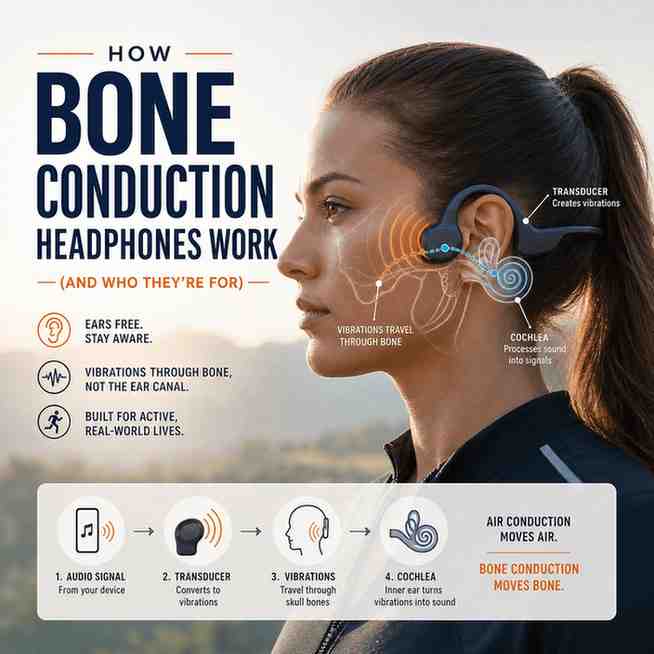
Bone conduction headphones (also written as bone-conduction or bone conducting headphones) are open-ear headphones that play audio by vibrating against the bones in your face and skull, usually right in front of your ears.
That’s the big difference from traditional headphones. Normal earbuds and over-ears send sound through the air into your ear canal. Bone conduction takes a side route.
The promise is simple: your ears stay free. You get music, podcasts, or calls while keeping environmental awareness. For runners, cyclists, and anyone who hates the plugged-up feeling of earbuds, that’s the whole appeal.
Set expectations early, though. They do not “beam sound into your brain.” There’s nothing sci-fi happening. It’s just vibration traveling through bone.
Here’s the mental model we use:
- Speaker equals a tiny vibrator (a transducer).
- Your skull equals the pathway.
- Your inner ear still does the hearing.
How normal hearing works (air conduction) — the baseline to compare against
To understand why bone conduction feels different, it helps to know the default system: air conduction.
In normal hearing, sound waves travel through the air and enter your ear canal. Those waves hit your eardrum (ear drum), which vibrates. Those vibrations move through the small bones in your middle ear, and then into the inner ear.
At the end of that chain sits the cochlea, a spiral-shaped structure filled with fluid and tiny hair cells. The cochlea acts like a translator. It converts vibration into nerve signals, and your brain interprets those signals as sound.
So the basic flow looks like this:
Outer ear (collects sound) → ear canal → eardrum → middle ear bones → cochlea → nerve signals
Traditional headphones work by feeding the outer ear and ear canal more sound, usually with some degree of sealing that increases bass and reduces outside noise. That isolation is a feature for flights and offices. However, it’s also why many people feel cut off, distracted, or even uncomfortable after long sessions.
Bone conduction changes the entry point.
How bone conduction headphones work (step-by-step)
Bone conduction headphones follow the same end destination as normal hearing. They just change the route.
1) Your audio source sends a signal
Your phone, watch, laptop, or MP3 player sends an electrical audio signal to the headphones, either through a cable (rare now) or via Bluetooth (most common).
2) The transducers convert electricity into vibration
Instead of drivers designed to push air (like a tiny speaker cone), bone conduction headphones use transducers that are built to turn that signal into mechanical vibrations.
Think of it as controlled shaking, timed perfectly to the audio waveform.
3) Vibrations travel through bone to your inner ear
Those vibrations pass through facial/skull bones and reach the cochlea. Once the cochlea receives vibration, it does what it always does: converts it into nerve signals. Your brain still “hears” in the normal sense, even if the pathway feels unusual at first.
4) What’s bypassed (and what isn’t)
Bone conduction bypasses the outer ear and middle ear, meaning it largely bypasses the ear canal and eardrum.
It does not bypass your auditory system. Your inner ear and brain still do the same job.
A simple comparison we like because it’s accurate and easy to remember:
Air conduction moves air; bone conduction moves bone.
Where the vibration actually goes (and why placement matters)
Most bone conduction headphones sit with pads pressed against the upper cheek area, just in front of your ears, roughly on the cheekbones/temple region. Some designs sit slightly differently and can feel closer to the jaw bones depending on the frame and your head shape.
When contact is firm and stable, clarity improves and you get more perceived bass. When contact is loose, energy gets lost and the sound can turn thin or muffled.
That’s why many popular designs use:
- Wraparound neckbands for stable tension
- Ear hooks or frame shaping for consistency
- Small tension adjustments or flexible materials to fit different head sizes
There’s a comfort tradeoff, though. Too loose equals weaker sound. Too tight equals pressure, fatigue, and that annoying “why do my temples feel bruised?” sensation after an hour. The best fit is secure enough to keep contact during movement, but not so tight that you’re thinking about it.
What they’re good at (and what they’re not)
Bone conduction headphones are excellent in the right context. They’re also frustrating in the wrong one. Here’s the honest split.
What they’re good at
Situational awareness and safer outdoor listening
These headphones keep your ear canals open, so you can hear traffic noise, cyclists behind you, people calling your name, and general ambient sound. For running and walking near roads, that’s the practical reason many people switch.
Comfort and hygiene versus in-ear earbuds
If you get ear irritation, ear fatigue, or that “plugged ear” feeling, open-ear designs can feel like a relief. There’s less heat buildup than over-ears, and less earwax mess than earbuds since nothing is inserted into the canal.
Podcasts, calls, and voice-first audio
Voices live in the midrange, and bone conduction tends to do mids well when the fit is right. That’s why they often shine for audiobooks, meetings, and phone calls while moving.
What they’re not good at
Private listening
Sound leakage is real. In a quiet room, people nearby may hear your audio, especially at higher volumes. That makes them harder to recommend for libraries, shared offices, or late-night bed listening next to someone.
Big bass and “sealed headphone” fullness
Bass is harder when you are not sealing the ear canal. Physics wins here. Some models do better than others, but if you want punchy low end, most in-ears or over-ears will sound richer.
Noisy environments
Because there’s no isolation, you’re mixing your audio with the world. That’s great when you want awareness. However, it’s not great on loud trains, busy streets, or open offices. Active noise cancellation is uncommon and limited in open-ear designs.
Realistic guidance: we think bone conduction is excellent for podcasts and calls outdoors. For music enjoyment, it depends on your expectations, your fit, and how loud your environment is.
Who bone conduction headphones are for
These work best for people who value awareness and comfort more than pure sound quality.
Runners and walkers
If you run near roads, on mixed-use paths, or in parks with bikes and dogs, bone conduction can feel like the safest compromise. You can still hear cues and traffic while listening to a playlist or podcast.
Cyclists
Cycling is one of the most obvious matches because hearing your surroundings is non-negotiable. That said, helmet straps can interfere with the frame, so fit is part of the buying decision. We’d prioritize a stable design that doesn’t shift when you look over your shoulder.
Gym and workouts
Sweat resistance, secure fit, and long-session comfort are the practical wins here. Many people also prefer bone conduction for workouts because earbuds can feel gross or slippery when you sweat.
Outdoor activities and recreation
Hiking, group training, dog walking, skating, and commuting in areas where awareness matters are all strong use cases. The open-ear format also makes it easier to talk to someone without constantly pausing or removing an earbud.
Work calls on the move
For quick calls while walking, bone conduction can be surprisingly convenient. You can hear yourself naturally, which makes it easier not to shout. Still, microphone quality varies a lot, and wind noise outdoors is the thing that separates decent from great.
Who should think twice (or choose a different style)
Bone conduction headphones are a tool. They’re not a universal upgrade.
If you need isolation
If you fly often, ride loud public transit, work in a noisy office, or simply want to focus, traditional headphones with good passive isolation or noise cancellation will work better. Bone conduction intentionally lets the world in.
If you want “big bass”
If your buyer context is gym hype music, EDM, hip-hop, or anything where bass is the emotional engine, you’ll probably be happier with sealed in-ears or over-ears. Bone conduction can sound clean, but it rarely sounds thunderous.
If you need truly private listening
Sound leakage can annoy people nearby, especially in quiet rooms. You can reduce it with lower volume and better placement, but you can’t eliminate it the way you can with sealed designs.
If you’re extremely noise-sensitive
Some people want less stimulation, not more. Open-ear is the opposite of that. Even if the audio is calm, your environment still comes through.
When bone conduction can help (and when it won’t)
Bone conduction has a real connection to hearing science, which is why people sometimes assume consumer bone conduction headphones are “hearing devices.” They’re not, but the principle overlaps.
When it can help conceptually
Bone conduction can be useful in cases of conductive hearing loss, where the issue involves the outer or middle ear. Since bone conduction can bypass the ear canal and eardrum, it can sometimes route sound around those problems and still stimulate the cochlea.
Where BAHA fits in
You may see references to bone-anchored hearing aids (BAHA). These are medical devices that use bone conduction technology, often with surgical implantation or specialized coupling methods, to deliver clearer transmission to the cochlea.
Consumer bone conduction headphones are not BAHA. They’re using a similar idea in a non-medical, non-implanted, lifestyle product.
When it may not help
If someone has sensorineural hearing impairment, meaning the inner ear or auditory nerve is affected, bypassing the outer and middle ear may not solve the core issue in the same way. In such cases, it’s important to consult with an audiologist who can provide tailored advice and potentially recommend specific hearing solutions, such as those outlined in these Pediatric Amplification Guidelines.
A gentle safety note: if you’re dealing with hearing difficulty, talk to an audiologist. Consumer headphones are not medical devices, and guessing can waste time.
Why it feels different from earbuds or over-ears
Even if two devices play the same track, bone conduction can feel different for three reasons: pathway, tuning, and sensation.
The “different pathway” perception
Your brain still perceives sound, but you also feel vibration on your skin and bone, especially at higher volumes. Some people adjust immediately. Others need a few days to stop noticing the sensation.
Frequency response in practical terms
Most bone conduction headphones emphasize the midrange, which is why voices often come through well.
- Mids: usually strongest (podcasts, calls)
- Bass: often lighter than sealed headphones
- Treble: can vary by model and placement, sometimes sounding slightly sharp if the fit is very firm or volume is high
Why it can sound muffled
Poor contact is the most common cause. Low volume relative to ambient noise is the second. If the outside world is loud and your headphones are quiet, your brain fills in the gap by focusing on the external sound, and your audio seems dull.
Soundstage and “natural” feel
Open-ear listening can feel more spacious because you are hearing both the world and your audio at the same time. While it’s not the same as audiophile soundstage, it can feel more natural for exercise and outdoor movement.
Comfort, fit, and hygiene: the underrated reasons people switch
A lot of people buy bone conduction for safety. Many keep them because of comfort.
Pressure points: different, not always “less”
No ear canal insertion is a real win if earbuds irritate you. Still, bone conduction can create pressure on the cheek/temple area. Good models spread that pressure well. Poor fits concentrate it and become annoying fast.
Heat buildup and airflow
Compared to over-ear pads, bone conduction is breezy. There’s more airflow, less sweat trapping, and less of that hot-ear feeling in summer.
Earwax and cleanliness
Because nothing sits inside the ear canal, many users find them easier to keep clean and less prone to earwax buildup issues. It’s not glamorous, but it’s a practical reason people switch.
Fit system overview
Most designs rely on:
- Neckband tension: keeps the transducers pressed in place
- Frame size and flexibility: affects comfort for different head sizes
- Ear hooks (on some models): adds stability during movement
For long sessions, we’d prioritize a design that stays put when you run, chew, or turn your head, without clamping hard enough to cause fatigue.
Wireless, battery, and call performance: what to check before buying
Most bone conduction headphones are Bluetooth headphones, so the buying checklist looks familiar, with a few outdoor-specific twists.
Connection stability and codecs
Outdoors, stability matters more than fancy specs. Crowded RF areas can cause dropouts, especially in dense city streets, stations, or big gyms. A solid Bluetooth implementation and a stable fit that keeps the antenna orientation consistent can matter more than you’d think.
Battery life that fits real routines
If you want a full week of commutes and workouts, look for battery life that realistically covers your schedule. Also pay attention to quick charge features. Being able to grab an hour of playback from a short charge is genuinely useful when you forget to plug in.
Microphone and call quality
Open-ear can be great for calls because you hear yourself naturally, so you’re less likely to shout. The weak spot is often wind noise outdoors and mic placement. If calls are a main use case, prioritize models known for decent wind handling.
Controls and usability
Physical buttons are usually better than touch controls for workouts. Sweat, gloves, and rain can make touch controls frustrating, while buttons remain predictable.
Waterproofing and sweat resistance
Marketing loves the word “waterproof.” Specs tell the truth.
Water resistance vs waterproof
Most workout headphones are water resistant, meaning they can handle sweat and splashes. True waterproofing for submersion is a different bar and usually comes with stricter design requirements.
For more detailed insights on headphone reviews focusing on aspects such as water resistance, exploring various user experiences could be beneficial.
IP ratings, quickly
- IP55: typically covers sweat, rain, and water jets to a degree. Great for running and gym use.
- IP68: commonly indicates dust-tight and submersion-rated up to a specified depth/time (varies by manufacturer).
Always check the manufacturer’s exact definition because IP ratings can be tested under different conditions.
Use cases: rain runs vs swimming
Rain runs and gym sweat are where most buyers live, and IP55 is often enough. Swimming is different.
Bluetooth does not work well underwater, so swim-focused bone conduction headphones often include onboard storage (MP3 player features) instead of relying on streaming. If swimming is your goal, shop specifically for swimming headphones, not just “water resistant” ones.
Bone conduction vs other open-ear designs
Not every open-ear headphone uses bone conduction. Some are simply small speakers aimed toward your ear.
Bone conduction
- Vibrates against your cheekbone/temple area
- Keeps ears fully open
- Usually stable for sport-focused use
- Often better for awareness-first buyers
Air-conduction open-ear
- Uses speakers near the ear canal without sealing it
- Can sound fuller, especially in bass, compared to bone conduction
- Can be more affected by wind and fit variability
- May leak sound differently, sometimes more obviously in quiet spaces
How to decide: if your priority is awareness plus a secure fit during movement, bone conduction is often the better tool. If your priority is music-first open-ear listening and you still want some awareness, air-based open-ear designs can be a better match.
How to get the best sound from bone conduction headphones
Bone conduction is picky. Small changes can make a big difference.
1) Placement
Align the pads on the upper cheek/cheekbones, just in front of the ears. Move them a few millimeters up or down and listen again. You’ll often find clarity instantly.
2) Tension
Aim for the sweet spot: secure contact without pain. If it’s sliding during a run, it’s too loose. If you feel pressure fatigue after 20 minutes, it’s too tight.
3) Volume strategy
Keep volume moderate in quiet environments to protect hearing and reduce vibration fatigue. Raise volume only when you actually need to overcome outdoor noise.
4) EQ tips
If your app or device supports EQ:
- Light bass boost can help music feel less thin
- A small mid boost can improve podcasts
- If treble feels sharp, slightly reduce the high end
5) Reduce leakage
Lower volume first. Then reposition for better coupling. And if you’re in a quiet room with people nearby, consider switching to a more private headphone style.
Notable brands and models people compare
You’ll see the same names come up again and again in searches, and it helps to know how to compare them without getting sucked into hype.
Shokz headphones are the best-known benchmark in the category, so many buyers use them as the reference point. You’ll also see Soundcore and Philips bone conduction headphones frequently as alternatives, often competing on price, feature sets, or availability.
You may also run into niche products like the ARTZT neuro SoundVibe II, sometimes mentioned in training or therapy contexts. If you see big claims, evaluate them carefully and separate “vibration tech” from medical-grade outcomes.
Across any brand, compare the factors that actually change your day-to-day experience:
- Fit and stability during movement
- IP rating for sweat and rain
- Battery life and quick charge usefulness
- Call quality, especially outdoors
- Sound leakage at your normal volume
- Long-session comfort, including pressure points
If you want objective measurements, independent testing outlets like RTINGS headphone tests can be useful because they measure things like frequency response, leakage, and microphone performance instead of relying on vibes.
What “open ear” does (and doesn’t) protect you from
Open-ear listening helps you hear your surroundings. It does not automatically protect your hearing.
Loud is still loud, even if the sound arrives through bone conduction. If you crank volume to overpower traffic noise, you can still expose your auditory system to unsafe levels.
A few practical rules we stick to:
- Keep volume lower in quiet environments.
- In noisy areas, consider whether you should listen at all, or switch to something with isolation so you do not feel forced to blast volume.
- Stay alert around traffic and intersections. Bone conduction helps, but it’s not a substitute for attention.
If vibration causes discomfort or headaches, reduce volume and loosen the fit. If it still bothers you, a different headphone style may simply suit you better.
The simplest way to decide if bone conduction is right for you
Bone conduction headphones work by using transducers to create vibrations, sending those vibrations through facial and skull bones, and letting your cochlea process them, while bypassing the ear canal and eardrum.
Our simple decision filter is this:
Choose bone conduction headphones if you value awareness, comfort, and hygiene for workouts or outdoor use. Skip them if you need isolation, big bass, or truly private listening.
The best next step is practical: buy a model with a good return policy and test it on your real routes, your real commutes, and your real workouts. They don’t block your ears. They change the path sound takes.
FAQs (Frequently Asked Questions)
What are bone conduction headphones and how do they work?
Bone conduction headphones are open-ear headphones that transmit sound through vibrations on your cheekbones or skull bones instead of pushing sound through your ear canal. They use transducers to convert electrical audio signals into mechanical vibrations, which travel through the bones directly to your inner ear’s cochlea, allowing you to hear audio without blocking your ear canals.
How do bone conduction headphones differ from traditional headphones?
Traditional headphones send sound waves through the air into your ear canal, vibrating the eardrum and middle ear bones before reaching the cochlea. Bone conduction headphones bypass the outer and middle ear by sending vibrations directly through facial bones to the cochlea, keeping your ears open and maintaining environmental awareness while listening.
Who should consider using bone conduction headphones?
Bone conduction headphones are ideal for runners, cyclists, and anyone who wants to stay aware of their surroundings while listening to audio. They provide situational awareness by keeping ear canals open, making them safer for outdoor activities near traffic or in busy environments where hearing ambient sounds is important.
What are the advantages of using bone conduction headphones?
The main advantages include enhanced situational awareness since your ears remain open to ambient sounds like traffic and conversations. They also offer comfort for those who dislike the plugged-up feeling of earbuds and can reduce ear fatigue during long listening sessions because they don’t block or seal the ear canal.
Are there any tradeoffs or downsides to bone conduction headphones?
Yes, bone conduction headphones generally have weaker bass response compared to traditional headphones due to their vibration-based sound transmission. They can also experience more sound leakage, meaning people nearby might hear what you’re listening to. Additionally, proper placement and fit are crucial for sound clarity and comfort; too loose causes muffled sound, too tight causes discomfort.
Where should bone conduction headphone transducers be placed for optimal performance?
Transducers should be firmly pressed against the upper cheek area or cheekbones just in front of your ears. Stable contact ensures better vibration coupling, improving sound clarity and perceived bass. Many designs use wraparound neckbands or ear hooks to maintain consistent tension without causing pressure fatigue during extended use.
