




Apple has confirmed a serious early-life problem affecting a small number of iPhone 18 Pro Max owners using AT&T in the United States.
The issue can cause the phone to lose cellular service, leaving users unable to make normal calls and potentially unable to send texts or use mobile data. Apple and AT&T have already taken steps intended to prevent additional customers from experiencing the problem.
But there is an important distinction that iPhone owners need to understand.
The software update is intended to prevent the problem. It is not a repair for phones that have already been affected.
Apple says iPhone 18 Pro Max devices that have already lost cellular service because of the issue need to be replaced. (MacRumors)
That makes this more serious than a typical early iPhone software bug.
Apple normally handles many launch problems through an iOS update. In this case, the company says that once an affected device reaches the failure state, software cannot restore its cellular service.
For AT&T customers who recently bought an iPhone 18 Pro Max, that distinction matters.
For everyone else, the situation is also worth watching because it demonstrates how complicated modern smartphone connectivity has become.
Table of Contents
- What happened to the iPhone 18 Pro Max?
- Who is affected?
- What Apple has officially confirmed
- What iOS 27.0.1 actually does
- Why some affected phones need replacement
- What the AT&T connection tells us
- Is the modem responsible?
- Why the problem is more serious than an ordinary network outage
- What affected iPhone 18 Pro Max owners should do
- What prospective buyers should know
- Is the iPhone 18 Pro Max still worth buying?
- What Apple and AT&T need to explain next
- What to watch next
- Conclusion
- Frequently Asked Questions
Key Takeaways
- Apple has confirmed a cellular problem affecting a small number of iPhone 18 Pro Max users on AT&T. The issue can cause the phone to lose service and prevent normal calls.
- Update iOS 27.0.1 and install the latest AT&T carrier settings if you own an affected model but have not experienced the failure. Apple says these updates are intended to prevent additional cases.
- If an iPhone 18 Pro Max has already lost service because of this problem, Apple says a replacement is required. Do not assume another software update will restore the device.
What Happened to the iPhone 18 Pro Max?
The iPhone 18 Pro Max went on sale in the United States on September 18, following Apple’s September 9 announcement. Apple positioned it as its top iPhone, with the A20 Pro processor, ProMotion display, a new camera system and improved battery performance.
U.S. pricing starts at $1,299.
That makes the current cellular problem particularly frustrating for buyers.
The problem does not appear to affect every iPhone 18 Pro Max.
Instead, Apple says it has identified an issue affecting a small number of devices using the AT&T network. Those phones can lose service and become unable to make calls.
Affected customers have reported phones entering SOS mode or otherwise losing normal AT&T connectivity.
AT&T acknowledged the problem on October 1 and instructed customers to update their devices.
Apple followed with its own confirmation.
The company’s response is unusual because it divides affected customers into two groups:
Owners who have not experienced the failure: update the software and carrier settings.
Owners whose phones have already been affected: contact Apple or AT&T for a device replacement.
That difference is the central point consumers need to understand.
Who Is Affected?
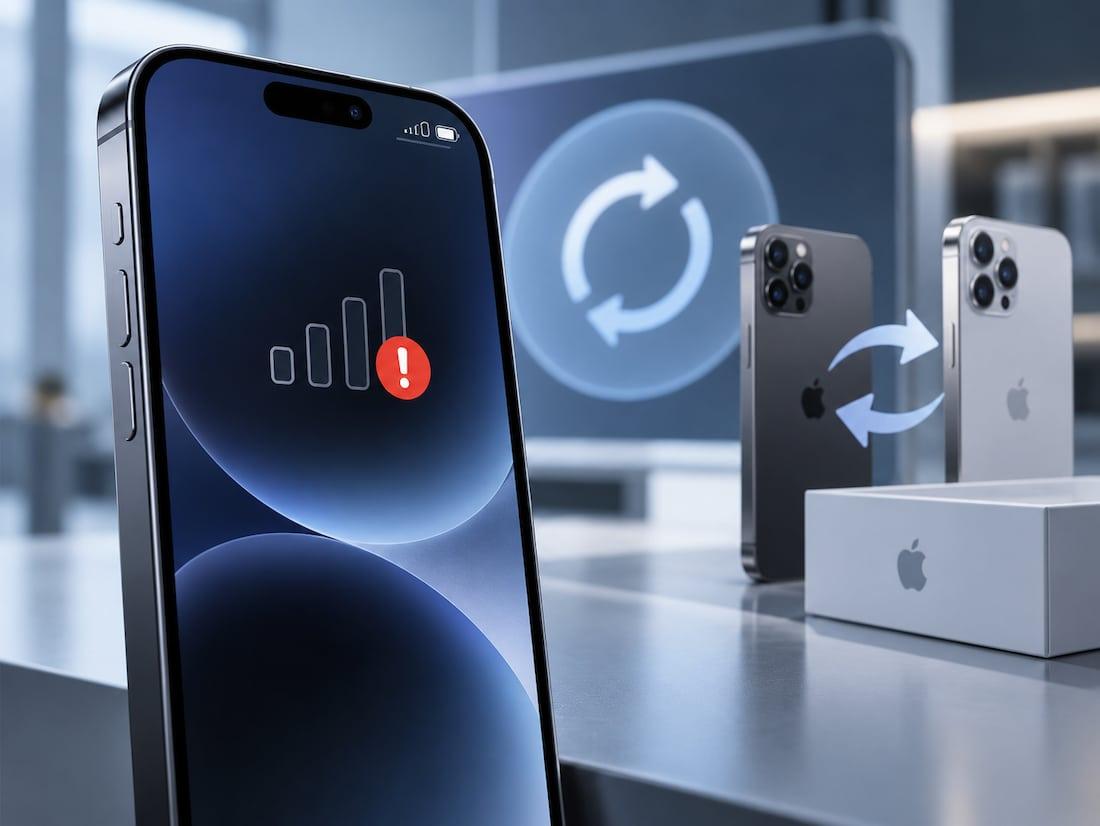
Based on Apple’s public statement, the currently confirmed combination is:
- iPhone 18 Pro Max
- AT&T network
- U.S. market
- Cellular-service failure
Apple has said it has only observed the issue with iPhone 18 Pro Max users on AT&T and has not identified other iPhone models or carriers as affected by this particular problem.
That does not mean every AT&T iPhone 18 Pro Max is defective.
In fact, Apple specifically characterizes the affected population as a small number.
It also means owners should avoid jumping from individual reports to a conclusion that the entire iPhone 18 Pro Max product line is unreliable.
The evidence does not support that conclusion.
The issue is specific enough that Apple and AT&T have been able to identify a particular device/network combination.
What Apple Has Officially Confirmed
Apple’s statement is unusually important because it provides several concrete pieces of information.
First, Apple acknowledges the issue.
Second, Apple says the issue can cause a device to lose service and become unable to make calls.
Third, Apple says it has released iOS 27.0.1 and a carrier-settings update to help prevent the issue.
Fourth, Apple says devices that have already been affected cannot simply have service reactivated with a software update.
Those devices need replacement.
That last point is the most significant.
It changes the consumer response completely.
If your phone simply has a software bug, waiting for the next patch can be reasonable.
If the phone has lost cellular functionality in a way Apple says software cannot reverse, waiting for another update is not the appropriate solution.
What iOS 27.0.1 Actually Does
Apple released iOS 27.0.1 on September 28.
Apple’s official software-release documentation confirms that iOS 27.0.1 is available for iPhone 11 and later and was released on September 28, 2026.
Apple’s published iOS update information also lists several fixes for the new iPhone 18 Pro models, including an unexpected restart problem related to failed Face ID authentication and a camera color artifact under specific conditions.
The important point is that Apple’s general iOS release notes do not establish that the update itself repairs an already-failed AT&T cellular connection.
Apple’s separate statement about the AT&T issue provides the more specific guidance:
iOS 27.0.1 plus the carrier-settings update are intended to prevent the problem from occurring.
That is different from saying:
iOS 27.0.1 repairs every affected phone.
Apple explicitly says it does not.
This distinction should be preserved in any consumer guidance about the problem.
Why Some Affected Phones Need Replacement
This is arguably the most interesting technical question.
Why would Apple be able to prevent a problem through software but require a hardware replacement for a phone that has already experienced the failure?
Apple has not publicly explained the underlying technical cause.
That means we should not invent one.
The most responsible interpretation is that Apple has identified a device state that it does not believe can reliably be restored through software.
That could involve hardware, firmware state, provisioning, modem behavior, carrier configuration or an interaction between multiple systems.
But without Apple’s technical explanation, none of those possibilities should be presented as fact.
This is where smartphone troubleshooting often becomes misleading.
A phone’s cellular connection is not controlled by one simple component.
Modern smartphones have to coordinate:
- cellular modem hardware;
- firmware;
- operating-system networking;
- carrier configuration;
- eSIM provisioning;
- network authentication;
- radio bands;
- carrier-side systems;
- SIM/eSIM credentials;
- network registration.
A failure in one layer can sometimes look like a problem in another.
For example, a phone displaying SOS does not automatically mean the modem is physically broken.
It means the device is not currently connected to its normal cellular network.
That can happen for many reasons.
In this case, Apple has gone further and identified a particular issue affecting a small group of iPhone 18 Pro Max users on AT&T.
But Apple has not publicly explained the precise root cause.
What the AT&T Connection Tells Us
The fact that the issue is tied to AT&T is significant.
It suggests that this is not simply a generic iPhone 18 Pro Max hardware failure affecting all networks.
Instead, something about the interaction between the device and AT&T’s network environment appears to matter.
That does not prove AT&T caused the issue.
It also does not prove Apple caused it.
In complex telecommunications systems, responsibility can cross multiple layers.
A modern smartphone must communicate with a carrier using standardized radio protocols, carrier-specific configuration and authentication procedures.
The phone also has to handle network transitions, provisioning and configuration updates.
This is one reason carrier settings updates exist.
They allow network-related configuration changes to reach supported phones without requiring a complete operating-system update.
Apple says the new AT&T carrier-settings update is part of its response to the problem.
That is an important clue about the nature of the mitigation, but it is not proof of the root cause.
Is the Modem Responsible?
This is where consumers should be particularly careful.
Independent reporting has focused attention on differences between modem configurations in the U.S. and other markets.
But the available evidence does not establish that a specific modem component is the cause of the AT&T failure.
Apple has not publicly identified the modem as the root cause.
Therefore, statements such as “the modem is defective” would be premature.
Likewise, saying that every U.S. iPhone 18 Pro Max has a defective modem would go far beyond the available evidence.
The correct editorial classification is:
Confirmed: Some iPhone 18 Pro Max devices on AT&T can experience cellular-service failure.
Confirmed: Apple has released software and carrier updates intended to prevent additional cases.
Confirmed: Apple says already-affected phones require replacement.
Unconfirmed: The exact hardware or software component responsible.
Unverified speculation: Claims that a particular modem model is definitely responsible.
That distinction is important for both readers and search visibility.
Why This Is More Serious Than an Ordinary Network Outage
Every smartphone owner has seen the occasional “No Service” or SOS indicator.
Usually, the solution is straightforward.
Move somewhere else.
Toggle Airplane Mode.
Restart the phone.
Check the carrier.
Wait for a local outage to resolve.
But this situation is different because Apple itself has acknowledged a device-specific issue.
The consumer impact is also substantial.
A smartphone is primarily a communications device.
If cellular service fails, users can lose access to:
- voice calls;
- SMS messages;
- mobile data;
- authentication messages;
- navigation when cellular data is required;
- mobile banking verification;
- work communications;
- emergency calling capabilities associated with normal cellular service.
AT&T specifically warned customers that the issue could affect calls, texts and data, including calls to 911, making the issue particularly important from a reliability perspective.
That does not mean an affected iPhone becomes completely incapable of contacting emergency services in every circumstance.
Rather, it means customers should take AT&T’s warning seriously and should not assume that normal cellular calling will remain available if the device is experiencing the failure.
What Affected iPhone 18 Pro Max Owners Should Do
Step 1: Check your iOS version
Open:
Settings → General → Software Update
Apple says iPhone 18 Pro Max users should install iOS 27.0.1.
Step 2: Check carrier settings
Go to:
Settings → General → About
If a carrier-settings update is available, iOS should prompt you to install it.
Apple said the AT&T carrier-settings update would automatically reach customers over time, while the About screen can be used to trigger the update manually.
Step 3: Determine whether you have actually experienced the failure
Do not assume you need a replacement simply because you own an iPhone 18 Pro Max on AT&T.
The replacement guidance is for devices that have already experienced the confirmed cellular failure.
If your phone continues to work normally, Apple’s current advice is to update.
Step 4: If service has already failed, contact Apple or AT&T
Apple says affected customers should contact Apple Support or AT&T or visit an Apple Store or AT&T location.
Do not waste days repeatedly resetting the phone if Apple has already determined that the affected device needs replacement.
Step 5: Back up your data
If you are taking a device in for replacement, make sure your important information is backed up.
That includes:
- Photos
- Messages
- Contacts
- Passwords
- Authentication information
- Important documents
- WhatsApp or other app-specific backups where applicable
A replacement process is much easier when your data is already safely backed up.
What Prospective Buyers Should Know
The obvious question is:
Should you still buy an iPhone 18 Pro Max?
Based on the evidence currently available, there is not enough justification to say consumers should categorically avoid the phone.
Apple says the affected population is small.
The problem is specifically associated with AT&T.
And Apple has already implemented software and carrier-level mitigation.
That means a prospective buyer should not interpret the situation as evidence that every iPhone 18 Pro Max is defective.
At the same time, buyers should not ignore the issue.
If you are an AT&T customer buying the iPhone 18 Pro Max, it is reasonable to be more attentive to cellular behavior during the return period.
Apple’s current iPhone 18 Pro Max remains a high-end device. Its official specifications include the A20 Pro chip, ProMotion display, advanced camera system and up to 45 hours of video playback.
The cellular issue therefore should be evaluated as a specific reliability concern, not as a complete judgment of the product.
TechOzea’s broader smartphone guide can also help buyers compare the iPhone against current Android alternatives instead of treating the purchase as a one-phone decision. TechOzea’s 2026 smartphone buying guide
The Timing Matters for Buyers
The issue is also arriving unusually early in the phone’s lifecycle.
That means Apple is still collecting information.
Some launch problems become easier to diagnose after thousands or millions of devices have reached consumers.
Others disappear quickly after a software or carrier update.
That makes today’s conclusion different from what we may know several weeks from now.
If Apple identifies the precise cause and publishes a technical explanation, the consumer risk assessment could become clearer.
If replacement numbers remain very small and no additional models or carriers become affected, the issue could ultimately become a relatively contained launch defect.
If Apple expands its replacement guidance, introduces a formal service program or identifies additional affected configurations, the significance would increase.
What Apple and AT&T Need to Explain Next
There are several unanswered questions.
How many devices are affected?
Apple currently says only a small number.
That is useful but vague.
A formal service program, if one is created, could eventually provide more information about the scale.
What is the root cause?
This is the biggest unanswered technical question.
Apple has not publicly identified it.
Until it does, consumers should ignore definitive claims about specific components.
Why can software prevent the problem but not repair affected devices?
Apple’s distinction is clear.
The technical explanation is not.
That is precisely the sort of information technical readers will want.
Will Apple publish a formal service program?
It is not currently established that Apple will.
A service program would provide standardized eligibility and repair/replacement procedures.
Will other carriers be affected?
Apple currently says it has observed the issue with iPhone 18 Pro Max users on AT&T.
There is no confirmed evidence in the sources reviewed for this article that the same failure affects other U.S. carriers.
That could change if additional reports are confirmed.
What This Says About Modern Smartphone Complexity
There is a larger lesson here.
Today’s smartphones are remarkably sophisticated.
A flagship device is not simply a screen, processor, battery and camera.
It is a miniature communications computer interacting with:
- cellular networks;
- Wi-Fi networks;
- Bluetooth devices;
- satellite services;
- carrier provisioning;
- cloud infrastructure;
- app ecosystems;
- authentication services;
- operating-system services.
That complexity creates enormous capabilities.
It also creates more opportunities for interactions between systems to fail.
The AT&T iPhone 18 Pro Max problem is a useful example.
The phone can function normally for many users.
The network can function normally for millions of customers.
Yet a specific combination of device, carrier and configuration can still produce a serious problem.
That is increasingly the reality of modern consumer electronics.
How This Differs From the iPhone 18 Pro’s Other Early Bugs
The iPhone 18 Pro family has had other early software complaints.
Apple’s iOS 27.0.1 documentation lists fixes involving unexpected restarts after failed Face ID authentication on iPhone 18 Pro and Pro Max devices and a camera color artifact under specific conditions.
Those problems are important, but they are conceptually different from the AT&T cellular issue.
A software bug can often be corrected through an operating-system update.
Apple’s current AT&T guidance says the cellular issue is different once an affected phone has already lost service.
That distinction should prevent consumers from treating every iPhone launch problem as the same type of defect.
Should AT&T Customers Be Worried?
Existing AT&T customers with a normally functioning iPhone 18 Pro Max should not panic.
The sensible approach is:
- Update to iOS 27.0.1.
- Install the latest carrier settings.
- Monitor cellular behavior.
- Keep a current backup.
- Contact Apple or AT&T if the phone begins exhibiting the confirmed failure.
There is no evidence that every AT&T iPhone 18 Pro Max is going to fail.
Apple’s statement explicitly describes the affected group as small.
However, because the issue can interfere with calls and data, it is not something owners should ignore.
What to Watch Next
The next major development will likely be Apple’s technical explanation, if one becomes available.
A second important development will be whether Apple establishes a formal replacement or service-program procedure.
Third, watch the number of carriers involved.
If AT&T remains the only confirmed carrier, that would narrow the problem considerably.
If similar reports appear on Verizon, T-Mobile or other networks and are confirmed by Apple, the story would become substantially more serious.
Finally, watch future iOS updates.
Apple may release another update addressing the issue or related connectivity behavior.
However, owners should not wait for a future version if Apple has already determined that their affected device needs replacement.
Conclusion
Apple’s iPhone 18 Pro Max is facing a serious but apparently limited cellular problem in the United States.
Apple has confirmed that a small number of iPhone 18 Pro Max users on AT&T can lose cellular service and become unable to make calls.
The company has released iOS 27.0.1 and an AT&T carrier-settings update designed to help prevent additional cases. Apple has also told users to update their phones.
But there is an important catch.
A phone that has already experienced the confirmed failure cannot simply be repaired through software, according to Apple. The company says those devices need replacement.
That makes the issue more significant than an ordinary launch-day software bug.
At the same time, consumers should avoid overreacting.
Apple says only a small number of devices are affected, and the confirmed issue is currently limited to the iPhone 18 Pro Max on AT&T.
There is no evidence that every iPhone 18 Pro Max is defective.
For current owners, the practical advice is straightforward: update immediately, make sure carrier settings are current, back up your data and contact Apple or AT&T if the device has already lost cellular service.
For prospective buyers, the situation is worth monitoring but does not currently justify a blanket recommendation to avoid the phone.
The most important unanswered question remains the root cause.
Until Apple provides more technical information, claims that a particular modem, component or carrier system is definitively responsible should be treated as speculation.
For now, the facts are enough.
A small number of U.S. iPhone 18 Pro Max owners on AT&T have experienced a serious cellular problem.
Apple knows about it.
Apple and AT&T are attempting to prevent additional cases.
And affected phones may need to be replaced rather than repaired through software.
That is the information buyers need today.
Frequently Asked Questions
What is the iPhone 18 Pro Max AT&T issue?
Apple says a small number of iPhone 18 Pro Max users on AT&T have experienced a problem that can cause the phone to lose cellular service and prevent normal calls.
Does iOS 27.0.1 fix the iPhone 18 Pro Max AT&T problem?
Apple says iOS 27.0.1 and an AT&T carrier-settings update are intended to help prevent the problem from occurring. Apple also says phones that have already been affected cannot have service restored through a software update and need replacement.
Do all iPhone 18 Pro Max phones have the problem?
No. Apple describes the affected population as a small number of iPhone 18 Pro Max users on AT&T.
Do iPhone 18 Pro Max owners on Verizon or T-Mobile need to replace their phones?
There is currently no confirmed evidence in the sources reviewed that the same issue affects Verizon or T-Mobile users. Apple has specifically identified the problem with iPhone 18 Pro Max users on AT&T.
Does the issue mean the iPhone 18 Pro Max modem is defective?
That has not been established. Apple has not publicly disclosed the root cause, so claims blaming a specific modem or component remain unverified.
What should I do if my iPhone 18 Pro Max shows SOS on AT&T?
First make sure iOS 27.0.1 and the latest carrier settings are installed. If the phone has experienced the confirmed failure and remains without service, Apple advises affected customers to contact Apple Support or AT&T or visit an Apple Store or AT&T location for replacement assistance.
Is the iPhone 18 Pro Max still worth buying?
There is not enough evidence to recommend avoiding the entire product. The issue appears limited to a small number of AT&T-connected iPhone 18 Pro Max units. Buyers should nevertheless be aware of the problem and test cellular functionality during the applicable return period.
Has Apple announced an iPhone 18 Pro Max recall?
Not based on the authoritative sources reviewed. Apple has acknowledged the issue and replacement requirement for affected units, but that should not be described as a formal recall unless Apple announces one.
