


A major smartphone-market decline is raising new questions about the cost of buying a phone in 2026. Preliminary research from Counterpoint Research indicates that global smartphone shipments fell 20% year over year in the third quarter, reaching their lowest Q3 level since 2012. The report points to memory shortages and rising component costs as important reasons for the downturn.
For US consumers, the headline does not mean that every phone will immediately become more expensive. It does, however, highlight a supply-chain problem that could influence the devices manufacturers prioritize, the specifications they offer at different price points, and the promotions available to shoppers.
The key question is not simply whether smartphone prices will rise. It is which buyers are most exposed to higher costs, how manufacturers may respond, and what consumers can do to get better value from their next phone.
Key Takeaways
- Do not interpret the 20% shipment decline as a 20% fall in US phone sales. The figure is a preliminary global shipment estimate, not a direct measure of American retail purchases.
- Compare total value, not just launch price. Software support, storage, battery condition, repairability, and expected years of use matter more when new-device costs are under pressure.
- Consider keeping, repairing, or buying refurbished before replacing a working phone. A newer model is not automatically the most economical choice, especially if your current device still meets your needs.
Table of Contents
- What happened to smartphone shipments?
- Why the shipment decline matters
- How memory shortages affect phone manufacturing
- Why AI infrastructure matters to smartphone buyers
- Why budget phones may face more pressure
- Why Apple and Samsung may be more resilient
- What US buyers should expect
- Should you upgrade, repair, or buy refurbished?
- How to choose a phone that lasts longer
- What to watch next
- Frequently asked questions
- Conclusion
What happened to smartphone shipments?
According to Counterpoint Research’s October 12 report, global smartphone shipments declined 20% year over year in Q3 2026. The research firm described the quarter as the weakest third quarter since 2012.
Reuters independently reported the preliminary figures and linked the decline to higher memory-component costs and supply shortages. The reporting also indicates that manufacturers have been responding by adjusting shipments and prioritizing profitability rather than volume alone.
The figures matter because smartphone production is a complex supply-chain operation. A manufacturer must secure components, plan production, arrange distribution, and decide how much inventory to send into different markets. If components become more expensive or difficult to obtain, the company may change production plans before consumers see a change in store prices.
That is why a shipment decline can be an early signal of market stress even though it does not tell us exactly how many phones Americans purchased.
What the market-share figures show
Counterpoint reported that Samsung held 23% of the global smartphone market in Q3, while Apple’s share reached 22%. Samsung’s shipments declined 3% year over year, and Apple also experienced a shipment decline despite its higher share.
Those figures should be interpreted carefully.
Market share measures a company’s position relative to the total market. A company can gain share even while shipping fewer phones if the overall market falls faster than its own shipments. A high market share also does not mean a company is immune to higher component costs.
The figures are global, not US-specific. They cannot tell us which American carrier sold the most phones, which US models were most popular, or how many individual consumers delayed an upgrade.
Why Apple’s launch schedule matters
Counterpoint said Apple’s Q3 result was affected by the absence of a standard iPhone 18 model in the launch-month lineup, compared with the full iPhone 17 lineup a year earlier. It also reported that the iPhone 18 Pro models had a stronger launch than their predecessors in some markets.
This is an important qualification. Smartphone shipments can change because of launch timing and product availability as well as consumer demand.
If a company releases fewer models during a particular quarter, its shipment figures may be lower even when some of its available products perform well. The opposite can also happen: a launch can temporarily increase shipments as retailers and distributors build inventory.
The current report therefore needs to be read as a combination of supply pressure, market conditions, and product-cycle timing—not as proof that all consumers have stopped buying phones.
Why the shipment decline matters
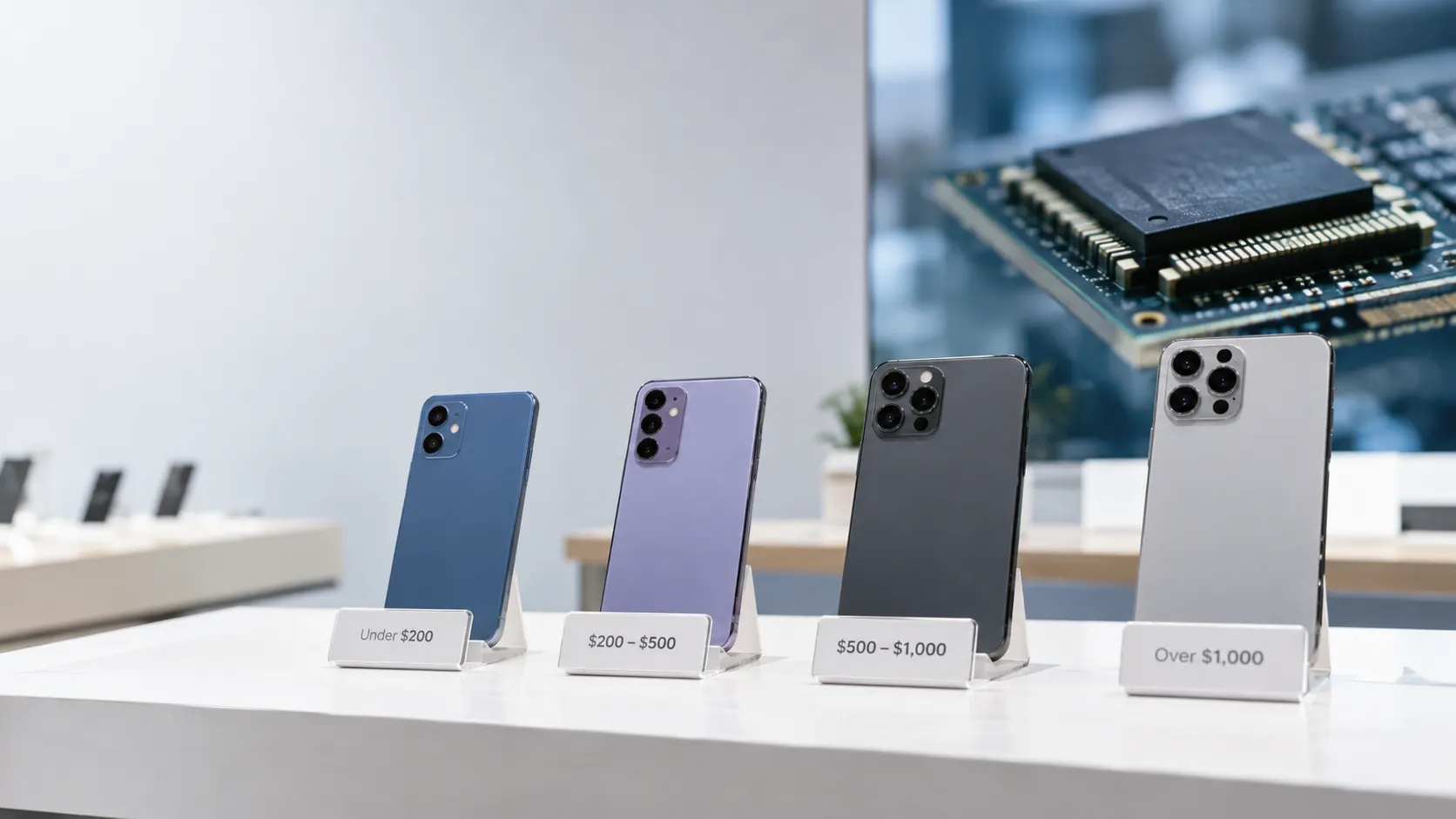
A decline of this scale can affect consumers in several ways, but not all of them will be visible immediately.
First, manufacturers must decide how to manage higher component costs. They can absorb some of the increase, raise prices, reduce the number of models they produce, change memory or storage configurations, or emphasize products with higher margins.
Second, supply pressure can change the options available to buyers. If producing a very inexpensive phone becomes less profitable, a manufacturer may concentrate on models that generate more revenue per device.
Third, consumers may hold on to their current phones longer. Counterpoint’s senior analyst Shilpi Jain said consumers were retaining devices for longer than expected and increasingly considering refurbished options and higher-value devices.
That behavior makes economic sense. If the price difference between a working older phone and a new model becomes less attractive, a buyer may decide to delay replacement.
The result could be a market with fewer low-cost options, more attention on premium devices, and a growing need for consumers to assess long-term value instead of treating annual upgrades as routine.
Shipments are not the same as retail sales
This distinction deserves particular attention.
A shipment report measures devices moving through the supply chain, depending on the research firm’s methodology. It is not the same thing as a tally of phones purchased by end users in retail stores or through carriers.
For example, a manufacturer might send fewer devices to retailers because it wants to reduce inventory. Retail purchases could decline by a different amount. Conversely, a retailer could sell through existing inventory even when new shipments are falling.
The 20% figure is therefore an industry signal, not a direct forecast of US retail demand.
How memory shortages affect phone manufacturing
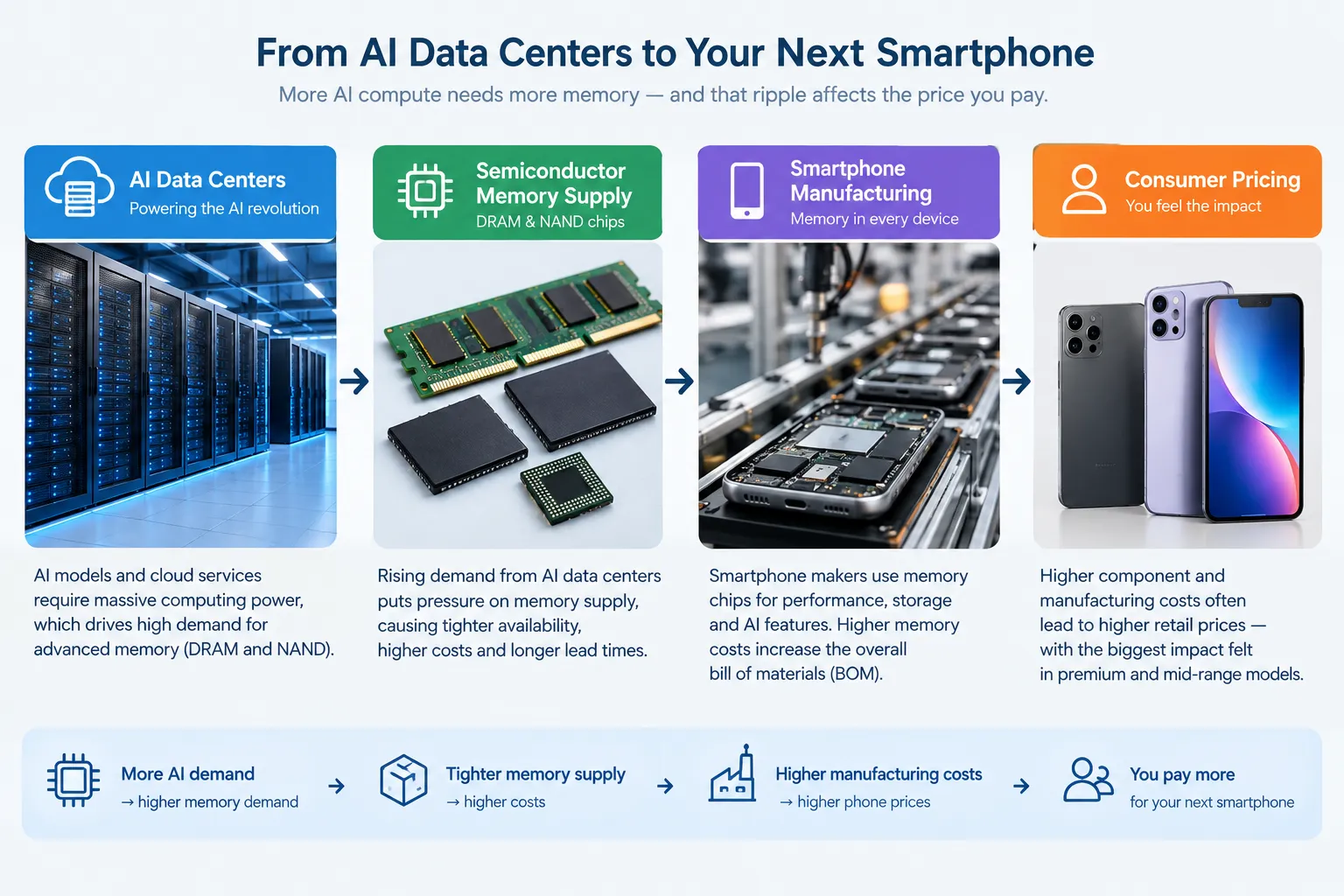
Memory is a basic part of modern smartphones. A phone uses working memory to run applications and manage active tasks, while internal storage holds the operating system, apps, photographs, videos, and downloaded files.
Manufacturers need reliable access to these components when planning production. If memory prices rise sharply, the cost of building a phone can increase even when the display, camera, enclosure, and processor remain unchanged.
That matters across price tiers, but the effect is not necessarily equal.
A premium phone may offer a manufacturer more room to absorb a cost increase. An inexpensive phone has a smaller price envelope, so even a modest component-cost change can create a more difficult decision.
The company might accept a lower margin, increase the retail price, use a different configuration, or produce fewer units. Each choice has consequences for consumers.
DRAM and NAND serve different purposes
The memory shortage is often discussed as though every type of memory were interchangeable. It is not.
Smartphones commonly use mobile DRAM for active workloads and NAND flash storage for persistent data. AI accelerators and servers can use different memory products, including high-bandwidth memory and server-oriented DRAM.
These technologies have different performance characteristics, packaging requirements, and applications. A shortage of one specific memory product does not mean that every chip can be substituted directly with another.
However, the markets are connected through manufacturing capacity, supplier investment decisions, production planning, and demand for semiconductor resources. If manufacturers shift investment and capacity toward more profitable products, other customers can face tighter supply or higher costs.
IDC’s August forecast described rising NAND and DRAM costs as a significant pressure on the smartphone market. The company projected a 16.7% global shipment decline for 2026 and estimated that the average selling price would rise 27.6% to $581. These remain IDC forecasts, not final results or US-specific retail prices.
Component costs do not translate directly into retail prices
A memory-cost increase is not the same thing as an equal percentage increase in a phone’s retail price.
The final price also reflects other components, manufacturing, distribution, marketing, retailer margins, taxes, currency movements, financing, and promotional strategy.
A manufacturer might absorb part of the increase. Another might change a configuration or discontinue a lower-margin model. A retailer could discount existing inventory purchased at an earlier cost.
The practical result is likely to vary by brand, model, market, and timing. Consumers should not assume that a particular phone’s price will rise by the same percentage as a memory component.
Why AI infrastructure matters to smartphone buyers
AI data centers require substantial computing resources. Some of that infrastructure depends on advanced memory systems, and the rapid expansion of AI services has increased demand for semiconductor capacity.
That creates an indirect link between AI infrastructure and consumer devices.
Smartphone manufacturers are also competing to offer more AI capabilities, from photo editing and translation to summarization and on-device assistants. Some of these features require capable processors and sufficient memory, while others depend partly or heavily on cloud services.
The pressure is therefore not simply that AI servers use memory. The larger issue is that AI growth affects semiconductor investment priorities at the same time smartphone makers are trying to build more capable devices.
On-device AI has a hardware cost
Running AI tasks locally can offer benefits such as reduced reliance on a network connection, faster responses for some tasks, and greater control over where certain information is processed.
However, local AI workloads can require more memory and computing capability than simpler smartphone functions. More capable hardware may increase manufacturing costs, although the size of that effect varies by device and implementation.
Not every AI feature requires a flagship phone. Some tasks run efficiently on relatively modest hardware, while complex tasks may rely on cloud processing. Consumers should look at what a feature actually does rather than assuming that every AI label requires the most expensive device.
The same caution applies to privacy. On-device processing can reduce the need to transmit certain data, but it does not automatically guarantee that every part of a service is private. Data handling depends on the implementation, permissions, cloud services, and the manufacturer’s policies.
The cost trade-off for manufacturers
A company has several possible responses when hardware costs rise:
- Keep the retail price stable and accept a lower margin.
- Raise the price while retaining the existing configuration.
- Offer fewer memory or storage options.
- Reduce the number of models in its lineup.
- Emphasize premium products where margins may be stronger.
- Improve software efficiency so devices can deliver useful features with available hardware.
None of these responses is guaranteed across the industry. Different manufacturers have different supply agreements, product strategies, and customer bases.
The important consumer question is whether a phone’s price and specifications still represent good value for the intended use.
Why budget phones may face more pressure
Budget smartphones operate under different economics from premium devices.
A phone selling at a low price has less room to absorb a higher bill of materials. Its manufacturer must cover components, assembly, distribution, support, and other costs without pushing the retail price beyond what its intended customers can afford.
That makes inexpensive models vulnerable when memory and storage costs rise.
IDC’s August analysis said the market for phones priced below $100 was facing severe pressure and that manufacturers were reducing their exposure to the lowest-priced segment. It also projected a sharp decline in worldwide shipments for the year. Those are IDC’s market forecasts and analysis, not proof that every low-cost phone will disappear.
What buyers might notice
Consumers could encounter several outcomes:
Higher starting prices. A new model may launch at a higher price if the manufacturer cannot absorb its increased costs.
Fewer configuration choices. A company may focus on one or two versions instead of offering a wide range of memory and storage combinations.
A stronger emphasis on midrange phones. Manufacturers may prefer models that offer more revenue per sale.
Changes in feature priorities. Brands could choose to preserve the features that matter most to buyers while adjusting other specifications to manage cost.
More importance for older models and refurbishment. Last year’s phone may remain a good purchase if its software support and hardware still meet the buyer’s needs.
These outcomes are possibilities, not confirmed changes to every US product line. The current shipment report does not identify exactly which models will change price or specifications.
How to assess a budget phone
The most useful comparison is not simply RAM, camera megapixels, or advertised battery capacity.
Consider the phone’s software-support period, real-world performance, storage capacity, display quality, battery replacement options, durability, and network compatibility.
A cheaper phone that stops receiving security updates sooner may cost less at checkout but provide less useful life. Conversely, paying for a premium feature you rarely use may not improve value.
TechOzea’s coverage of the Samsung Galaxy A27 5G and CMF Phone 2 Pro can serve as starting points for comparing different device categories. Check current specifications, prices, and software-support commitments before making a purchase.
Why Apple and Samsung may be more resilient
Counterpoint’s latest report places Samsung and Apple at the top of the global market-share table, at 23% and 22%, respectively. Both companies nevertheless experienced shipment declines.
Large manufacturers may have advantages when negotiating with suppliers, planning inventory, and managing product portfolios. They also sell premium devices, accessories, and services that can help diversify their revenue.
However, scale does not eliminate exposure to component costs. The report’s figures show that leading market positions and shipment declines can coexist.
Premium phones are not immune
A high retail price may give a manufacturer more flexibility to absorb costs, but premium devices can still be affected by component availability, pricing decisions, and demand.
For consumers, a premium model is worth buying only when its additional features deliver real value. A faster processor, more advanced camera system, or larger display may be useful to some people but unnecessary for others.
For example, the iPhone 18 Pro Max is a large, premium device. Apple’s specifications list a 6.9-inch display and a weight of 249 grams. Those characteristics may suit people who prioritize a large screen, but they may be drawbacks for buyers who prefer a lighter phone.
Similarly, consumers comparing Android flagships should consider whether premium performance, camera hardware, and software features justify the extra cost for their own usage.
The broader lesson is straightforward: the best-selling brand is not automatically the best-value phone for every buyer.
What US buyers should expect
The latest global shipment figures do not provide a precise forecast of US phone prices. They do provide a reason to be more deliberate about purchase timing and value.
The practical effect on American consumers will depend on manufacturers’ pricing decisions, carrier offers, retailer inventory, product launches, and the cost of components.
Prices may change unevenly
One phone might receive a price increase while another remains at its current price. A manufacturer could retain a lower headline price but offer fewer configurations. A retailer may discount a model to clear inventory even while replacement products become more expensive.
This makes broad claims such as “all phones will cost 20% more” unreliable. The current data does not support that conclusion.
Promotions can offset some pressure
Carrier promotions, trade-in offers, retailer discounts, and manufacturer financing can lower the effective upfront cost of a phone. However, the conditions matter.
A phone advertised as free or heavily discounted may require an eligible trade-in, a particular plan, monthly bill credits, or a minimum period of service. Buyers should compare the total cost across the required period rather than focusing only on the headline discount.
Refurbished devices may offer better value
Refurbished phones are worth considering when they include a meaningful warranty, clear condition information, reliable battery performance, and enough remaining software support.
Google’s addition of Pixel 9-series devices to its Certified Refurbished program is a current example of manufacturers using refurbishment as another purchasing route. The reported prices began at $499, although availability was already limited for the standard Pixel 9 at the time of publication.
A refurbished phone is not automatically the best deal. Compare it with discounted new devices, carrier offers, and the expected cost of ownership. A lower price is useful only if the device’s condition and support meet your needs.
Existing phones may be more valuable than expected
If your current phone still performs well, receives security updates, and has acceptable battery life, keeping it longer can avoid a substantial purchase.
A battery replacement or repair may be cheaper than a new device. The correct choice depends on the phone’s condition, repair cost, remaining support, and whether it meets your current requirements.
Should you upgrade, repair, or buy refurbished?
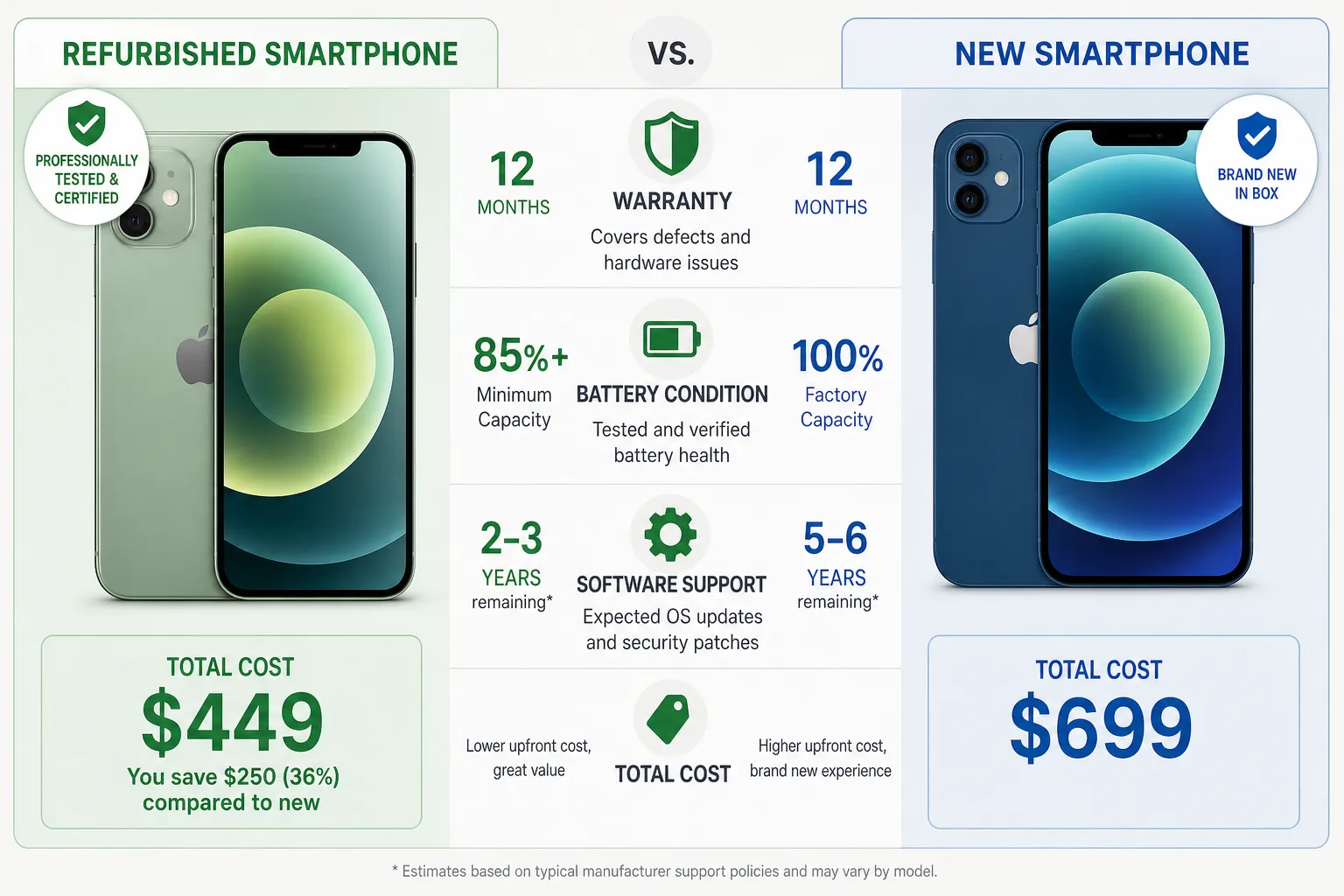
A smartphone market under cost pressure makes this a more important question than the annual product cycle suggests.
Keep your current phone if it still meets your needs
Consider keeping it if applications run smoothly, the battery lasts long enough, storage is adequate, and security updates remain available.
You do not need to replace a phone simply because a newer model has a faster chip or additional AI functions.
Repair it if one issue limits its usefulness
A battery replacement, charging-port repair, or screen replacement can extend the life of a device.
Before paying for a repair, compare the quote with the cost of a suitable replacement. Also check whether the manufacturer or an authorized service provider can complete the repair and whether the phone will continue receiving security updates.
Buy refurbished if the savings are meaningful
Refurbishment can be a practical middle ground between keeping an older phone and purchasing a new flagship.
Check the seller’s warranty, return policy, battery condition, repair history if available, and carrier compatibility. Confirm that the exact model supports the network bands and features you need in the United States.
A phone can be technically unlocked but still lack full compatibility with every carrier feature. Verify the model number and carrier requirements before paying.
Buy new if the benefits solve a real problem
A new phone may be the right choice if your current device is unreliable, no longer receives important security updates, lacks necessary network support, or cannot run applications you depend on.
If you need to upgrade, set a budget and prioritize features you will actually use. Avoid paying more for a large storage tier, advanced camera system, or AI feature set unless it addresses a genuine need.
TechOzea’s smartphone buying guide can help structure the comparison, but confirm that its model list and prices are current before relying on it for a final decision.
How to choose a phone that lasts longer
When component costs and retail prices are under pressure, a phone’s useful life becomes central to value.
Check software support before buying
Find out how long the manufacturer promises operating-system upgrades and security updates. A phone that remains supported for longer can be a better long-term purchase, assuming its hardware remains suitable.
Also distinguish a published support commitment from a prediction. Do not rely on vague statements that a device is “future-proof.”
Buy enough storage, not necessarily the most storage
Storage is difficult to upgrade on many phones. If you take lots of photos, record video, or keep large files offline, choose a capacity that will comfortably meet your needs.
However, do not pay for a large capacity simply because it is available. Cloud storage, external backups, and periodic file management may reduce how much built-in storage you need.
Evaluate battery replacement and repair options
Battery performance declines with use. A phone with a replaceable battery or an accessible authorized repair service may be easier to keep for longer.
Check the repair cost and availability for the exact model. Do not assume that a device will be inexpensive to repair just because it has a common brand name.
Match performance to your workload
Everyday tasks such as messaging, browsing, navigation, video calls, and casual photography generally do not require the most expensive processor.
Gaming, intensive video editing, advanced photography, and some AI workloads can benefit from more powerful hardware.
The right purchase is the least expensive device that meets your real requirements with sufficient room for future needs—not necessarily the phone with the highest benchmark score.
Protect the phone you already own
A case, screen protector, regular backups, sensible charging habits, and timely software updates can help preserve a device’s usefulness.
None of these measures eliminates battery aging or hardware failure. They can, however, reduce avoidable damage and make it easier to keep a suitable phone for longer.
What to watch next
The Q3 shipment report is preliminary, so the next useful developments will be those that clarify how the market is responding.
Final shipment and market-share data
Finalized figures will help show whether the preliminary 20% decline remains intact and how the results vary by manufacturer and region.
Look for methodology notes and distinguish global shipments from US retail sales.
Memory prices and supply conditions
The next several quarters of component-market research will help show whether supply pressure is easing or remaining elevated.
TrendForce‘s September 30 outlook projected further quarterly increases in conventional DRAM and NAND contract prices for Q4. These are component-market expectations, not direct forecasts of retail smartphone prices.
Manufacturer pricing and product decisions
Actual US prices, configurations, availability, and product launches will provide better evidence of consumer impact than broad industry predictions.
Watch for changes to starting prices, storage options, entry-level model availability, trade-in offers, and support commitments.
Refurbished-phone availability
Refurbished programs may become more attractive if new-device prices rise or consumers delay upgrades. Their value will depend on actual inventory, warranty terms, battery condition, and remaining software support.
Consumer behavior
The key question is whether consumers continue to extend replacement cycles, choose less expensive devices, or shift toward refurbished phones.
These patterns could influence how manufacturers plan future products, but they should be established through actual sales and market research rather than inferred from shipment figures alone.
Frequently asked questions
Did smartphone sales fall 20% in the United States?
No. The 20% figure refers to preliminary global smartphone shipments in Q3 2026, according to Counterpoint Research. It does not measure US retail sales directly.
Why are smartphone manufacturers facing memory shortages?
Demand for memory used in AI infrastructure has increased pressure on the semiconductor supply chain. Manufacturing investment and capacity decisions can affect the availability and cost of memory used in consumer devices, although different memory products are not directly interchangeable.
Will every smartphone become more expensive?
Not necessarily. Prices depend on component costs, manufacturer strategy, inventory, retailer promotions, carrier offers, and competition. The current shipment report does not establish a uniform retail-price increase.
Are budget smartphones most at risk?
Lower-priced models can be more vulnerable because manufacturers have less room to absorb higher component costs. IDC’s 2026 forecast identifies severe pressure on the lowest-priced segment, but this does not mean every budget phone will disappear.
Should I buy a phone now or wait?
Buy when your current phone no longer meets your needs or a suitable offer fits your budget. If your existing device remains reliable and supported, there is no need to upgrade solely because the market is changing.
Are refurbished phones a good alternative?
They can be, particularly when sold with a clear warranty, a reasonable return policy, reliable battery condition, and adequate software support. Compare the total cost with discounted new devices before deciding.
Could AI make phones more expensive?
AI features can increase hardware and development requirements, but the price effect depends on the implementation and product. AI demand is one part of the broader memory-supply issue; it is not sufficient evidence that every AI-enabled phone will receive a price increase.
Conclusion
The preliminary 20% decline in global smartphone shipments is an important warning about the pressure facing the industry. Memory shortages and higher component costs are affecting manufacturer decisions, while AI infrastructure is adding to demand for semiconductor resources.
For US consumers, the consequences will not be identical across brands or price ranges. Some phones may become more expensive, some configurations may change, and some manufacturers may concentrate on products with stronger margins. Promotions and refurbished options will continue to affect the value available to buyers.
The most practical response is to evaluate a phone based on its complete ownership cost. Consider software support, repairability, battery condition, storage, carrier compatibility, and how long the device will remain useful.
You do not need to buy a more expensive phone simply because the smartphone market is under pressure. You need to buy—or keep—the device that meets your requirements at a price you can justify.
